

It’s safe to say that virtually every Marylander and resident of the Chesapeake region is familiar with the iconic blue-and-yellow cans that contain Old Bay Seasoning.
But not everyone knows that Old Bay’s origins are rooted in the darkness of the Holocaust and Kristallnacht, the infamous “night of broken glass” that took place 84 years ago today and is viewed as the precursor to the Shoah.
For its annual community-wide Kristallnacht commemoration, the Baltimore Jewish Council hosted a talk on Nov. 9 by Ralph Brunn, son of Old Bay’s creator, at the MMAE Congregation in Pikesville.
“It’s an honor for our shul to host this observance,” said MMAE’s Rabbi Yerachmiel Shapiro. “There are experiences that add spice to our existence. Let Kristallnacht and its lessons create a powerful and potent spice in the way we live our lives and treat others, and how we want to be treated. At a time when dangerous antisemitic statements are made by celebrities and many people are not condemning them, we ask HaShem to watch over the people of the world and may peace fill this world like the waters fill the sea.”
A retired Pikesville resident, Ralph Brunn, 97, spoke of growing up in the small southwestern German town of Wertheim. His Bavarian-born father, Gustav, was a successful spice merchant who worked closely with the area’s sausage manufacturers.
“My father came from a very poor family and only attended school until he was 12 because he had to go to work,” Ralph Brunn said. “But we were a family that did well. My father was [financially] comfortable. We had a nice home and garden. It was a nice, easygoing life, no problems.”
After the rise of the Nazi regime in 1933, the Brunns decided to move to a larger city because of legislation enacted against Jewish businesses.
“So we moved to Frankfurt,” he said. “There were more Jews there, so we felt there was safety in numbers.”
But the situation quickly deteriorated for Jews living in Frankfurt and throughout Germany, Brunn said. Because Jewish children were no longer allowed in public schools, he and his sister, Lore, attended a Jewish school. He also recalled public signage prohibiting Jews from entering businesses and other institutions.
Because of all the intensifying anti-Jewish laws and activities in Germany in 1937, Gustav Brunn reached out to his elderly uncle who moved to Baltimore before World War I. The uncle signed an affidavit to bring the family to the United States. At the time, the U.S. enforced restrictive immigration quotas.
Ralph Brunn recalled that while German Jewry was alarmed by the acceleration of antisemitism during the mid-1930s, “not all Jews in Germany thought it was time to immigrate. They felt the Nazi hatred would just blow over and things would improve. Remember, we were Germans, and the [Jewish] men fought in World War I just like the rest of the Germans.”
The Brunns were set to leave Germany in mid-November of 1938. But Ralph Brunn said everything changed on Nov. 7 when Herschel Grynszpan — a 17-year-old, German-born Jew distraught over his parents’ expulsion from Germany — shot and killed German diplomat Ernst vom Rath in Paris.
“The [Nazi] propaganda machine immediately went into action,” Brunn said. “The Nazis just wanted an opportunity to clean house, and it came in November of 1938. That was all they needed to rally and go after the Jews. The Stormtroopers and Brownshirts went from one Jewish household to the next, breaking and destroying everything in sight.”
During the harrowing hours of Kristallnacht in Germany, Austria and the Sudetenland on Nov. 9-10, more than 7,000 Jewish-owned businesses were destroyed or damaged, as were more than 1,400 synagogues and prayer rooms, and many Jewish cemeteries. At least 91 Jews died during the pogroms of that night.
For the widespread damage of Kristallnacht, the Nazis imposed a punitive collective fine of $400 million on the Jewish community , according to the U.S. Holocaust Memorial Museum.
In the midst of all the mayhem and bloodshed, Brunn said his family’s home was miraculously spared.
“I have to feel God interceded with my family,” he said. “By mistake, the SA [the Nazi paramilitary group] went next door to our house and smashed up the residence of our gentile neighbors.”
But the day after Kristallnacht, Gustav Brunn was among 30,000 Jewish men arrested and sent away to concentration camps. For 10 days, he was incarcerated at Buchenwald.
“We couldn’t communicate with my father and didn’t know where he was,” said Ralph Brunn. “But somehow, a Jewish lawyer who lived in Frankfurt knew where he was and arranged to get him back.”
Upon his return, Gustav Brunn — with shaved head and suffering from pneumonia — arranged for his family to take a train to France, where they would board a steamship to America. He brought his hand-crank industrial spice grinder with him, and today it is exhibited at the Baltimore Museum of Industry along with the Brunn family’s story.
“My father was done with Germany,” Ralph Brunn said. “He just wanted to get out as soon as possible.”
Once the family reached Ellis Island and were identified by the uncle, the Brunns moved to Baltimore. Ralph Brunn was 14.
“The reason we came was because my great-uncle was here and my father felt there were so many people in New York that it would be easier to find a job in Baltimore,” said Ralph Brunn.
But Gustav Brunn initially struggled to gain steady employment and make ends meet. “He had a terrible time,” Brunn said. “Somebody at the Associated [Jewish Charities] told him he should just go into business. My father had a little bit of money to start with, so he went to the second floor of a building [at 26 Market Street] across from the Baltimore Wholesale Fish Market and started a spice company.”
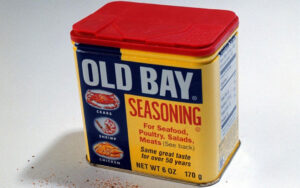
Because his Baltimore Spice Company was located across from the fish market, Gustav Brunn realized that creating a blended seasoning for seafood might be a profitable endeavor. He invented an imitation pepper out of myriad herbs and spices that proved to be quite popular for use on shrimp and crabs. At the suggestion of a friend, he named the seasoning Old Bay after the local passenger steamship line.
“My father was a seasoning man,” Ralph Brunn said. “He worked on it and came up with Old Bay Seasoning. It grew and grew, and competition came around. But Old Bay prevailed.”
Eventually, after serving for three years in the U.S. Army during World War II, Ralph Brunn went to college and worked closely with his father in the family business.
“He built the foundation of the business, and I built upon that,” he said.
The Brunn family sold the business to British conglomerate Hanson Industries in 1986, a year after the death of Gustav Brunn at age 92. McCormick & Co. bought the Old Bay line in 1990.
“When we were going full-tilt at Baltimore Spice, I had four vice presidents under me and we worked day and night, seven days a week,” Brunn said. “So we were glad to sell it.”
Brunn said the lesson of his life experiences is that Jews and others must remain vigilant and outspoken against antisemitism and all forms of hate.
“The important thing is to call it what it is, and not just the Jewish community but churches as well,” he said. “Our fellow Americans should rise up against it as well.”
Brunn said his family’s story is one of resilience, hope and perseverance. “There are lot of people out there with a lot of headaches and problems in life,” he said. “You can’t always expect sunshine and roses in life. You just have to work through it all. That’s what my father and my family did.”

"A Beautiful Noise" chronicles the singer-songwriter's rise to musical icon.

Duke Zimmerman and Lori Gale will talk at Towson University about their new book "People Get Ready" and the role played by Globe Posters in the civil rights movement.
The new exhibition revisits and updates a previous show about ritual hair covering in the observant community.

One of the most competitive local races for public office this political season is for Baltimore County Executive. Jmore recently spoke with four of the candidates about their views on how they hope to enhance life in the county.