Among my prized possessions is a magazine, Pro Football (price: 50 cents), from the early autumn of 1959 with an analysis not merely of the Baltimore Colts’ first championship team but of their adoring fans.
“Baltimore is this kind of a football town,” the esteemed football maven Murray Olderman wrote, recalling the 1958 season. “Last year in a cold November rain, 51,333 fans huddled miserably in Memorial Stadium. The clock showed a minute to play, and not a spectator made his way toward the exit.
“What was the score? Colts 56, Green Bay 0.”
That’s the merest snapshot of Baltimore’s football love affair at its most sublime. The home team’s up by eight touchdowns in a storm and nobody leaves? Of course not. Who walks out at the heart of a love affair?
But some of us are feeling a little anxious about the other side of today’s football love affair: not about fans walking out, but fans who aren’t walking in.
Everybody around here feels relieved that the Ravens clinched a playoff spot with their 17-9 victory over Atlanta on Saturday.
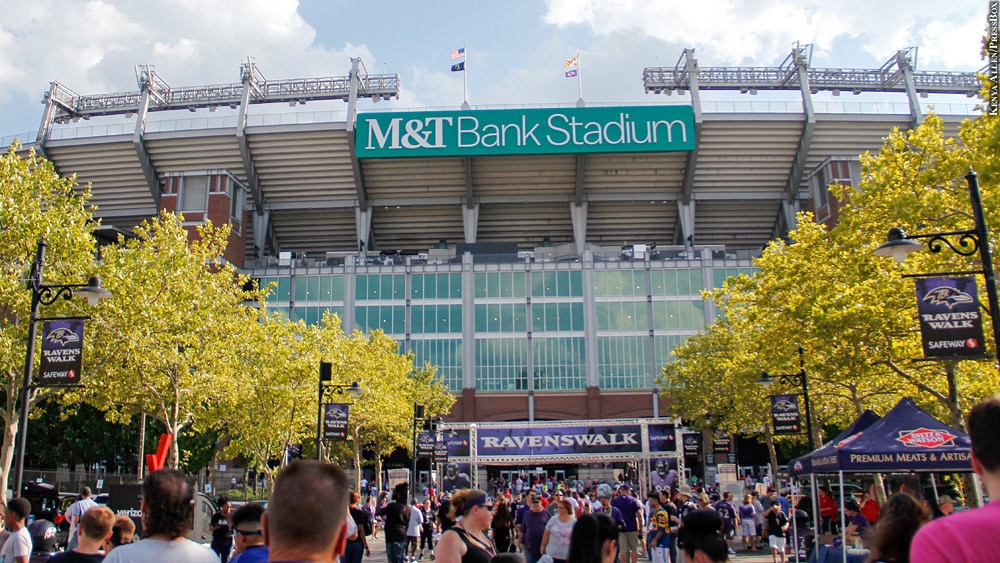
But did you notice the thousands of empty seats all around M&T Bank Stadium, not only at the finish but all day long? The ballpark officially holds 70,745 spectators. Officially, they were near that number on Saturday, but only because the seats were sold ahead of time and automatically get tabulated.
Unofficially, the number of empty seats was pretty uncountable from a distance. It looked like a lot of thousands. And as the Baltimore Banner reported, although “attendance numbers weren’t immediately known … tickets on the secondary market fell as low as $4 before kickoff.”
Four bucks? That’s, like, 1953 ticket prices.
I have friends who tried to get $20 for $70 tickets and failed. And Saturday wasn’t the first time this has happened.
Yes, the weekend’s weather was awful. And, yes, the Ravens have been uninspiring, and fans haven’t forgotten last year’s long losing streak that closed out the season. And yes, Lamar Jackson hasn’t played in several weeks. He’s still nursing a bad knee.
Ironically, in that stormy 1958 game against Green Bay, the Colts’ quarterback (some kid named Unitas) was knocked out of the game with a punctured lung and bruised ribs and didn’t return for three weeks. In his absence, George Shaw took over at quarterback and the ballclub continued their championship march.
When Unitas finally returned to action, wrapped in a protective corset, he threw a long touchdown pass to Lenny Moore on the very first play from scrimmage. On the radio, Chuck Thompson drily remarked, of Unitas, “How rusty can a guy get?”
But we were talking about attendance.
Game-time temperature Saturday was 17 degrees. Wind chill was 2 degrees. The Ravens have heated benches and large heaters they can huddle around. Fans can huddle around their televisions, where the temperature’s a steady 72.
If we’re just talking about one game, and the bone-chilling outdoor conditions, then maybe we’re making too much out of Saturday’s empty seats. But some of us are recalling a pattern here.
Old-timers like me remember the love affair with the Colts as if it were yesterday. That passion’s been no less for the Ravens. It’s real, and it’s intense.
But we also remember the years of Robert Irsay, when things started falling apart. We’re still flinching at the slightest hint of those wintry years, and thankful that Steve Bisciotti’s not Irsay. Here’s looking for a warming playoff run.
Michael Olesker’s latest book, “Boogie: Life on A Merry-Go-Round,” was recently published by Apprentice House. It’s the life story of Baltimore legend Leonard “Boogie” Weinglass, an original “Diner” guy who grew up to create the Merry-Go-Round clothing chain and contribute millions to charity.
Allow me a few paragraphs of time travel, and let’s go back to Johnny Carson’s monologue the night after Neil Armstrong became the first man to set foot on the moon. I’m paraphrasing here, but I think the joke still works 57 years after Carson first delivered it. “The good Read more

The BCO, founded in 1984, will perform the works of Frank Zappa, Beethoven, Mason Bates and Karena Ingram.

As he gets ready to leave for California, Rabbi Daniel Cotzin Burg looks back on his time in Baltimore and his 10 years writing for Jmore.