
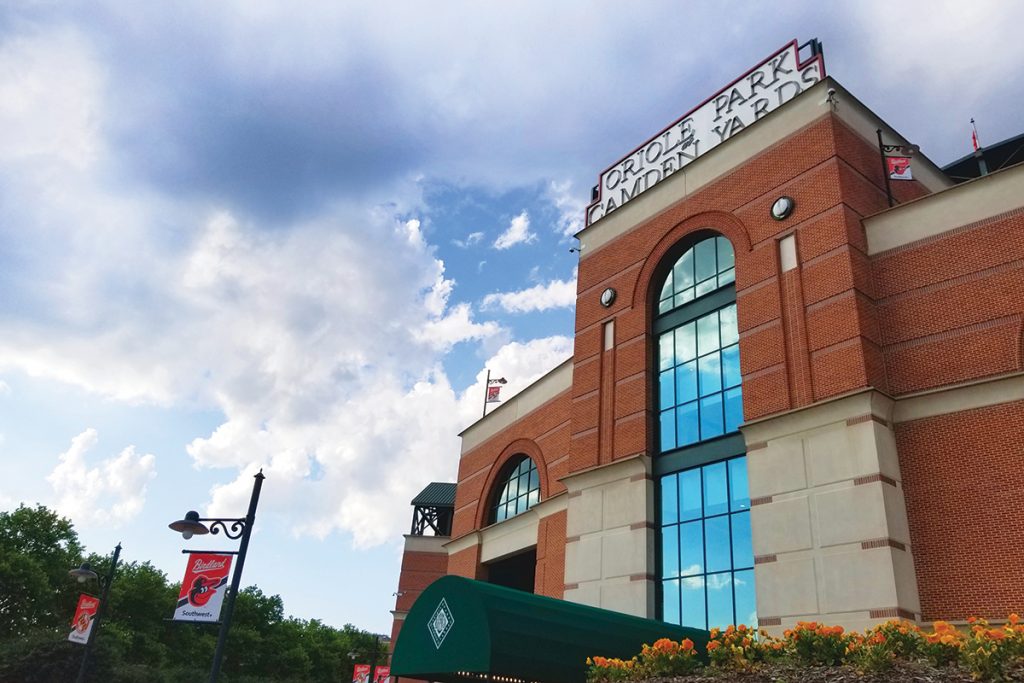
I hold in my hands the tattered remains of the Mar. 1954 edition of Sport magazine. It feels like the Dead Sea Scrolls of the Baltimore Orioles baseball team, a kind of pre-history of a municipal religion about to be born.
And its contents bear directly on the modern Orioles, who are commencing the 2023 season with more reason for optimism — up to a point — than we’ve had around here in years.
Those 1954 Orioles were about to be born out of the scarred remains of the old St. Louis Browns. In their last season there, the Browns drew 297,238 fans. That’s about 3,500 fans per game.
When the geniuses of the American League agreed to transfer the Browns to Baltimore, the sale price was a piddling $2,475,000, but it came with big-league self-consciousness: could the newborn Orioles outdraw the old Browns or would Baltimore embarrass itself in front of the whole country?
The answer came quickly. In my hands now is The Sun’s coverage on May 20, 1954. This was just five weeks into the season. The newspaper’s headline reads, “Fans Send Attendance Over Browns’ Home Draw for All of 1953.”
At Memorial Stadium the previous night, the O’s drew 29,722 fans to defeat the Washington Senators, 5 to 3, and brought the young season’s home attendance to 318,679, already more than 20,000 past the previous year’s Browns’ attendance.
So here we are, nearly seven decades later, and the Orioles launch their most promising team in years, but the old attendance anxieties are here in a different form than 1954’s.
When Oriole Park at Camden Yards was new, this was a team accustomed to drawing nearly four million people each summer. But that was before a new Washington Nationals franchise was born down the road and changed loyalties for fans in the D.C. suburbs. Who needed to trek all the way to Baltimore when the Nationals were a few easy subway stops from home? Not many, we’ve discovered.
Also, those big Baltimore attendance figures came before years of Orioles’ mismanagement created some awful teams. And it was years before lots of fans stayed home in the aftermath of the Freddie Grey disturbances and squeegee kids nervousness.
No one imagines attendance figures approaching four million again. In fact, half that figure would feel like a fresh start.
Could home attendance bounce back this summer? The squeegee headlines seem to have disappeared. That helps. We’re now eight years since Freddie Gray. That helps. But Washington baseball’s not going anywhere. And there’s still that shadow of about 300 city homicides every year.
Nobody’s connected this bloodshed even slightly with Oriole Park or the safe parking there. But there’s an echo, especially out in the Baltimore suburbs, that you hear routinely: “I don’t go downtown anymore,” it says.
Baseball attendance has always created nervousness in Baltimore. Look over the Orioles’ entire history and you can see just two eras of unexpectedly big crowds.
There was the time between the mid-1970s and the mid-‘80s when Wild Bill Hagy made it cool for young people (with dates) to fill the park. Previously, the Orioles were life-and-death to reach 1 million fans a year. In the great Hagy years, they were suddenly drawing about 2 million.
And there was the era when Oriole Park was new, and Cal Ripken Jr. was out there every night, and Peter Angelos, having spent millions to buy the team, poured more money into creating a powerhouse.
But in much of the team’s history, this was a football town, and that’s where the money routinely went. Even in 1954, that year full of big dreams down on 33rd Street, the O’s drew only 1,060,910.
Baltimore was America’s sixth biggest city back then, with a population pegged at 949,708. Today, the city’s got barely 600,000 inhabitants.
The Orioles are hoping a lot of those folks out in suburbia start making their way downtown again. This club looks like they’re going to be a lot of fun. What a loss, if they don’t hear some big noise rattling around the park cheering them on.
Michael Olesker’s latest book, “Boogie: Life on A Merry-Go-Round,” was recently published by Apprentice House. It’s the life story of Baltimore legend Leonard “Boogie” Weinglass, an original “Diner” guy who grew up to create the Merry-Go-Round clothing chain and contribute millions to charity.
Allow me a few paragraphs of time travel, and let’s go back to Johnny Carson’s monologue the night after Neil Armstrong became the first man to set foot on the moon. I’m paraphrasing here, but I think the joke still works 57 years after Carson first delivered it. “The good Read more
As he gets ready to leave for California, Rabbi Daniel Cotzin Burg looks back on his time in Baltimore and his 10 years writing for Jmore.
Michael Olesker pays tribute to WJZ’s retiring Marty Bass, a longtime fixture on local TV screens.