

It’s Lamar Jackson’s name in the headlines these days, but it’s another Baltimore quarterback who came to mind over the weekend when his widow and daughter each posted heavenly messages to him on social media.
The daughter’s name is Paige; the widow’s name is Sandy. Their last name is Unitas.
“Happy 90th birthday in heaven,” Paige Unitas posted on Sunday, May 7, John Unitas’s birthday.
“If tears could build a stairway, and memories a lane, I would walk right up to heaven and bring you home again,” Sandy Unitas wrote. “I miss you, my husband.”
It’s been more than two decades since John slipped away. Death came Sept. 11, 2002, precisely one year after the terrorist attacks.
It must have been a blindside hit that got him. The man who put “sudden death” into the American sports lexicon would have stared down the real thing if he’d seen it coming.
Time chips away at memory. Other quarterbacks have come and gone who have approximated Unitas’ football skills, and other games have dimmed the legitimacy of calling the 1958 Sudden Death championship contest against the New York Giants “the greatest game ever played.”
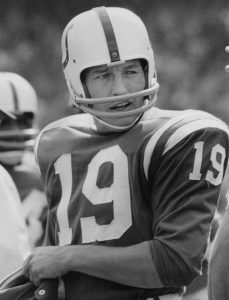
But it’s hard to imagine an athlete who gave a city its modern identity and sense of pride, and epitomized a legendary love affair between a team and a town, the way Unitas did over 17 hard-scrabble seasons.
Rejected by all the big colleges, and by the Pittsburgh Steelers who drafted him, Unitas was signed by the Colts while playing semi-pro football for $6 a game.
His first contract with the Colts earned him roughly $600 per game, a nice pay raise at the time though it sounds impossibly miniscule today.
He was football-scrawny and hunched over, and played in a time when quarterbacks were considered fair game for violence.
I once asked Hall of Fame tackle Art Donovan, “Who was the toughest of the old Colts?” I figured he’d say Gino “The Giant” Marchetti or Don Joyce or Gene “Big Daddy” Lipscomb, who wrestled in the off-season, or Mike “Mad Dog” Curtis.
“The toughest?” Donovan said without hesitation. “Unitas. Because he took the most punishment. And never said a word about it.”
Some old-timers may recall the 1960 game the Colts played in Chicago against the “Monsters of the Midway” Bears. With barely a minute left to play, the Colts trailed by four points when the Bears’ Doug Atkins tackled Unitas and battered his mouth and nose.
The Colts called time-out. They couldn’t get the blood to stop pouring from Unitas’ nose. Coach Weeb Ewbank told Unitas he was taking him out of the game.
“You do,” John told him, “and I’ll kill you.”
They got the blood to stop flowing only when offensive guard Alex Sandusky grabbed a clump of mud and shoved it up Unitas’ nose. When they huddled a moment later, Lenny Moore said, “John’s face was so battered, we couldn’t bear to look at him.”
On the next play, as time ran out, Unitas threw a long touchdown pass to Moore and the Colts marched off the field victorious.
For a long time, such breathtaking moments gave Baltimore its sense of self. We were a tough working-class town, and this guy came from the same kind of roots. Maybe we’d never have the glamour of New York or the political power of Washington, D.C.
But we had John Unitas throwing footballs across the horizon every Sunday, and this meant we could hold our own with any team or any town.
Michael Olesker’s latest book, “Boogie: Life on A Merry-Go-Round,” was recently published by Apprentice House. It’s the life story of Baltimore legend Leonard “Boogie” Weinglass, an original “Diner” guy who grew up to create the Merry-Go-Round clothing chain and contribute millions to charity. Olesker is also the author of “The Colts’ Baltimore: A City and its Love Affair” (Johns Hopkins University Press).
Allow me a few paragraphs of time travel, and let’s go back to Johnny Carson’s monologue the night after Neil Armstrong became the first man to set foot on the moon. I’m paraphrasing here, but I think the joke still works 57 years after Carson first delivered it. “The good Read more

As he gets ready to leave for California, Rabbi Daniel Cotzin Burg looks back on his time in Baltimore and his 10 years writing for Jmore.
Michael Olesker pays tribute to WJZ’s retiring Marty Bass, a longtime fixture on local TV screens.