

Nestled in bubble wrap and shipped in a golf travel bag, a newly restored Torah scroll belonging to Baltimore Hebrew Congregation recently had a layover in Jerusalem before being transported to its new home in Brazil.
But the story of its journey started more than three decades ago.
In the wake of the collapse of the Soviet Union in the early 1990s, the World Union for Progressive Judaism declared, “Many Progressive or Reform congregations worldwide, especially in re-emerging Jewish communities … lack an essential element of our lives as Jews: a Torah scroll.”
The WUPJ established its Shomrei Torah program to match synagogues and temples with Torahs with congregations needing them. Helene H. Waranch, a past chair of the North American Council of the WUPJ, worked for years to help BHC one of those donor congregations.
“BHC is well-known and well-respected in the Reform community and should be setting an example by donating one of its Torahs,” said Waranch, a BHC congregant. “We have more than we need.”
In particular, the Pikesville congregation possessed a surplus of Torah scrolls after absorbing Temple Emanuel in 2016. BHC was the steward of 19 Torahs, although some were no longer “kosher” due to age and usage.
“We take the stewardship of our Torahs seriously and work hard to maintain them and make sure they are cared for and used on a regular basis,” said BHC’s Cantor Ben Ellerin.
Seven years ago, the congregation raised funds to repair several of its Torahs, and last fall BHC created a committee to oversee the donation of at least three scrolls.
“Torahs should be used to enable Jewish life to thrive and grow,” the committee stated. “Sharing our wealth of Torah scrolls with others will benefit Judaism as a whole, specifically smaller synagogues in need of Torah scrolls.”
Working with the Shomrei Torah program, BHC narrowed its list of possible recipients to four communities in Argentina, Costa Rica and Brazil, said committee member Sharon Mond. She said the committee evaluated each community’s need and selected the Israelite Union of the Itajai Valley, or UNIVRI, in the small southern Brazilian town of Balneário Camboriú.
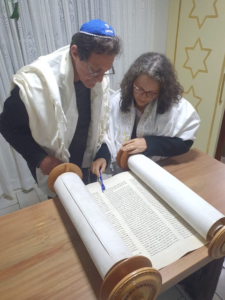
Mond said the four-year-old congregation of 30-40 families serves a large and isolated part of Brazil, with a student rabbi and no Torah scrolls.
Alexandra Casser, a soferet, or female scribe, who lives in Fairfax, Virginia, repaired the Torah donated to the Brazilian congregation. By hiring a female scribe, Cantor Ellerin said BHC wanted to make a statement and seize “an opportunity to live our values by working with a talented member of the soferet community and making real in yet another way the importance in the Reform movement of treating women and men equally.”
Once the Torah was restored to kosher status, Andrew Keene, the WUPJ’s vice chair of finance who is based in Washington, D.C., accompanied the BHC donation to Jerusalem.
The actual transfer took place at a ceremony at the WUPJ headquarters in the Israeli capital, in a room with a glass wall overlooking Jerusalem’s Old City. Waranch represented BHC at the ceremony, where seven Torahs were transferred from congregations — mostly American — to those around the world needing Torahs.
Waranch described handing the Torah over to UNIVRI president Jorge Crestani as “an affecting and effective moment.” UNIVRI’s acting spiritual leader, student rabbi Ethel Scliar Cabral, said she was also moved by the experience.
“Like a transplanted heart, the Sefer Torah gives life and voice to the community that receives it,” she said. “And the Sefer Torah itself takes on new life. Its words echo strong again and will be nourished by study and action. Baltimore and the Itajai Valley region become sisters forever, like one great synagogue that crosses continents and reaches the heavens.”
BHC staffers and congregants say they hope this will not be the end of that relationship. Torah Committee co-chair David Beller said BHC did not want to merely “give away a Torah and be done with it, but that that gift be the beginning of an ongoing relationship between our two congregations.”
Said Julie Wohl, BHC’s education director: “We hope to build relationships between our students and their peers at the congregations around the world that we donate Torahs to, but we’re still in the very early stages of thinking about exactly what that might look like.”
Sharon Mond believes the Torah matching project makes an important statement at this time. “It’s about the interconnectedness of Jews around the world at a time of increased antisemitism,” she said. “This Torah is a tangible symbol of that interconnectedness. And that’s a beautiful thing.”
Jonathan Shorr is a local freelance writer.
The BCO, founded in 1984, will perform the works of Frank Zappa, Beethoven, Mason Bates and Karena Ingram.

For more than 130 years, Sol Levinson & Bros. has been woven into the fabric of Baltimore’s Jewish community.
Led by local Israel-American cellist Amit Peled, the Mount Vernon Virtuosi aims to inspire people beyond musical enjoyment.

A former college campus activist, Veksler will speak at Chizuk Amuno on June 8 at the Ruth and Jay Lenrow Visiting Scholar-in-Residence for Combating Antisemitism.