
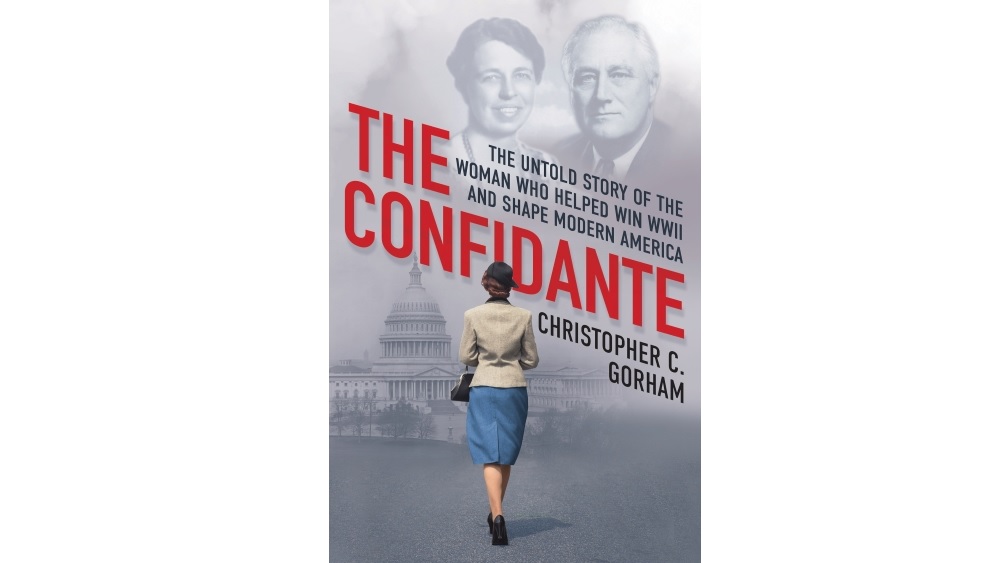
In the spring of 1945, in the dying days of World War II, Mrs. Anna M. Rosenberg arrived at the Nazi slave labor camp at Nordhausen in army trousers, an Eisenhower jacket and a khaki cap, carrying a purse containing lipstick.
The lipstick is important. She was one of the first Allied civilian women to inspect the horrors of the death camps. She went because President Franklin Roosevelt sent her and General Dwight Eisenhower urged her to come quickly after he’d seen the atrocities himself.
They sent her because she was one of the most respected women of her time, although today she’s virtually unknown.
But Christopher C. Gorham has a new book, “The Confidante: The Untold Story of the Woman Who Helped Win WWII and Shape Modern America” (Citadel). The story should win back some of the recognition Rosenberg deserves.
Rosenberg, who died in 1983, went to war-torn Europe and told Roosevelt what life was really like for the dogface American troops. She guided the direction of the G.I. Bill of Rights for health care and the Manhattan Project that produced the atomic bomb. She convinced President Harry Truman that the U.S. military had to be racially integrated.
We should know about such a woman. But most of us don’t, not anymore.
She was the first person awarded the Medal of Freedom, the civilian equivalent of the Congressional Medal of Honor. Five years after the war, she was the first woman named U.S. assistant secretary of defense. This prompted the scurrilous Sen. Joseph McCarthy to wage a smear campaign against her. He should have known better.
From the 1920s Manhattan world of politics and public relations, into the Eisenhower- Kennedy-Johnson White House years, the Hungarian-born Rosenberg fought for women’s equality and national health care and racial fairness.
She did it with a mix of toughness and smarts — and classic Jewish mother tenderness.
Few moments in her life compared with her arrival at Nordhausen. As Gorham writes in “The Confidante,” “Of the four thousand souls at Nordhausen, only a few could stand on rickety, pipe-stem legs. Their eyes were sunk deeply into their skulls and their skins under thick dirt were a ghastly yellow. … Some sobbed great dry sobs to see the Americans. … Others merely wailed pitifully.”
Rosenberg arrived days after the camp’s liberation. She later wrote, “I saw the survivors. Few could stand erect.” A few women, emaciated and dazed, approached her.
She wanted to offer them “something, anything.”
She groped around in her purse “and found I had a few lipsticks,” she later recalled. “I hesitated. How could I give lipsticks to people who were starving? Yet I had nothing else.”
She said she was ashamed, but offered the lipstick to a ragged woman who held the container tenderly in hands caked with dirt.
“The look that came over her face cannot be described,” Rosenberg said. “The lipstick was nothing, yet to this woman it was everything. It was the first thing she had owned in years. Everything had been taken from her. Even her name had been blotted out by the Nazi stamp, Juden.”
In the ‘50s, Gen. George C. Marshall enlisted Rosenberg as the No. 2 person at the Pentagon. No woman had ever held such a high position. Then he sent her to Korea to see how U.S. troops were handling two brutal enemies: North Korea and the weather.
She seemed to be everywhere. Most of the big national magazines, in America and abroad, wrote long, glowing profiles on her. “She’s the only person who ever stood up for us,” said one soldier.
“The boys in Korea,” said Sen. William Benton after his inspection trip along the front lines, “used to scrawl on the walls, ‘Anna was here.’ Was any woman ever paid greater tribute?”
And yet who remembers Anna Rosenberg today? Time steals from memory, and modern attention spans shrink. This woman’s life should be taught in history classes everywhere.
Maybe this remarkable new book, “The Confidante,” will rescue her memory. Anna Rosenberg was a giant of her time. She should be revered in our own.
Michael Olesker’s latest book, “Boogie: Life on A Merry-Go-Round,” was recently published by Apprentice House. It’s the life story of Baltimore legend Leonard “Boogie” Weinglass, an original “Diner” guy who grew up to create the Merry-Go-Round clothing chain and contribute millions to charity.

As he gets ready to leave for California, Rabbi Daniel Cotzin Burg looks back on his time in Baltimore and his 10 years writing for Jmore.

Michael Olesker pays tribute to WJZ’s retiring Marty Bass, a longtime fixture on local TV screens.
The Orioles' weak defense plays a major role in the nightly carnage, writes Michael Olesker.