
By Eva Fogelman and Menachem Z. Rosensaft
Last month, the U.S. Supreme Court sided with a Colorado web designer named Lorie Smith who refuses to create wedding websites for gay couples because of her religious objection to same-sex marriage. The ruling risked opening the floodgates to a host of discriminatory acts under the guise of First Amendment freedom of expression.
Most of us thought we had made progress in eliminating government-sanctioned bigotry. But Justice Neil Gorsuch’s 6-3 majority opinion in 303 Creative LLC v. Elenis, saying Smith’s refusal to serve a same-sex couple is “protected speech,” reminds us that discrimination endorsed by the high court remains a clear and present danger, first and foremost for the LGBTQIA+ community but also for the rest of us.
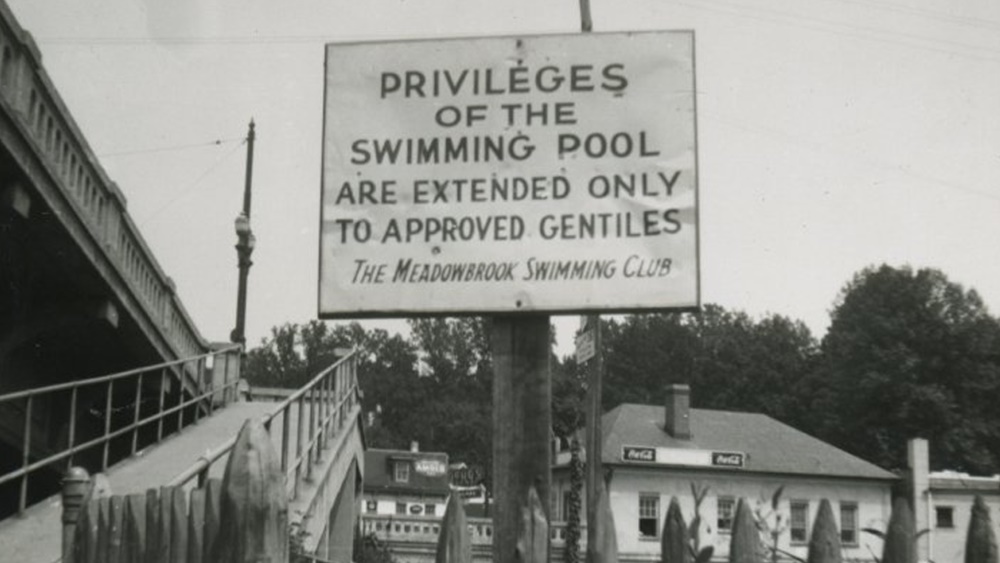
As children of Holocaust survivors, we tend to understand social and political events through the prism of the destruction of European Jewry. The Jews were deprived of their rights in Nazi Germany immediately after Hitler came to power in 1933. And we know that excluding Jews and others from commercial and civil life was one of the earliest stages before their eventual annihilation.
The 303 Creative case forces us to contemplate the possibility that white supremacists, antisemites, Islamaphobes and other hate-filled individuals and groups will now be allowed to recast their bigotry in First Amendment or religious freedom terms. As Justice Sonia Sotomayor wrote in her dissent, the decision “threatens to balkanize the market and to allow the exclusion of other groups from many services.”
With this new ruling, what is to prevent a devout Christian who believes that Jews killed Jesus from selling wedding dresses only to brides who accept Jesus as their savior or from refusing to print bar mitzvah or Ramadan invitations?
What about a white supremacist caterer who believes that interracial marriages violate his or her religious beliefs? Will his lawyer use this SCOTUS decision to construct a clever First Amendment or Free Exercise defense that allows him to get away with not serving such couples?

We are reminded of Gregory Peck’s character of Philip Schuyler Green who, masquerading as a Jew in the 1947 film “Gentleman’s Agreement,” is turned away from a “restricted” resort, as so many Jews were in real life.
Jackie Robinson, Louis Armstrong and other Black Americans were denied entry into hotels, restaurants and other central institutions of American society until the civil rights revolution of the 1950s and 1960s put what we thought was an end to such nefarious practices.
A previous generation of jurists also thought that legally sanctioned discrimination was accommodating sincere religious beliefs. “Almighty God created the races white, black, yellow, malay and red,” wrote County Circuit Judge Leon M. Bazile of Caroline County, Virginia, in his now notorious Jan. 6, 1959, ruling sentencing Mildred Loving, a woman of African-American and Native-American descent, and Richard Loving, a white man, to one year in jail for violating Virginia’s miscegenation laws.
Judge Bazile continued by saying God placed the races on separate continents. “And but for the interference with his arrangements there would be no cause for such [i.e., interracial] marriages. The fact that he separated the races shows that he did not intend for the races to mix.”
It was not until June 12, 1967 — more than eight years later — that the Supreme Court overturned the Lovings’ criminal conviction and declared Virginia’s prohibition of interracial marriages to be unconstitutional.
Do we now have to worry that the court in the future might validate some version of Judge Bazile’s bigotry under the guise of the First Amendment?
Americans are witnessing the legal legitimization of an “us vs. them” society. It comes at a point when the LGBTQ+ community was just beginning to gain legal ground. Now, the community is again legally seen by many as “the other.”
We don’t believe it is alarmist to say such delegitimization may be the beginning of a process of dehumanization. History has taught us that when we no longer see others as equal to ourselves, we grant license to bigots to treat such individuals as less than human.
Why are we compelled to speak out and feel strongly that all of us have an obligation to speak out? Because of the warning for the ages that German pastor Martin Niemöller taught us, a warning which we, present-day Americans, ignore at our peril:
First they came for the socialists, and I did not speak out — because I was not a socialist.
Then they came for the trade unionists, and I did not speak out — because I was not a trade unionist.
Then they came for the Jews, and I did not speak out — because I was not a Jew.
Then they came for me — and there was no one left to speak for me.
We are here to speak out for and stand with the LGBTQ+ community and for all who may eventually be adversely affected by this misguided ruling. For all we know, it could be us.
Eva Fogelman is a New York-based social psychologist and psychotherapist, and author of “Conscience and Courage: Rescuers of Jews During the Holocaust” (Anchor).
Menachem Z. Rosensaft is a lawyer and human rights activist, adjunct professor at Cornell Law School and author of “Poems Born in Bergen-Belsen” (Kelsay Books). He lives in New York.
Allow me a few paragraphs of time travel, and let’s go back to Johnny Carson’s monologue the night after Neil Armstrong became the first man to set foot on the moon. I’m paraphrasing here, but I think the joke still works 57 years after Carson first delivered it. “The good Read more
As he gets ready to leave for California, Rabbi Daniel Cotzin Burg looks back on his time in Baltimore and his 10 years writing for Jmore.


A former college campus activist, Veksler will speak at Chizuk Amuno on June 8 at the Ruth and Jay Lenrow Visiting Scholar-in-Residence for Combating Antisemitism.