
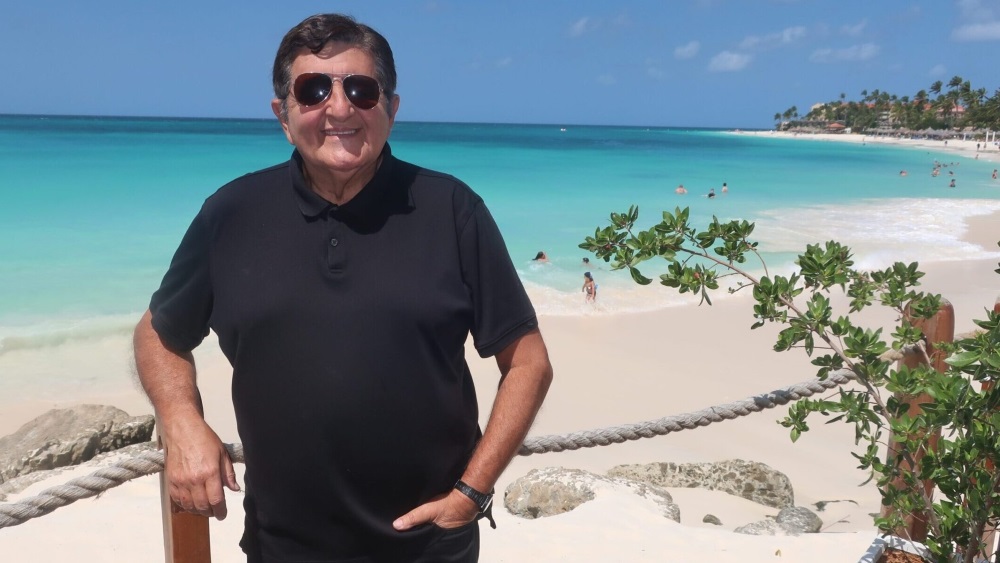
By Dan Fellner
One of Rabbi Alberto (Baruch) Zeilicovich’s first pastoral duties was to officiate the funeral of a 20-year-old congregant murdered by a drug cartel while at a disco.
It was the late 1980s in the Colombian city of Medellin, and Rabbi Zeilicovich had entered the pulpit at the height of that country’s drug wars. Two years later, he would bury another member of the congregation murdered by the cartel.
“We felt fear,” said Rabbi Zeilicovich. “The president of the congregation told me, ‘You cannot walk on Shabbos to the synagogue. You should come with a car.’ I asked, ‘Are you afraid someone is going to kidnap me?’ He said, ‘No, I am afraid somebody will kill you.’”
To give him a break from Colombia’s cycle of violence, a prominent congregant sent Rabbi Zeilicovich on a vacation in 1990 to the Caribbean islands of Aruba and Curacao.
Ultimately, that trip resulted in the other bookend of his career: Rabbi Zeilicovich recently came out of retirement to begin a three-year contract as spiritual leader of Beth Israel Synagogue on the Dutch island of Aruba in the southern Caribbean Sea.
The rabbi had visited the island at least once a year for the past 32 years. “First, the people are very friendly,” he said of Aruba, which has a population of about 100,000. “Second, it’s a very safe place. And third, the island is a paradise. Everything is so beautiful.”
Located in the Aruban capital of Oranjestad, Beth Israel is not affiliated with any movement of Judaism but operates in the style of the egalitarian Conservative movement.
Rabbi Zeilicovich was born and raised in Buenos Aires, where he experienced antisemitism and life under an oppressive military regime. He studied at a rabbinical seminary in the Argentine capital before completing his ordination at the Schechter Institute of Jewish Studies in Jerusalem.
Following his six years in Medellin, Rabbi Zeilicovich moved to a synagogue in Bogota, Colombia’s capital, before rabbinical stints in Puerto Rico, Texas and most recently New Jersey, where he announced his retirement from Temple Beth Sholom in Fair Lawn in late ٢٠٢٠.
Rabbi Zeilicovich and his wife, Graciela, had moved to Israel when he got a phone call from Rabbi Daniel Kripper, a friend and fellow Argentine who was retiring from Beth Israel.
“He said, ‘Baruch, what are you doing in Israel?’ I said, ‘I’m going to the beach,’” Rabbi Zeilicovich recalled. “He said, ‘Why don’t you come to the beach in Aruba where you can have a congregation again?’ And I said, ‘Why not?’”
Jewish life and culture in Aruba dates back to the 16th century when immigrants arrived from The Netherlands and Portugal. The island’s Jewish population has always remained small, today numbering about 100.
Beth Israel was consecrated in November of 1962. The synagogue brands itself a “Conservative egalitarian temple keeping Sephardic and Ashkenazic traditions.” (There is also a Chabad chapter on the island that opened in 2013.)
With a membership of just 50 local families and a few dozen overseas residents, Beth Israel has limited resources. A Dutch law stipulating that the salaries of clergy in Holland’s overseas territories be paid by the government helps the synagogue remain solvent.
“When I want to brag about myself, I say I am an employee of the Crown of Holland,” Rabbi Zeilicovich said with a laugh.
Rabbi Zeilicovich said a typical Friday night Shabbat service attracts about 20 people, about one-third of whom are tourists. Some arrive on the cruise ships that dock just a mile away from the synagogue; others stay at condos or at one of Aruba’s posh resorts.
If there aren’t enough worshippers for a minyan on Saturday mornings, a Torah study group meets instead. The synagogue’s small sanctuary can hold 60 worshippers, and is normally full for the High Holidays.
“We are a friendly, welcoming congregation,” Rabbi Zeilicovich said. “We are family — mishpocha. When you come here, we try to make you feel that way.”
Rabbi Zeilicovich said one of his priorities is to improve the synagogue’s marketing efforts and revamp its website. He noted that Aruba’s Jewish community often is overshadowed by Curacao, its Dutch neighbor to the east that is home to the oldest synagogue in continuous use in the Americas.
“We are behind in marketing,” he said. “And we understand we are missing a huge opportunity.”
For now, Rabbi Zeilicovich is enjoying his time in Aruba and can’t help but marvel at how his life has changed since his days in Medellin when just getting from his home to the synagogue was an ordeal.
“I think about that,” he said, “and look to heaven and say, ‘God, thank you.’”
Travel writer Dan Fellner wrote this article for the JTA global Jewish news source.

A former college campus activist, Veksler will speak at Chizuk Amuno on June 8 at the Ruth and Jay Lenrow Visiting Scholar-in-Residence for Combating Antisemitism.

Spending on "hasbara" should be “like investing in jets, bombs and missile interceptors,” argues Israel’s foreign minister.
Israeli-Americans Rachel Goldberg-Polin and Jon Polin talked about the pain of losing their 23-year-old son, who was kidnapped and later murdered in the Oct. 7th tragedy.

The remaining 6,000 members of the community are expected to immigrate by 2030.