
By Jacob Gurvis
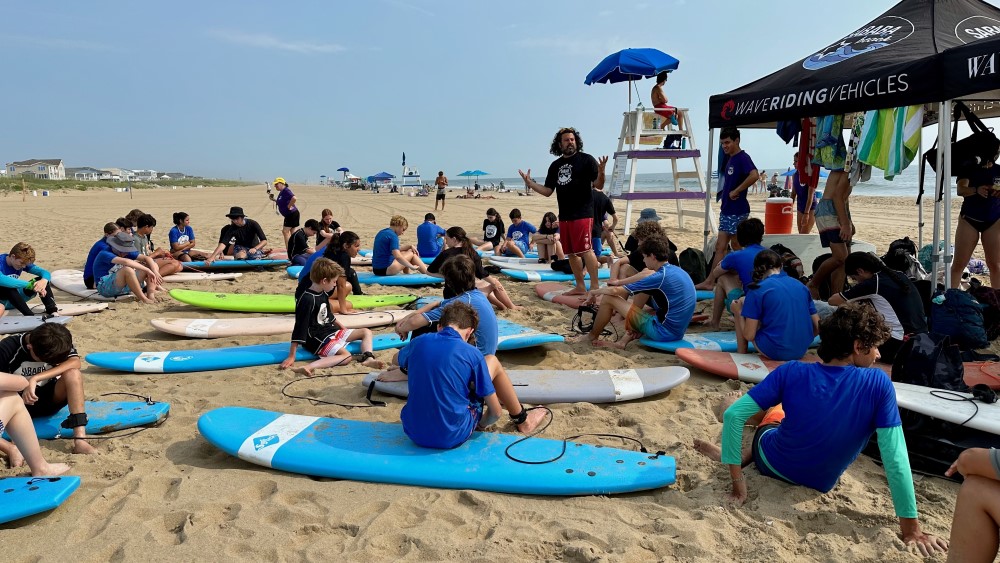
On a recent morning at Sandbridge Beach, not far from Virginia Beach, a fog disrupted beachgoers’ otherwise picturesque summer setting. The fog was so thick even the water became invisible. Most swimmers and surfers retreated to their towels for a break.
But one group returned to their tent and formed a circle. They began by singing the Jewish prayer “Mah Tovu,” mashed up with the hymn “Sanctuary.” Then after a brief introduction from camp director Danny Mishkin — who explained “b’tselem elohim,” the concept that human beings are created in God’s image — campers took turns sharing what gifts they bring to their community.
Such is the dual mission of Sababa Beachaway, an overnight camp specializing in ocean education and exploration through a Jewish lens. The camp offers four focus areas — surfing, sailing, scuba diving and an education track called “ocean discovery,” on top of typical camp activities and Jewish programming and prayer.
“We teach a more spiritual style of Jewish learning and Jewish engagement,” Mishkin said.
Mishkin said the camp’s approach to spirituality enhances campers’ connection to Judaism and the ocean. “They’re a little more open to a more spiritual life when you take them to the beach, which is a very innately spiritual place,” he said.
Maya Cohen, 16, said being at Sababa has helped her connect spiritually, which wasn’t as easy for her before camp. “I like the community. It feels like a second home to me,” she said.
Surf’s Up
Sababa just wrapped up its fifth summer, which consisted of three two-week sessions for campers ranging from 9 to 17 years old. Though the camp has experienced considerable growth — from 80 sessions sold its first summer to 230 this year — it’s been anything but smooth sailing.
In 2015, Mishkin and his co-founder and co-director, Lynn Lancaster, created a day camp in New York with help from a Jewish grant for out-of-the-box summer programs for teens. Both directors are synagogue veterans with a background in Jewish education and youth engagement.
A longtime sailor herself, Lancaster said she and Mishkin chose to create a surfing program to provide an opportunity not readily available to children in New York.
She also referenced “Race to Nowhere,” a 2010 documentary about the increasing burnout and depression experienced by children in the face of mounting pressure to succeed at a young age. What better way to escape the pressures of school and college applications than spend a summer at the beach?
Mishkin has been surfing for around 20 years since he took two lessons during his honeymoon in Hawaii and “became obsessed with it.”
After a few summers running the day camp, which started with only nine campers, Mishkin and Lancaster launched an overnight camp in Virginia, with support from the Foundation for Jewish Camp’s incubator program. While some Jewish camps in California allow campers to specialize in surfing, Sababa may be the only Jewish camp primarily focused on the sport.
For the first two summers in 2018 and 2019, Sababa was based out of Old Dominion University in Norfolk. Then, COVID hit. There was no camp in 2020, and Sababa ran a scaled-back program the following summer in New York, where both directors live during the year.
Sababa then returned to Virginia last summer, moving to Virginia Wesleyan University. The campus features a swimming pool, climbing wall and sports fields. And the school accommodates Sababa’s need for a kosher kitchen, too.
Starting last summer, Sababa became part of Commonpoint Queens, a social services organization in New York that runs local community programming and operates seven camps. A partner of New York’s UJA-Federation, Commonpoint’s camps are all Jewish and kosher or kosher-style, according to the group’s vice president of operations, Craig Lastres.
After navigating two pandemic summers as an independent camp, Lancaster said being part of Commonpoint has been “a wonderful, wonderful thing for us.”
Sababa’s campers represent a wide range of Jewish affiliation, from those who wrap tefillin and observe the summer’s fast days to those for whom “this is their Jewish connection,” Lancaster said. (There are also a few non-Jewish campers, drawn by the prospect of daily surfing.)
“I think as a camp and as a community, we are doing incredibly important work, as these kids are getting to know each other, they’re learning from each other’s Judaism,” Lancaster said.
Campers also come from a variety of socioeconomic and national backgrounds, with kids coming “from Park Avenue to the park bench,” Lancaster said. And this summer, Sababa welcomed campers from as far away as Israel and Uruguay, as well as a staff member from Mexico City.
One camper, who has spent four summers at Sababa, said he has attention-deficit/hyperactivity disorder and is on the autism spectrum. “What I love about this camp is they can accommodate for all that, and they support you,” he said.
With its campus next door to Norfolk — home to NATO and the world’s largest naval base — Sababa tries to tap into the local military community by offering scholarships for military children through the Jewish Board of Chaplains. “If there are [military] service people that want to have those Jewish values that they’re not getting, it’s an interesting market we’re trying to tap into,” Lastres said.
Riding Waves, Seeking Horizons
At its inception, Sababa only offered surfing before expanding to add the other three specialty areas. The camp brings in local companies for the sport instruction, which both directors hailed as central to the program’s success.
While most of the instructors aren’t Jewish, Lancaster and Mishkin said they are fully bought-in to Sababa’s spirituality focus.
“When they see us do our morning ritual at the beach,” Mishkin added, “the head surf instructor said, ‘When I heard you say that, I knew I was part of something special. I just knew that this was a different type of program.’”
The campers spend Monday through Friday mornings at their specialties, which run for a week at a time and are split into groups based on skill level. In the afternoons, it’s back to campus for more traditional camp programming — activities like art, soccer, photography and drama. “It’s a lot like running two camps,” Lancaster said.
Evenings feature Jewish programming, hikes, bonfires and other nature-forward experiences. Then on Shabbat, the camp has egalitarian services on Friday night — a portion of the service has music, while the main ma’ariv section does not — plus four service options on Saturdays, ranging from traditional prayer to options centered around meditation, nature and drama.
Caleb Weiss, 14, said he comes to Sababa for his friends and to spend every day at the beach. “It connects what I love and my religion, which is really neat,” he said.
Jill Weinstein, a therapist from Atlanta who has worked at Sababa for three summers, said she has witnessed firsthand how the camp has enhanced kids’ emotional intelligence — especially in the context of water sports, where they have no choice but get back up when a wave knocks them down.
“It teaches a lot of these kids resiliency and grit,” she said. “It’s pretty amazing to see where they start at the beginning of the week and where they end, and just the accomplishment and just the smile on their face when they accomplish something.”
Eight years after starting the day camp in New York, Lancaster said she “never had any idea this could become a full-time gig.”
But looking out at the water, Lancaster echoed the sense of wonder the camp aims to imbue in its participants.
“How do you not recognize that you’re part of something bigger than yourself when you’re out here?” she asked. “And to do that in a Jewish context is very, very powerful.”
Jacob Gurvis is the audience engagement editor for the JTA global Jewish news source.
A junior at Roland Park Country School, Katie Grossman writes about a recent experience that spurred her to take action to fight antisemitism.
Presented by Jews United for Justice and a consortium of local synagogues, "Beyond Welcoming the Stranger" offered a Jewish approach to helping immigrants.
John Singer wants to help Marylanders of all economic backgrounds to afford ankle foot orthoses.

At Krieger Schechter Day School, joining in the later elementary or middle school isn’t a setback -- it’s a launch pad.