
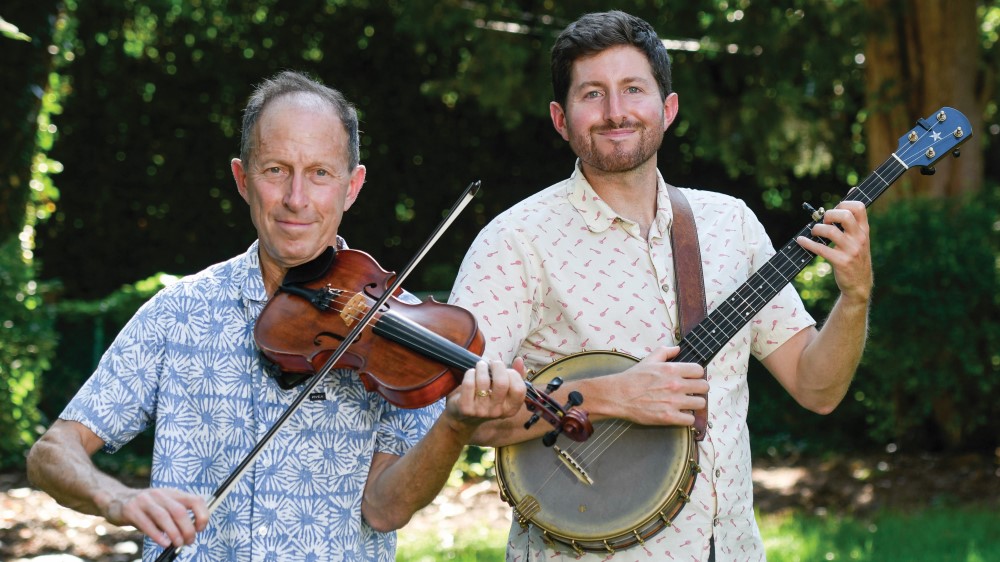
Brad Kolodner is thoroughly familiar with all the banjo jokes out there.
“What’s the difference between a banjo and an onion? Nobody cries when you cut up a banjo.”
“What do you call 20 banjo players buried up to their necks in sand? Not enough sand.”
Just don’t ask him to indulge in any so-called banjo humor. Kolodner, who grew up in Guilford and now lives in Hampden, takes his primary chosen instrument quite seriously.
“I think it all comes down from minstrel times and being associated with poor white folks. But [banjo jokes] get stale after a while,” he says. “The banjo has an ancient feel that gets right to your core. You hear rhythms, melodies, a rich sound. It deserves the same artistic credibility as other instruments. … I have no family history or connections to the South or the banjo and its roots, but I feel very connected to it.”
In actuality, Kolodner, 33, does have familial connections to old-time Americana music since he and his father, Ken, a veteran local roots musician, may be the only Jewish father-and-son team working in their genre. As a duo since 2009 and with their acoustic quartet Charm City Junction, the Kolodners perform around the country and are well-known in old-time and bluegrass circles for pushing the boundaries of the tradition into uncharted territory.
The Kolodners — both of whom are Baltimore natives and graduates of Friends School of Baltimore — were among the headliners at the first annual Maryland Folk Festival last month in downtown Salisbury.
“We’re very excited about it,” says Brad, who performed at last year’s National Folk Festival, also in Salisbury. “It’s one of our biggest events of the year.”
A Northwest Baltimore native who lives in Guilford, Ken Kolodner is considered a virtuoso of the hammered dulcimer, a unique instrument in old-time music circles. He is also a well-regarded fiddler, and his former world folk music trio Helicon still draws big crowds for its annual Winter Solstice concerts.
A Hopkins-trained epidemiologist who worked for many years as a part-time medical researcher and consultant, the elder Kolodner first became a professional musician in the 1980s while in his early 20s.
“I’ve always loved music but didn’t play as a kid,” he says. “I took piano lessons for a few months, but it didn’t really take. But I went to some bluegrass hostels and fiddlers’ conventions when I was around 22 or 23, and the fiddle really appealed to me. I started playing for fun and taught myself. I used to slow down tunes on the ‘Old Time Fiddle Classics Volumes 1 and 2’ LPs and tried to learn the songs.”
After becoming a seasoned fiddle player on local and national stages, Ken found himself drawn to the hammered dulcimer, a trapezoid-shaped stringed instrument played with wooden mallets that produces a sweet, ethereal sound. Besides gaining a national following playing the instrument, Ken teaches the hammered dulcimer to other players. (His son is also a popular instructor of the banjo.)
“I went to a couple of concerts and saw [the hammered dulcimer] and thought it would be fun to play,” Ken says. “It can have many voices. It can sound like a harpsicord or a piano. You can also play it in a percussive style.”
Still, when he attends old-time music festivals or jam sessions around the country, Ken admits he’s more likely to schlep along his fiddle than the hammered dulcimer. “It’s just easier to carry around,” he says with a chuckle.
The Son Also Rises
Growing up, Brad played the cello for a short while but didn’t display any real interest in music. “I always thought he had a good ear, but he wasn’t super-interested in working at it,” Ken recalls. “Both of my kids loved music, but we weren’t the kind of parents to say, ‘You have to do this.’”
But when he was 17, Brad asked Ken if he could accompany him to a music camp in Maine in the summer of 2007. The father’s one stipulation was that Brad had to attempt to study an instrument there, so the younger Kolodner took an introductory banjo workshop led by New York-based Americana musician Richie Stearns. He displayed a natural ability and was immediately hooked.
“I used to listen to classic rock – Steve Miller, Jim Croce, Tom Petty – and I didn’t particularly like old-time music,” Brad says. “But I thought [the banjo] was really cool, and I heard some of those old-time sounds in the background of the classic rock I listened to.”
Also making a strong impression on him was the communal aspect of the old-time music scene.
“This was my dad’s work, his job. But I hadn’t seen the social side of the music until I started playing and met up with the community of musicians,” Brad says. “There’s a lot of camaraderie there. You can go anywhere and meet and play with other players. I went to Barcelona last year and jammed with a bunch of great players there.”
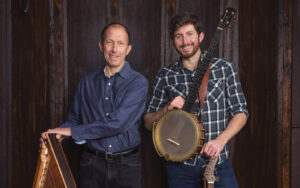
In particular, Brad was attracted to the clawhammer banjo style that involves more frailing or strumming and less fingerpicking razzle-dazzle than the bluegrass playing style. He watched online lessons and practiced constantly.
Quickly, Brad became so proficient at the banjo that Ken started inviting him onstage to play a song or two with Helicon.
“I was pretty intimidated early on,” Brad says. “I was thrust onto bigger stages that I didn’t really deserve to be on at that point. It was a novelty for me to come out and play a couple of tunes for 1,000 people out there.”
But his background as a television-radio broadcasting major at Ithaca College helped him feel comfortable in the spotlight. “I had hosted some events and shows, and I liked being the storyteller or narrator, so I wasn’t completely a fish out of water,” Brad says.
Ken says playing with his son was intoxicating and highly rewarding, and he continues to enjoy the experience of sharing musical conversations with his offspring. “We just love to jam together,” he says. “That’s all we did in the beginning.”
As he and his father — who have recorded four albums together — started playing more regularly together and developing a following, Brad decided to become a vocalist as well.
“Singing evolved because others told me I should sing more,” he says. “It wasn’t natural for me at first, but I saw people singing at jam sessions and I’ve become more confident. I like singing a lot, but I always try to be true to myself and just sing like myself.”
Over the years, the Kolodners have traveled all over to perform, including some small towns and rural communities with few Jews and little knowledge base about the Jewish faith. “Because of our last name, people sometimes ask where that’s from,” says Brad. “It happens at a lot of shows. Also, there are a lot of Jewish old-time music fans and players at shows.”
Still, he says being Jewish hasn’t really been an issue on the road, and the Kolodners have steered away from playing religious material or such vernacular Jewish musical forms as klezmer or Yiddish folk songs. “In terms of repertoire, it’s not a big part at all,” Brad says. “Bluegrass is associated with Southern Christianity, but we don’t really play in that context. We don’t sing gospel songs.”
Says his dad, who occasionally threw in a Jewish musical chestnut into Helicon’s wide-ranging repertoire: “Religion and gender and such, they don’t really enter things or are thought of [in acoustic roots music circles]. It’s a cliché but music is the great unifier,” he says. “Of course, [being Jewish] is part of who I am, but I don’t think it influences how I play in any way.”
Still, Brad notes that he brought along a banjo when going on Birthright Israel a few years ago. “I sat by the pool one day and played ‘Erev Shel Shoshanim,’ and all these heads turned,” he says. “People asked me about the banjo and talked to me. That was fun.”
Late Nights, Long Drives
Although he’s performed on the same stages as such roots music luminaries as Doc Watson, Arlo Guthrie and Alison Krauss, Ken says he always tries to remain focused and not get intimidated by playing in front of well-known musicians.
“You can’t worry if you’re good enough,” he says. “The bottom line is, you have to love it and want to share it with other people. [Celebrities] are there to just enjoy it all, too. It’s all about the music. The reward for us is giving people joy. That makes it all worth it. The getting there and setting up is an effort, but the playing is always fun. I never walk offstage glad that it’s over.”
His son echoes that sentiment.
“I certainly love it,” Brad says. “The long drives and late nights are still worth it just to play a 45-minute set. There are spiritual highs I can only get while playing music, whether at a jam session or by myself or in front of thousands of people. I’m grateful I can play music for my job. I still get anxious about it — ‘Will I do a good job?’ But people are there to enjoy their evening, and if we’re enjoying ourselves, they’ll see that.”
The Kolodners say they’re thrilled with the resurgence in roots music over the past couple of decades, especially among younger people. But they don’t necessarily view themselves as ambassadors or advocates of the musical tradition.
“We just enjoy playing this kind of music because it’s very rewarding for us, artistically and socially and community-wise,” says Brad. “It’s not a relic of the past or just for old people or antiquated. It shouldn’t just be in a museum. When people hear it, they feel connected and see there’s a depth to it. It’s people with their hands on real instruments and playing in a way that’s not over-produced. There’s an accessibility to the music that feels authentic and real. It’s for everyone.”
For information about the Kolodners, visit kenandbrad.com.
Duke Zimmerman and Lori Gale will talk at Towson University about their new book "People Get Ready" and the role played by Globe Posters in the civil rights movement.
The new exhibition revisits and updates a previous show about ritual hair covering in the observant community.

One of the most competitive local races for public office this political season is for Baltimore County Executive. Jmore recently spoke with four of the candidates about their views on how they hope to enhance life in the county.
The Pikesville resident's latest offering "There's a Dragon in the Tree House and He Won't Come out!" was co-written with her grandsons.