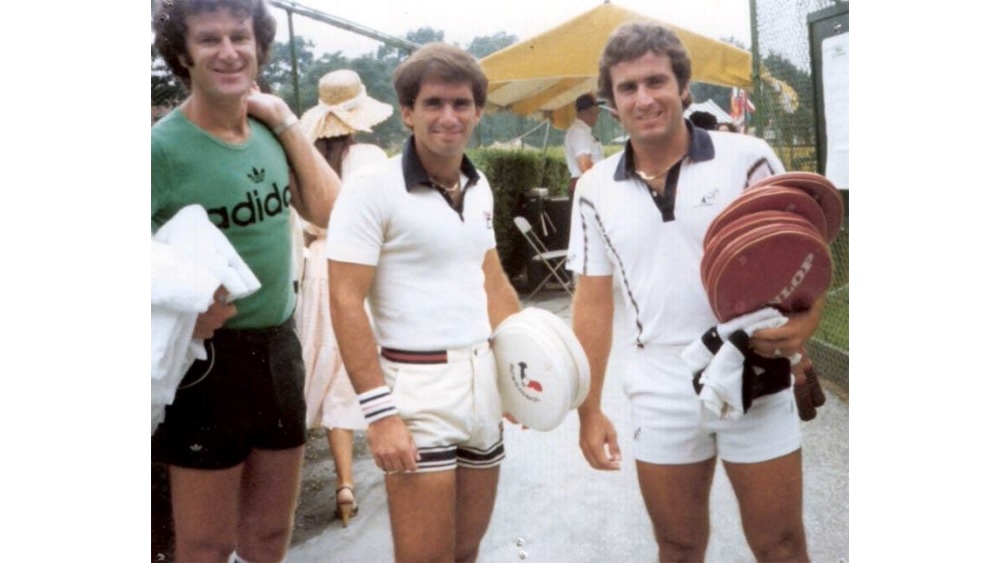
When Harold Solomon revisits his professional tennis career in the 1970s and ’80s –- which is earning him a place in the Maryland State Athletic Hall of Fame this November — there are numerous highlights that stand out.
Being the first player to win the national Orange Bowl 18-and-under junior championships twice, turning pro in 1972 and rising to No. 5 in the world in singles, spending four years in the top 10. Reaching No. 4 in doubles in 1976. Being a member of four U.S. Davis Cup teams, making it to the semifinals of the U.S. Open in 1977 and reaching the French Open final in 1976.
But among his 22 singles titles, there’s one that touches Solomon’s Jewish roots like no other. It came in Tel Aviv in 1980 when he defeated Israeli tennis legend Shlomo Glickstein in the finals, 6-2, 6-3.
“It was my wife’s and my first trip to Israel, and we were just really astounded by the people there and what they’d accomplished,” recalls Solomon, 71, a Washington, D.C., native who grew up in Silver Spring. “And the stadium there, I don’t remember how many it holds, maybe 8,000 or so, but there were people everywhere. I mean they had to stop the match because people were sitting in the walkways. It was completely crazy. But to go there and see the country and meet the people and win the tournament was really exciting. We met some people there that are still long-lasting friends.”
Love at First Sight
Solomon — who “rejoices in his Jewish heritage” but “it’s not something I’ve continued to practice as I’ve grown older” — remembers being a Hebrew school student at Temple Israel in Silver Spring.
“I wanted to be outside playing tennis,” says Solomon, who first picked up a racquet at age 5 after watching his father play and soon fell in love with tennis. Solomon won his first tournament at age 8 in Takoma Park. By the time of his bar mitzvah, he was playing in the finals of the national 14-and-unders.
Just 5 feet 6 and 130 pounds, Solomon wasn’t as strong as his opponents. But he was in superb condition and could outlast foes with his ability to return shots for extended periods, earning the nickname “The Human Backboard.”
He and his father would do drills when Harold was 12 or 13 where they would hit a thousand balls in a row without missing. “If you missed before a thousand, you’d have to start all over again,” Solomon recalls. “It made me really work on my footwork and my focus.”
The hard work continued in college at Rice University. “If the players were out there practicing for two hours, I’d practice for four.”
Spending winters in Florida as a teenager also helped Solomon develop his tennis expertise, says childhood friend and 2019 Maryland State Athletic Hall of Fame inductee Steve Krulevitz.
“It was great to hang around with Harold. He was always so serious about his tennis and his training,” says Krulevitz, who played in 32 Grand Slam events himself and is in his 39th year running a tennis camp at Gilman. “I picked up good habits from him.”
Krulevitz would sometimes go down to Solomon’s house for tournaments in Florida and host Solomon for Maryland events. He calls Solomon the second greatest tennis player from the Mid-Atlantic area, behind only Arthur Ashe.
“He had one of the best returns of serve in tennis at the time and he could hit winners off short balls. Just bury them,” he says.
Solomon’s marathon style was in evidence when he won his first singles title at the Washington Star tournament of 1974. The final against Guillermo Vilas featured one rally of 105 consecutive shots. “One article said someone ran out and got a Coke and a hot dog and came back, and we were still playing the same point,” Solomon recalls with a laugh.
Backhands, Buddies & Bagels
He also flourished in doubles, teaming with Eddie Dibbs to rise to No. 4 in the world. Dibbs coined the term “bagel” for a 6-0 set. Sportswriter Bud Collins started calling Solomon and Dibbs “the bagel twins” and it stuck, leading some to think Dibbs was Jewish, too.
“Eddie was Jewish when it was convenient to be Jewish,” Solomon recalls. “When we’d go to Jewish clubs to do things, he would never deny the fact that he wasn’t Jewish.”
In fact, Dibbs is Lebanese, which Krulevitz recalls created a problem one night.
“I was playing a tournament in Los Angeles and it was Rosh Hashanah so I said, ‘I don’t play until tomorrow so I’m going to shul.’ Eddie says, ‘I’ll go along with you.’ We get to the door and explain we’re from back East, and they ask for our ID. He looks at Eddie’s driver’s license and say, ‘You’re not coming in.’ Why not? ’You’re an Arab. We don’t let Arabs in here.’ True story. Unbelievable.”
Solomon also fought for human rights, serving as the Association of Tennis Professionals president (1979-1981) and then on the boards of both the men’s and women’s tennis tours. “I was fighting hard for equal prize money and women’s rights while representing the men too, which was not a popular position at the time. But it was something I felt was really important, to make a difference and be involved in other things.”
Since 1978, those “other things” have included The Hunger Project, a global organization he and his wife support and advocate for. The Hunger Project focuses on empowering women’s leadership in ending hunger and mobilizing people to end their own hunger.
After coaching rising stars such as Mary Joe Fernandez, Monica Seles, Jennifer Capriati and Jim Courier for 15 years, he opened the Harold Solomon Tennis Institute in 2005 near his home in Fort Lauderdale. The institute closed after 13 years but Solomon still works with young players, including his 12-year-old grandson.
“He enjoys the game but no pressure,” Solomon says with a smile.
One other interesting fact: Playgirl Magazine named Solomon one of the 10 sexiest men of the year in 1980. “It would have been awesome for my social life if I hadn’t gotten married in 1978,” Solomon jokes.
But he has no regrets. He and Jan, who was the No. 1 women’s tennis player at Rice when Solomon was the No. 1 male, have been married for 45 years and have two children and three grandkids with a fourth due in December. The family will be proudly looking on Nov. 9 when Solomon is inducted into the Maryland State Athletic Hall of Fame.
“At these events you always think about the people responsible for helping you achieve the things you achieved,” says Solomon, a member of the USTA Mid-Atlantic, Intercollegiate Tennis, and D.C. Sports halls of fame. “The first thought goes to my parents, my father spent a ton of time and effort with me, and my mom, for taking me and my three siblings to tournaments. It was a lot. My coaches, friends, my wife. There was a lot of support.”
The Maryland State Athletic Hall of Fame will induct Harold Solomon on Thursday, Nov. 9, from 6-10 p.m. at 6817 Martin’s West, Dogwood Rd. Other 2023 inductees at the 62nd Hall of Fame Induction Banquet include basketball player Adrian Dantley, gymnast Dominique Dawes, football player Jermaine Lewis, horse racing’s Northern Dancer, sportscaster Scott Garceau and former University of Maryland women’s basketball coach Chris Weller. Doors open at 6 p.m. For tickets, visit mdsahof.com.
Chris Zang is a Baltimore-based freelance writer and copy editor for Jmore.
The BCO, founded in 1984, will perform the works of Frank Zappa, Beethoven, Mason Bates and Karena Ingram.

For more than 130 years, Sol Levinson & Bros. has been woven into the fabric of Baltimore’s Jewish community.
Led by local Israel-American cellist Amit Peled, the Mount Vernon Virtuosi aims to inspire people beyond musical enjoyment.