
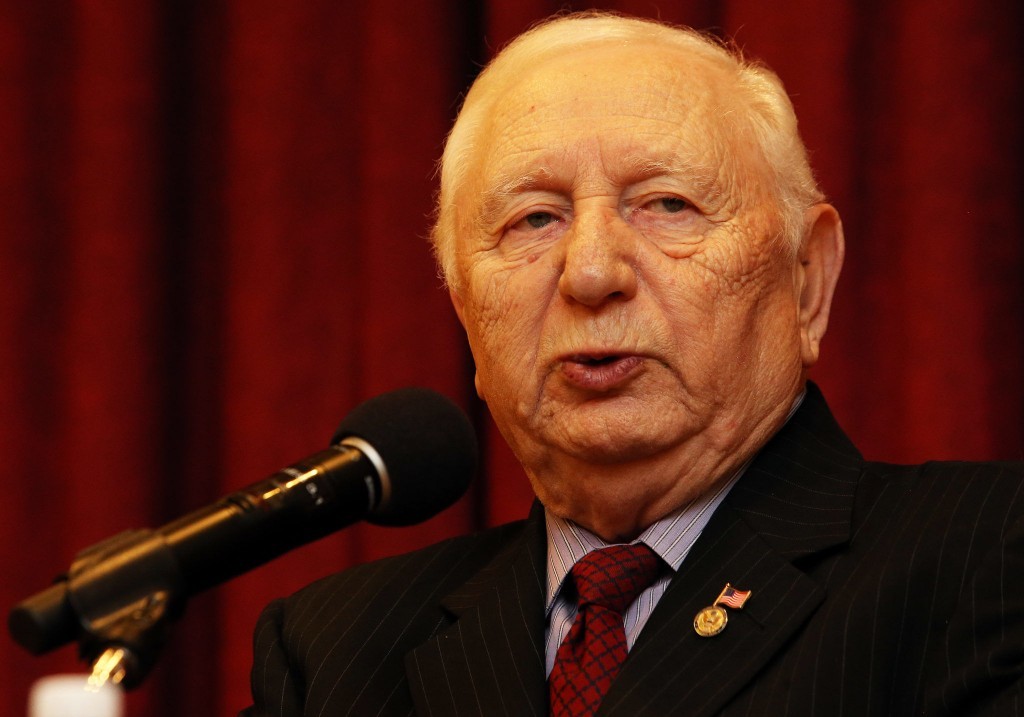
Howard Kaidanow, a local Holocaust survivor and partisan fighter who spoke publicly at schools and other venues about his experiences during World War II, passed away last Friday, Nov. 24.
A Lutherville resident and Beth El congregant, he was 94.
The Lodz-born Kaidanow grew up in a small town in eastern Poland that is now part of Belarus. At a Yom HaShoah (Holocaust Remembrance Day) program at Towson University in April of 2017, he recalled living a typical middle-class life with his parents and younger brother.
In 1939, their lives changed drastically when the Soviet Union invaded their town, and again in June of 1941 when Nazi forces took over the region.
“Life changed for the worst,” Kaidanow said. “It’s impossible for me to tell you what they did to us. People should not do that to people. Even animals don’t do that to themselves. … The Nazis did all kinds of things to you. I went through it and I still can’t believe that people could do that to other people, no matter who the people are.”
One day during Passover in April of 1942, Kaidanow remembered his brother running into their house and telling the family that there was shooting outside. “My mother hid my brother and me in a bunch of straw behind the house,” he said. “About 10 minutes later, we heard a knock on the door. Nazis broke down the door, came in and asked my mother where the rest of the family was located. My mother didn’t tell them, so they beat her and shot her to death.
“That same day, my father was burned alive. They took 50 Jewish people, put them in a barn and lit the barn on fire.”
Kaidanow and his brother escaped and ran to a town called Kurenec where they lived for a short while with an uncle. Then they fled to a wooded area, he said, where they joined a group of Jewish partisan fighters. As a partisan with the Markov Brigade, he said he spent most of his time blowing up German trains.
“If I didn’t become a partisan, I don’t know what I would have done because I was afraid,” he said. “When you become a partisan, at least the Nazis can’t just shoot you or kill you because you have a gun and you can defend yourself.”
Kaidanow said he spent two winters in the forests as a partisan. “The winters were the worst on record,” Kaidanow said. “It was so cold. But I think people are stronger than iron. We survived. I survived as a kid. But it was not easy, I can tell you that.”
Kaidanow’s brother also survived the war, along with a few other family members from their father’s side. Every family member on their mother’s side was murdered during the war.
“Howard was a fine man and the world is a better place having had him in it,” Michael N. Grossblatt, junior warden of the Amicable-St. John’s Masonic Lodge #25, wrote on the website of Sol Levinson & Bros. “He had been through so much at such a young age but was still so friendly and living a full life. He was presented with a Recognition from the Jewish Partisan Educational Foundation in which it stated, ‘His actions contributed to the preservation of thousands of lives and have continued to inspire future generations to stand up and make a difference.’ Only a select few amazing humans can be recognized like this.”
After the war, Kaidanow spent some time in the former Soviet Union, eventually making his way back to Poland and then East Germany. There, he was in a Displaced Persons camp and finished school before coming to the United States in 1954.
He met his wife, Esther, also a Holocaust survivor, on a blind date in Philadelphia. They married in 1961 and moved seven years later to Baltimore, where Kaidanow worked as a businessman.
Later in life, Kaidanow started speaking in public about the Holocaust..
“Somebody has to tell this story,” he said. “People talk mostly about the concentration camps, which was horrible. But the Germans killed 1.5 million Jewish people without the concentration camps, just in the little towns and cities. I decided somebody had to tell the story. There weren’t too many partisans left here, so that’s what I’m doing now.”
Kaidanow said he hoped his speaking engagements helped prevent listeners from being vulnerable to bigotry and hate. “You cannot go on hating,” he said. “If you continue hating long enough, you will hate yourself. You have to live your life. It’s not healthy for me to hate everybody. I don’t do that. But I remember. I don’t forget.”
Kaidanow is survived by his wife, Esther Kaidanow; his children, Tina S. Kaidanow, and Eric (Patricia) Kaidanow; his brother, Jerry (Ellen) Kaidanow; and his granddaughter, Mia Kaidanow. He was predeceased by his parents, Sarah Frieda and Eliyahu Kaidanow.
Funeral services will be held at Sol Levinson’s Chapel, 8900 Reisterstown Road in Pikesville on Thursday, Nov. 30, at noon. Interment will be at Beth El Memorial Park in the 9700 block of Liberty Road in Randallstown.
Contributions in Kaidanow’s memory may be sent to Holocaust and Human Rights Education Center, 4 West Red Oak Lane, Suite 204, White Plains, New York 10604.
Jewish Community Services' upcoming "Future-Ready Workplace" event will feature a keynote address from workplace expert and bestselling author Liz Fosslien.
A Baltimore native, Sweren was a collector of artists' books whose own works were displayed in national galleries.
The BCO, founded in 1984, will perform the works of Frank Zappa, Beethoven, Mason Bates and Karena Ingram.

For more than 130 years, Sol Levinson & Bros. has been woven into the fabric of Baltimore’s Jewish community.