

Many of us are familiar with Psalm 23, beginning with the words, “The Lord is my shepherd,” from funeral processions or when singing during the third meal on Shabbat.
But how many times have we paused to read the psalm in depth and reflect on its lessons? Psalm 23 contains messages of hope, comfort, and divine support — relevant teachings for us today as we fervently pray for Am Yisrael’s welfare.
A commentary that offers this deeper perspective is that of the Israeli biblical scholar Amos Hakham (Da’at Miqra). Hakham splits the psalm into two sections, each offering a different form of imagery: a shepherd and his flock, and a host welcoming a guest into their home. The following is based on his reading.
The shepherd-flock imagery is introduced in the psalm’s opening words: “The Lord is my shepherd; I shall not want.” This provision and protection are then delineated, one step at a time. Hashem “makes me lie down in green pastures. He leads me beside the still waters.” As His flock, God leads us through pastures with plentiful herbage to feast upon, alongside calm waters that are easy to drink. And when we swerve from the right path while travailing these pastures, He restores our footing, helping us get back on track: “He restores my soul. He leads me on straight paths for His name’s sake.”
And even as He guides us through dark and treacherous terrain, “Yea, though I walk through the valley of the shadow of death,” we have nothing to fear: “I will fear no evil for you are with me.” Why? Because “Your rod and Your staff, they comfort me.” Our shepherd uses a rod to thwart off wild animals and a staff for support as we are guided through these fearful stretches.
The shepherd-flock imagery reminds us that we can find refuge in Hashem in our moments of vulnerability — like the helpless flock, looking toward its faithful shepherd for protection and guidance.
The second section shifts the setting to times of plenty and security, as we are pampered in our host’s home. The host welcomes us with a set table, elevating us above our rivals: “You prepare a table before me in the presence of my enemies.”
Hakham explains that in biblical times, it was customary to anoint one’s head with oil for pleasure and in times of joy and celebration. The host wouldn’t want less for his esteemed guest: “You anointed my head with oil.” We are also offered wine till the point that: “My cup runneth over.” All this goodness leads the guest to never want to leave the host, Hashem’s, home: “Surely goodness and mercy shall follow me all the days of my life; And I shall dwell in the house of the Lord forever.”
I view the second section as adding onto the first. Just as Hashem takes care of us when we are vulnerable, as we move like flock through dangerous terrains in life, Hashem also looks after us in our times of plenty — inside the house, out of harm’s way — providing us more than we need or deserve.
King David, the author of the Psalms, began his career as a shepherd and concluded as a king, hosting guests and dignitaries in his palace. He knew what it meant to be vulnerable and to have plenty. He also drew analogies from these experiences as he wrote this psalm, allowing him to understand the dynamics from all sides. In his psalm, King David reminds us that Hashem has never, and will never, forsake us. Over the past months, our nation has traversed the valley overshadowed by death.
We nevertheless mustn’t fear, for Hashem is with us! And Hashem will once more return us to times of plenty and tranquility, so that soon, speedily in our days, we will “dwell in the House of the Lord forever.”
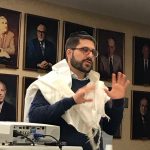
Rabbi Dr. Eli Yoggev serves Pikesville’s Beth Tfiloh Congregation.

As he gets ready to leave for California, Rabbi Daniel Cotzin Burg looks back on his time in Baltimore and his 10 years writing for Jmore.


Michael Olesker pays tribute to WJZ’s retiring Marty Bass, a longtime fixture on local TV screens.

The Orioles' weak defense plays a major role in the nightly carnage, writes Michael Olesker.