
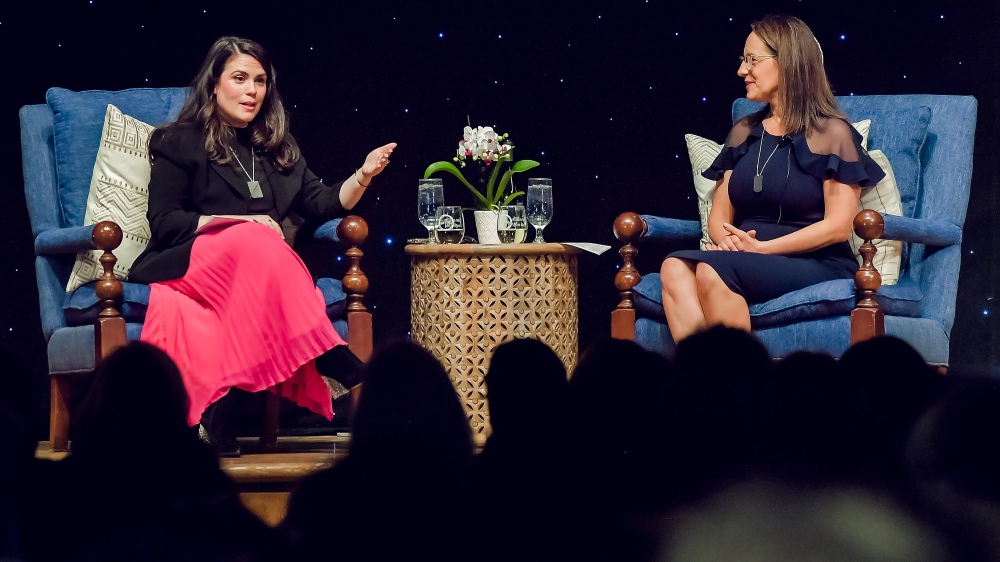
Even though she’s an outspokenly proud Jewish woman who helms the nation’s oldest Jewish women’s grassroots organization, Sheila Katz admits she’s rattled.
“It’s a really scary time to be Jewish in America right now, and it’s a scary time to be a woman in America right now,” she said.
The CEO of the National Council of Jewish Women, Katz spoke recently at The Soul Center’s annual “Wit, Wine & Wisdom” event at Beth El Congregation in Pikesville.
The Soul Center is a spiritual startup and innovation hub that engages Baltimore’s Jewish community. More than 400 people attended this year’s “Wit, Wine & Wisdom,” hosted by Beth El’s Rabbi Dana Saroken, founder and spiritual director of The Soul Center.
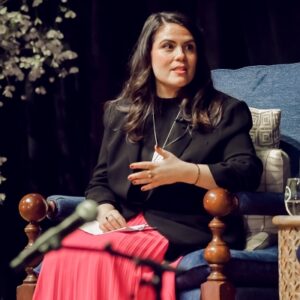
A native of Suffern, New York, who lives in Washington, D.C., Katz, 40, noted that the phenomenon of antisemitism existed long before the Oct. 7 Hamas terrorist attacks in Israel. “But it’s worse now. It exists in all spaces,” she said. “It exists on the right, it exists on the left, and it’s important that we call it out, wherever it is.
“The best thing we can do is know how to name it, how to call it out, how to call people in and actually celebrate being Jewish.”
On the college campus level, students today are largely fearful and shying away from expressing their Jewishness, Katz said, due to skyrocketing antisemitism and anti-Israel sentiment. Universities and college administrations need to be as responsible in combatting antisemitism as they are for fighting racism, anti-LGBTQ activity or sexual assault, she said.
“There’s a roadmap for this; they know how to do it,” Katz said. “We have to continue to help students not feel alone and be proud of their Jewishness in these moments.”
Katz acknowledged that the younger generation of Jews tends to feel conflicted about Israel regarding its war with Hamas, largely due to the one-sided perspectives of the conflict aired on social media. She encouraged audience members to have frank and open conversations with family members about the war and to embrace differing viewpoints.
On a personal level, Katz said she has strived to engage with people to promote a better understanding of Israel’s perspective in the wake of Oct. 7, especially with leaders of other organizations who have largely remained silent about the massacre.
“You want to hold people accountable for not saying it and you want to dig deep as to why, because there’s antisemitism there,” she said. “And then, you want to help people get on the path. I want more people to get on the path.
“You have to have hope,” she said. “You have to believe in people.”
Last month, Katz was part of a contingent of Jewish activists, feminists and experts that addressed the rapes and sexual violence of Oct. 7 at the United Nations.
“It really mattered to us to be on the record, making sure everybody said that this happened,” Katz said. “Because to be killed in that way, to be tortured, to be mutilated, to be sexually assaulted in front of other people in all the least of dignifying ways in the world, the worst possible, can we at least say that this happened? That we believe them and can we make sure it never happens again?”
The overall objective was to confirm that the atrocities occurred, she said. “MSNBC and the New York Times and the Wall Street Journal, and a lot of media that had traditionally previously been saying ‘alleged,’ started referring to this as fact,” Katz said of the gender-based war crimes. “That is a major win in an age of disinformation and misinformation. … No one can deny that this happened, and if they do deny that this happened, they’re not credible news sources anymore.”
Much of the conversation between Katz and Rabbi Saroken focused on perspectives on female leadership. Katz said women leaders tend to be viewed differently than their male counterparts.
She said she learned that in the summer of 2019 when assuming leadership of the NCJW, a 131-year-old Jewish feminist civil rights organization with more than 210,000 advocates working for the full equity and safety of women, children and families in the United States and Israel.
Katz said colleagues and others often commented on her attire. As a result, she began wearing bright colors — especially pink — at meetings, mostly with men. She half-jokingly called it a “power move,” to emphasize her presence as a female leader and the need for strong females to be noticed and heard.
“I started wearing bright colors when I was going to be in rooms full of all men,” she said. “It was annoying at first that people would comment on what I was wearing, because men don’t get watched in that way. But how you dress defines how you want to be perceived as a leader.”
Among her personal role models, Katz said, are her mother and other women in her family, as well as Rep. Kathy Manning (D-North Carolina). Manning was the first woman to serve as board chair of the Jewish Federations of North America, and Katz met her while working at her first job at the Hillel at the University of North Carolina-Chapel Hill.
Katz — who worked for 12 years at Hillel International — said she has tried to provide that same type of mentorship, support and guidance to other young Jewish professional women.
In her final remarks, Katz offered a blessing over wine to attendees at the Soul Center gathering. “May we each lead with compassion, curiosity and love,” she said. “And when the arc of the moral universe feels like it’s taking too long to bend toward justice, may we have resilience community and may we keep fighting together.”
Linda L. Esterson is a local freelance writer.

"A Beautiful Noise" chronicles the singer-songwriter's rise to musical icon.
Duke Zimmerman and Lori Gale will talk at Towson University about their new book "People Get Ready" and the role played by Globe Posters in the civil rights movement.
The new exhibition revisits and updates a previous show about ritual hair covering in the observant community.

One of the most competitive local races for public office this political season is for Baltimore County Executive. Jmore recently spoke with four of the candidates about their views on how they hope to enhance life in the county.