
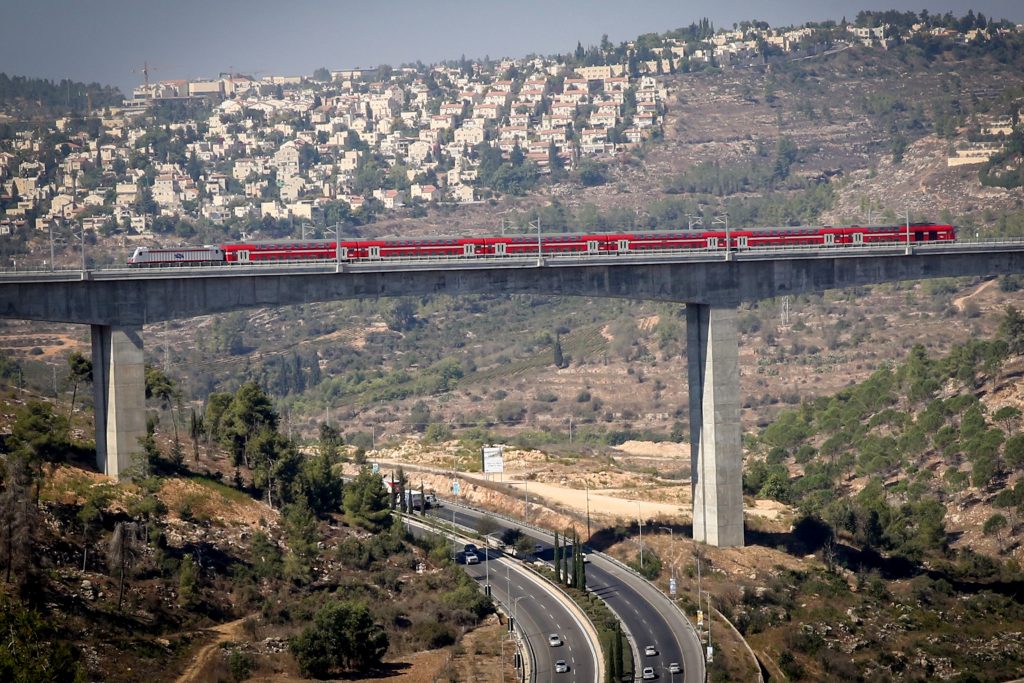
We were sitting on Amtrak Train No. 172 last Friday morning, Apr. 5, at the terminal in Newark, New Jersey, when a guy stood in the aisle with a phone in his hand and said, “There’s been an earthquake in New York City.”
We were heading to Connecticut for the weekend to see the grandchildren. We were not far from New York’s Grand Central Station. At that moment, if we were thinking about any disasters at all, it wasn’t an earthquake but the collapse of the Francis Scott Key Bridge back in Baltimore the week before.
The guy with the earthquake news was quickly backed up by another guy with a phone in his hand. But this guy said the quake was in New Jersey. And then seconds later came a conductor’s voice over the public address system.
“There’s been an earthquake,” he said, “and we have to wait here while they inspect a bridge up ahead to see if there’s been any damage before we can go across it.”
None of this sounded scary, even with the memory of the Key Bridge still fresh. It sounded preposterous. We hadn’t felt anything, hadn’t heard anything. We heard no audible reaction from any other passengers.
“’New Jersey: We Have Small Earthquakes,’” my wife said.
“That’s their state motto, isn’t it?” I said.
We were making jokes instead of allowing any panic to set in.
Then we started getting details from various news services.
They were calling it a 4.8 magnitude earthquake centered in northern New Jersey, about 45 miles from New York City, where residents were reporting shaking furniture and floors. Another report said some New York residents were running into the streets in fear. There were reports of shaking as far north as Maine and as far south as Norfolk, Virginia.
Later, when we got to Connecticut, we learned from our kids that their house had trembled, their kids felt it at school, and local middle school students were sent home.
As we sat there in the Newark terminal, wondering how long we’d have to wait before the bridge up ahead was deemed safe to traverse, here again was the voice of our conductor.
It was less than three minutes since he’d announced we’d be delayed until inspectors completed their examination of whatever bridge lay ahead.
Now he said they’d already finished their work, and we’d be leaving in a moment. But we’d proceed to New York at “restricted” speed.
In three minutes, they checked an entire bridge and said it was safe?
At roughly the same time this was going on, President Joe Biden was coming to Baltimore to visit the site of the Key Bridge remains. Biden said all the right things about the poor souls who lost their lives, about the need to restore the Port of Baltimore and all its jobs to full strength, and about Washington footing the bill to rebuild the bridge.
And so as our train slowly proceeded at its “restricted” crawl up the northeast corridor, we gazed out our window as we crossed each bridge along the way and noted the big distance to the waters below. We thought about that night on the Key Bridge and pondered the whims of fate.
Who could have imagined the wreckage of Baltimore’s bridge, and the loss of six men who presumed they would put in a tough night’s work but then return to the embrace of their families?
Who thinks about an East Coast earthquake that sends shudders across at least half a dozen states, but does no apparent major damage?
We can let ourselves be intimidated by life’s unanticipated moments and hide in our rooms for the rest of our lives or appreciate our luck of the day and give our grandchildren an extra-strength hug.
Which is what we did.
A former Baltimore Sun columnist and WJZ-TV commentator, Michael Olesker is the author of six books, including “Journeys to the Heart of Baltimore” (Johns Hopkins University Press) and “Michael Olesker’s Baltimore: If You Live Here, You’re Home” (Johns Hopkins University Press).

A former college campus activist, Veksler will speak at Chizuk Amuno on June 8 at the Ruth and Jay Lenrow Visiting Scholar-in-Residence for Combating Antisemitism.
A lifelong Baltimorean, Judge Rosenberg served as a U.S. magistrate judge from 1973 to 1998.
Michael Olesker pays tribute to WJZ’s retiring Marty Bass, a longtime fixture on local TV screens.