
“I scream, you scream, we all scream for ice cream!”–From a popular 1920s novelty tune
You could call it the official end of the “Velvet Era.”
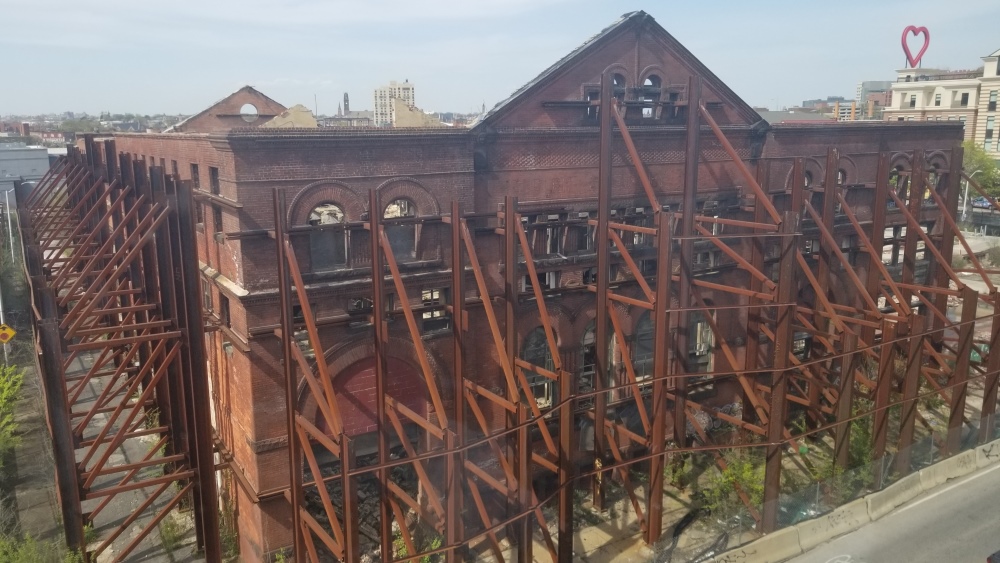
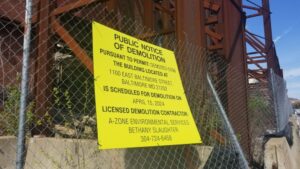
On Monday, Apr. 15, the demolition of the façade and skeletal remains of the old Hendler’s Creamery plant at 1100 E. Baltimore Street, near the Jewish Museum of Maryland campus, is scheduled to take place.
The planned razing will come after years of discussions and deliberations between local preservationists and Baltimore’s Commission for Historical and Architectural Preservation (CHAP).
But with or without the structure, memories of Hendler’s linger on in the hearts and minds of old-timers in the Jewish community and in the annals of ice cream lore.
Charm City has a noteworthy spot in the history of ice cream. In 1851, an enterprising Baltimore milkman and peddler named Jacob Fussell — a Quaker born in then-rural Harford County — opened an ice cream factory in southern Pennsylvania and transported his tasty products to Baltimore, thus becoming the first commercial ice cream distributor in the United States.
But when you really sink your teeth into the subject of Bawlmer and ice cream, you always have to talk about Hendler’s, a brand of the sweet stuff manufactured in East Baltimore for decades and beloved by generations of local dessert aficionados.
There was a time when Hendler’s was ubiquitous in Baltimore and throughout the region. “In the windows of drugstores, confectioneries, and groceries, and on the yellow trucks criss-crossing Baltimore, you saw it everywhere, the familiar trademarked Kewpie doll with a vague come-hither look, advertising ‘Hendler’s, the Velvet Kind,’” wrote the late Gilbert Sandler in his seminal work “Jewish Baltimore: A Family Album” (Johns Hopkins University Press).
The company’s roots date back to a Latvian Jewish immigrant named Isaac Hendler, who operated a dairy at several locations in East Baltimore. His forward-thinking son, Lionel Manuel Hendler, worked in his father’s dairy stores for years, and in 1905 started his own ice cream business at the age of 20.
Six years later, Hendler’s business was booming, and the company purchased the 59,340-square-foot East Baltimore Street facility – a former cable car powerhouse (and later a Yiddish teater, or theater) built in 1892 and designed by local architect Jackson C. Gott — for $40,000 and converted it into the nation’s first fully automated ice cream factory.
After that, Hendler’s became an industry and customer favorite, distributed in approximately 400 stores and maintaining a fleet of 120 delivery trucks during its peak years. Among the industry innovations undertaken by Hendler’s were new types of product packaging, a fast-freezing technique that provided a creamy texture to ice cream, and the creation of one of the first ice cream delivery systems via refrigerated trucks.
“The ice cream was virtually everywhere in Maryland,” the Maryland Historical Society (now known as the Maryland Center for History and Culture) posted in a 2013 blog titled “The Velvet Kind: The Sweet Story of Hendler’s Creamery.” “The factory ran six days a week with vanilla ice cream being made almost everyday. Vanilla, chocolate, and strawberry were production mainstays, but the creamery dabbled in more exotic flavors as well. Hutzler’s department store sold several varieties, including ginger and peppermint. For the Southern Hotel, Hendler’s supplied a tomato sorbet which was served as a side dish rather than dessert. The eggnog ice cream produced each year at Christmas time, which Hendler made with real rum, was a major hit.
“The factory also cranked out other holiday-themed products, such as an Independence Day treat made with vanilla, strawberry and blueberry ice creams, and a Mother’s Day cake topped with a silk screen of James McNeill Whistler’s portrait of his mother.”
As the business (and his bank account) grew exponentially, Manny Hendler moved to a grand mansion in the posh Eutaw Place neighborhood, and became a prominent philanthropist and captain of industry around town. He and his family belonged to the Suburban and Woodholme country clubs and summered at “Harlequin on the Severn,” their luxury, Victorian-style waterfront estate in Anne Arundel County.
“He held board positions in the secular and civic communities,” Sandler wrote, “the Red Cross, Boy Scouts, United Palestine Appeal, Associated Jewish Charities, Joint Distribution Committee, Association of Ice Cream Manufacturers and the Borden Company, which had owned the Hendler Creamery since 1929. And every Christmas season, Hendler’s received deserved recognition for donating ice cream to orphanages and hospital wards.”
But as the national ice cream industry exploded over the decades and competition became fiercer, Hendler’s began fading from the scene. Manny Hendler, who served as a Borden executive for years while managing his ice cream business here, retired in 1961 and died the following April at the age of 78. (In Reservoir Hill, a thoroughfare near Eutaw Place called Hendler Lane still pays tribute to the ice cream pioneer.)
The creamery closed in the early ’70s, officially becoming part of local nostalgia. Last May, CHAP approved the demolition of the remainder of the company’s imposing, three-story Richardsonian Romanesque building in East Baltimore, which was listed on the National Register of Historic Places in 2007. Plans are reportedly underway for the development of a community green space in that spot.
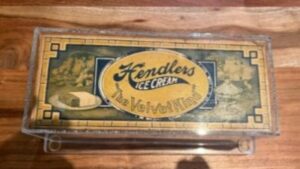
But in antiques and tchotchke shops around town and elsewhere (including several websites), you can still find signs, clocks and trinkets for “Hendler’s, the Velvet Kind” and almost taste those delicious flavors of silky-smooth ice cream.
“The name and the legend invite revisiting by those interested in the Hendler legacy – an extraordinary product created and marketed by an extraordinary man,” Sandler wrote. ‘’Hendler’ the man and ‘Hendler’ the ice cream are fused in the community psyche.”
A legacy that will never melt away.
Leslie Simmons, executive vice president and chief operating officer of LifeBridge Health, will serve as interim president of Sinai and Grace Medical while a national search is conducted for Shlossman’s successor.

Schwab currently serves as president of Cumberland's historic B'er Chayim Congregation.

On this episode of "The Food Enthusiast," Dara Bunjon talks with Lexx Mills, co-creator of Stursi, expertly crafted non-alcoholic cocktails.
A former U. S. Marine, Pat Young has served as a Baltimore County Council member representing District 1 since 2022.