
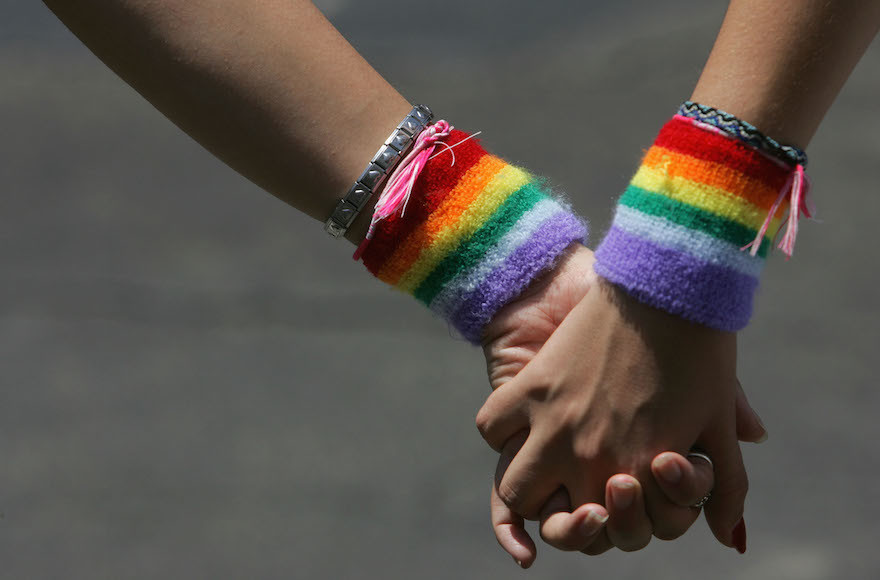
By Megan Brantley
I remember the panic setting in shortly after pressing the post button on Facebook in December of 2010: “Megan Brantley is gay: deal with it.”
I was 20 and already felt “late” in coming out, but I could not quiet the voices screaming in my heart and soul.
“What will they think?” and “They’re going to be disgusted” ran through my head. I remember late nights lying awake, begging and praying to be changed, to be “normal.” I kept refreshing my profile to see if anyone responded.
I was fortunate to have loving and affirming responses to coming out, and realize how lucky I was. This is not just a coming-out story: my Jewish identity and queer identity have been developing together for a long time.
I did not grow up immersed in the Jewish community. My Jewish journey has been an ongoing process of my own choosing from the time I was old enough to tell my mom I wanted to have a seder, to now at 33 — and yes, I still really love seders.
In 2022, I went on a Birthright trip with one of the last cohorts accepting 27–to-32-year-olds. Nervous about being accepted as an LGBTQ Jew on the trip, I wondered how others might feel sharing a room with me. Turns out, almost half of us were some color of the rainbow. Being around other LGBTQ Jews, in Israel, was healing and transformative. After I returned home, I started synagogue shopping.
I was nervous entering a religious space: worried if I would be welcome, I had zero intention of going back in the closet. From the moment I met them, Har Sinai-Oheb Shalom Congregation’s Rabbi Rachel Sabath Beit-Halachmi and Cantor Alexandra Marcus have embraced me as a Jew and a queer person. Their commitment to welcoming everyone, and their commitment to the Jewish People, all Jewish people, was why I joined.
There’s a difference between being tolerated and being embraced: Tolerance is a cold, awkward ride in an elevator with a stranger. Being embraced is the loving arms of someone who wants to celebrate you. “The entire world is a very narrow bridge,” notes Rabbi Nachman of Breslov.
In the Torah, the Israelites are called on to create a census and organize their tribes to prepare for battle. They are journeying from Egypt to safety, from enslavement to freedom.
This year, this feels particularly apt as an LGBTQ Jew. The world not only is a narrow bridge but is as if it’s a tightrope; like my tribes are being forcibly separated to prepare for battle against each other.
I’ve found exclusion from the queer community because of my unwillingness to condemn Israel for existing. I feel the fear from the Jewish community, wondering why on college campuses students who belong to Hillel are being barred from taking part in college LGBTQ life, or worse being bullied if not physically assaulted.
I feel the pain from LGBTQ Jews who’ve been told we’re abominations, a threat to society and the worst, child predators. That we are traitors and self-hating Jews for seeing the humanity of those in the margins of Jewish and Israeli society; and yes, this includes Palestinians.
In many Jewish spaces, I am too queer to be embraced, and in many LGBTQ spaces I am too Jewish, and yes, too Zionist: That our mere existence is “Pinkwashing,” or that we don’t exist at all.
I find this phenomenon in my current role in a Jewish nonprofit, knowing part of my community needs to be included, and another part of my community wants to prevent that inclusion. It’s painful to know there are those in the Jewish community that I love but who will not love me.
In Noam Sienna’s book “A Rainbow Thread: An Anthology of Queer Jewish Texts from the First Century to 1969,” they note, “Queer Jewish identity is so often imagined as existing in spite of — or in opposition to — the world of Jewish text and tradition.” Sienna argues studying Jewish texts from a queer lens is not meant to rewrite Jewish tradition, apply contemporary values and morals to ancient peoples, or even to pretend that Judaism has always been accepting of us. Instead, it makes the point that we were there.
When I think about the incredible lineages I come from, I am filled with what this month is about: Pride.
I think of my great-grandfather, who escaped Poland to the United States to have a better life where he could be free to be proudly Jewish. I think of my family that stayed in the east-central Polish town of Nowy Dwor and fought to the death in the resistance. I think of those I’ll never know, who hid and then went to Israel.
I think of 1969 and the Stonewall Inn, where trans women and lesbians, primarily Black and of color, decided to fight back: tired of abuse by the state for who they were and who they loved: without whom Pride would not be possible.
I think of my gay brothers, dying of AIDS with no help from their government, suffering active violence and hate. I think of my lesbian elders, the only ones willing to touch them: donating blood, feeding and caring for them.
Trans and nonbinary siblings, under attack for being who they are, bravely protesting and testifying to their communities and legislators that they deserve equality and affirming health care.
In the face of such hardship and pain, being an LGBTQ Jew is filled with joy and strength. We have created a beautiful tapestry of songs, sermons, Judaica and poetry celebrating our dynamic identities. We have created entire synagogues full of LGBTQ Jews and their beloveds.
It is no coincidence that Jews have been on the forefront of fighting for the rights of marginalized peoples, and it’s no surprise that LGBTQ Jews are overrepresented in these struggles.
I’ve learned that Judaism and the joy of being a queer person are not at odds: I can study Talmud and Torah with a unique lens, and I can educate the non-Jewish queer community about how Jews have been part of the struggle for our rights.
As a religious school teacher, my most desperate plea to my students is to embrace B’tselem Elohim, that all humans are created in the Divine Image of G-d, and Ahavat Yisrael, love all your fellow Jews.
Not just in June but every day, hear queer Jews and all queer people. Hear our pain and the ways we have lacked belonging in our communities, create spaces for us to be our authentic selves.
Feel not just the pain but also the joy, the love, the freedom and the Pride.

Megan Brantley is the director of community relations for the Baltimore Jewish Council. She has been a member of Har Sinai-Oheb Shalom Congregation since 2022. The column is an excerpt of a sermon she recently delivered at HSOSC in honor of LGBTQ Pride Month.
A Norfolk native, Frankle worked at Sinai Hospital, Camp Airy and privately for five decades.
Esther Greenberg, Leora Match, Kathlleen St. Villier Hill and Ben Gershowitz will be recognized for the contributions to the community.
For more than five decades, Dr. Rosenstein was known by local families as a trusted and caring physician for their children.
What does it mean to be fully present with each other and the sacred, asks Maryland-born cultural anthropologist Alanna E. Cooper.