
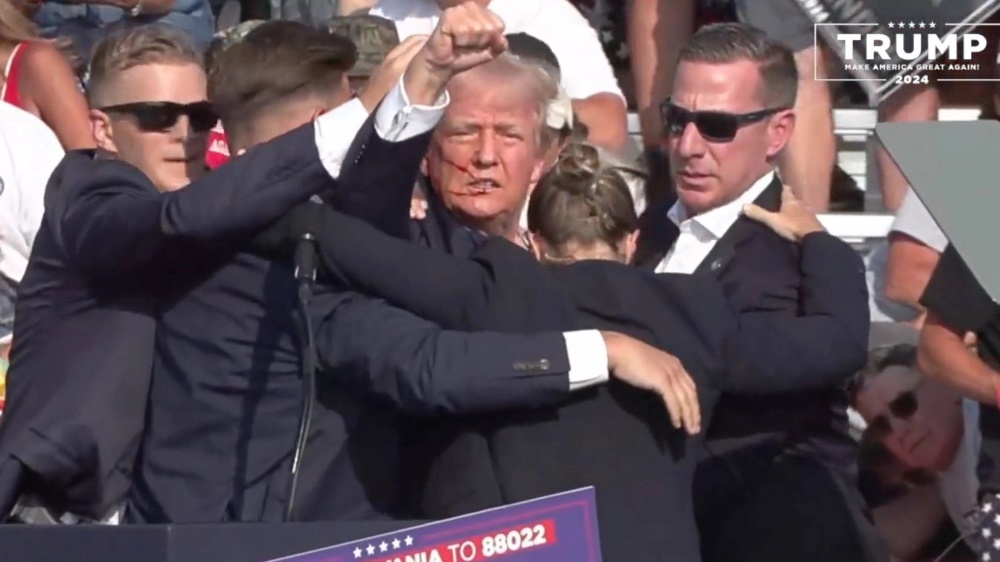
One-quarter inch to the left and Thomas Matthew Crooks’ bullet penetrates Donald Trump’s skull instead of his right ear, and America would be gathering this week at Arlington National Cemetery instead of a Republican convention in Milwaukee.
A quarter inch.
Instead, the former president, blood dripping down his face, defiantly thrusts his fist into the air at a political rally in Butler, Pennsylvania, and hollers, “Fight, fight, fight,” leaving us with a photographic image that will stay with us forever.
They’ll put it in the history books and the museums alongside the classic “The Spirit of ’76” Revolutionary War painting.
But the irony of the moment is staggering. Trump becomes the living, breathing martyr to America’s hair-trigger history of violence.
Yet he’s the man who inspired the violent Jan. 6 assault on Capitol Hill. He’s the one who wants looters and shoplifters to be shot. He’s the one who mocked the savage beating of Nancy Pelosi’s husband, Paul.
Trump’s the one who wants “retribution” for all those who have sinned against him. He’s the one warning there could be a “bloodbath” if he’s not victorious in November.
And now, by a distance of a quarter inch, he becomes America’s living martyr.
Meanwhile, in the aftermath of Saturday’s attempted assassination of the former president, the nation’s wise men and women on both sides of the political aisle leave us with their usual empty platitudes and hypocrisy.
Violence, they inform us, has no place in America. That’s the phrase they use, one after another, all those sanctimonious Republicans and nervous Democrats eager to assure us they take no joy in the attempted assassination.
“Violence has no place in America,” one national leader says.
“There is no place for this kind of violence in America,” says another.
“There is absolutely no place for this kind of violence in our democracy.”
“Violence has no place in America.”
And on and on.
They should read the New York Times report that the U.S. Capitol Police last year charted 8,008 threats against members of the U.S. Congress.
Have all of these political leaders been sleepwalking through history?
Violence is everyplace in America. In this hour of sadness and anger, enough with the platitudes. Tell us how you would limit the violence.
No place for it, indeed.
Have they not heard about schoolchildren, clothed in their innocence, gunned down in the middle of their classroom lessons?
Have they not heard about congregants at a Pittsburgh synagogue slaughtered in the midst of their prayers? Or the Charleston Church massacre in South Carolina?
Have they erased from memory the shooting of the Kennedy brothers and Martin Luther King Jr., of Malcolm X and Medgar Evers, of George Wallace and Ronald Reagan, of Gabrielle Giffords and Steve Scalise?
Have they forgotten the bitter congressional battles over high-powered weapons, just like the one aimed at Trump on Saturday night?
Have they forgotten how Trump and his own party have stood in the way of so much gun control legislation over so many years, and so many deaths?
And then, not to let an opportunity slip by without cashing in on the moment, we have Utah’s Republican Sen. Mike Lee and former National Security Advisor Robert O’Brien with some novel piece of chutzpah.
They’re calling on President Biden to “immediately order that all federal criminal charges against President Trump be dropped, and to ask the governors of New York and Georgia to do the same. Such a gesture would help heal wounds and allow all Americans to take a deep breath.”
No, it wouldn’t.
We’re relieved that the bullet intended to kill Donald Trump only wounded him. We learn, once more, that he’s the luckiest man alive. He survives gunshots, outlasts courtroom dates, runs for president while simultaneously running from the law.
But the violence goes on, doesn’t it.
It has no place in America, yet it’s everyplace in America.
A former Baltimore Sun columnist and WJZ-TV commentator, Michael Olesker is the author of six books, including “Journeys to the Heart of Baltimore” (Johns Hopkins University Press) and “Michael Olesker’s Baltimore: If You Live Here, You’re Home” (Johns Hopkins University).
Michael Olesker pays tribute to WJZ’s retiring Marty Bass, a longtime fixture on local TV screens.

The Orioles' weak defense plays a major role in the nightly carnage, writes Michael Olesker.

Jmore Publisher Scott Rifkin, M.D., reacts to President Donald Trump's latest poll numbers and the real force behind the growing decline of the Trump movement.

For 35 years, the late Deborah Brodie, aka Bubbie Cookie, amassed a collection of over 200 Jewish ritual objects, which she used to teach her Hebrew school students with special needs.