

By Jackie Hajdenberg
As the resident film impresario at the Marlene Meyerson Jewish Community Center in Manhattan, Isaac Zablocki specializes in screening movies that challenge, provoke and enlighten audiences.
When first hearing of the Israeli animated historical epic “Legend of Destruction” before it hit theaters in the summer of 2021, Zablocki knew he needed to screen it.
While many films screened by Zablocki revolve around current events, “Legend” was different. It retold one of the most well-worn ancient Jewish narratives, about the destruction of the Second Temple in Jerusalem in 70 C.E.
To Zablocki, it could not have felt more urgent. That feeling has only intensified in the wake of the Oct. 7 Hamas attacks in Israel.
“It was relevant before Oct. 7. It’s even more relevant now,” said Zablocki, director of the JCC’s Israel Film Center. “It’s really shocking how history repeats itself. … Has Oct. 7 made the Jewish community more unified? Has it created, actually, more division? And I see both.”
The film — about the intra-Jewish rifts that preceded the temple’s destruction — was acclaimed in Israel because it reflected the deepening social and political divides in 21st-century Jerusalem. “Legend” won four awards at the Ophir Awards, Israel’s version of the Oscars, and in the middle of a rowdy session in Israel’s parliament, then-Prime Minister Naftali Bennett exhorted lawmakers to see the movie to understand that polarization “is not the way.”
The movie came to the United States in English last year with a fresh celebrity voiceover cast and drew praise. But while social rifts are still festering, the movie has not found mass appeal stateside.
“Legend” has “struggled,” according to The Art Newspaper, which reported that the movie has barely been screened. “What has scared off audiences outside Israel and the international film industry is the war in Gaza.”
And that is exactly why Jewish institutions are lining up to screen the movie in the days surrounding Tisha B’Av, the fast day on Aug. 12-13 commemorating both temples’ destruction.
While the world of arts and culture has seen a growing aversion to Israeli works since Oct. 7, Jewish creatives feel “Legend” could not be more relevant in the midst of a war that has exacerbated fissures both in Israeli society and among American Jews. Add onto that a climate of rising antisemitism and a bitter presidential campaign nearing its final stretch.
“It’s … a metaphor for the state of democracies in general, and divisions, and the deep meaning of divisions, and the great danger that we are experiencing, I think, in the western world in general, or the democratic world,” said director Gidi Dar, known for helming 2004’s popular film “Ushpizin.” “It’s not even just western states which are falling apart from within. Many states, maybe even America.”
The movie employs an innovative medium, telling the story by switching between and panning across 1,500 still paintings composed on Photoshop. Drawing from biblical as well as contemporaneous sources such as the writings of Roman-Jewish historian Flavius Josephus, it portrays the rival Jewish groups whose infighting eased the Roman army’s way into Jerusalem ahead of the burning of the temple.
And it came with an impeccable pedigree. In addition to Dar, its lead artists previously worked on Oscar nominee “Waltz With Bashir,” and the voiceover cast was full of Israeli A-listers. When it came to the U.S. last year, it was voiced in English by a star cast including Oscar Isaac, Elliot Gould, Evangeline Lilly, Billy Zane and Marilu Henner, and drew comparisons to “Gladiator” and “Ben-Hur.”
The stars also touted its resonance with contemporary conflicts.
“It’s tragic, it’s really brutal and sad, but it’s true,” Lilly said in a promotional video. “It’s a very important cautionary tale today.” Isaac called it “terrifyingly relevant.”
But Dar, 59, framed the focus on Jewish audiences as a choice, not a last resort.
“After Oct. 7, things changed a lot, and I made a decision to start in a grassroots work in the Jewish world,” Dar said. “I feel the first thing is to go with my own people in the Jewish world, and later on to grow, because I do think that this film is relevant also, you know, in [a] more general perspective which is not only Jewish,” Dar said. “I think that the film is also addressing issues which are today super relevant in the status quo of democracy.”
Later, he said, he’d like to explore screening the film in more contentious locations, such as college campuses that experienced anti-Israel protests this year.
“What happens then?” he asked. “And [it] depends: to who do we screen it? I might even screen to the guys who are anti-Israeli. But to be honest, I can’t predict it. I hope something will happen. I hope they don’t ignore it.”
In the meantime, Zablocki hopes those who view the film at the JCC, Jewish and not, are able to internalize its warning.
“The Temple was destroyed for sinat chinam, for needless hate,” Zablocki said, citing an interpretation of the events of the period found in the Talmud. “And that hate that exists in the internal division, different groups in a world when we’re living now, in a world that is so polarized and there’s so much division to the Jewish community, within the American community, within the Israeli community, we know what that means, and it can only end in disaster.
“And that message, to bring that out through a dramatic tale is just something that is so necessary right now.”
Jackie Hajdenberg writes for the JTA global Jewish news source.

"A Beautiful Noise" chronicles the singer-songwriter's rise to musical icon.
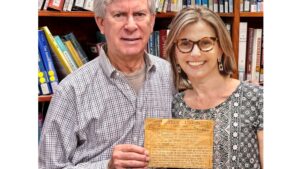
Duke Zimmerman and Lori Gale will talk at Towson University about their new book "People Get Ready" and the role played by Globe Posters in the civil rights movement.
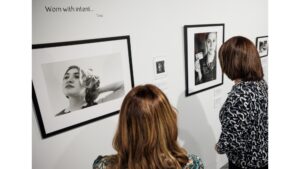
The new exhibition revisits and updates a previous show about ritual hair covering in the observant community.

The Pikesville resident's latest offering "There's a Dragon in the Tree House and He Won't Come out!" was co-written with her grandsons.