
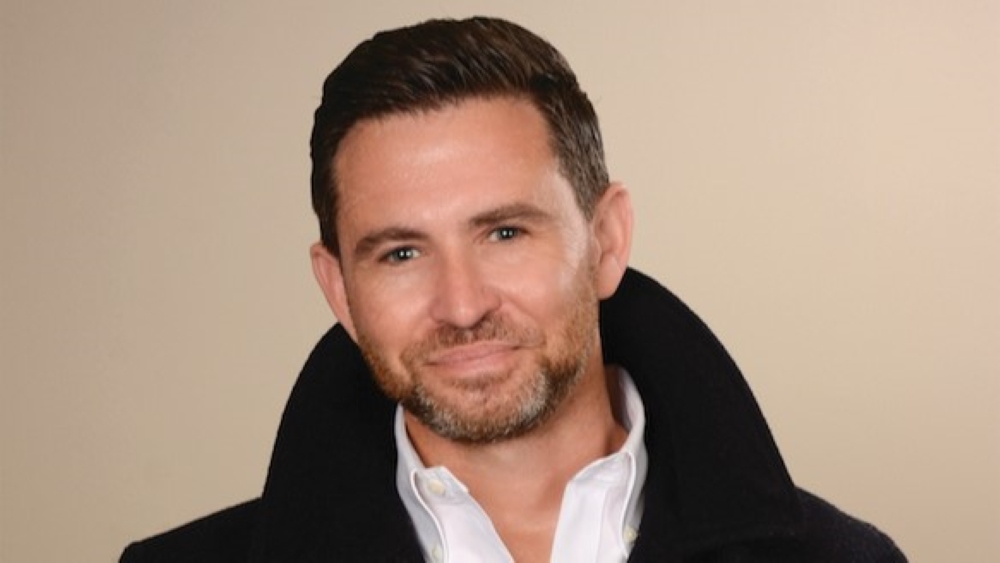
When people ask Richie Frieman how he comes up with ideas for writing, the 45-year-old author tells them, “Inspiration is everywhere.”
“My desktop is filled with a thousand stories that will never see the light of day,” says Frieman, an Owings Mills resident. “But some [ideas] hit harder.”
That’s what happened when Frieman came up with the idea for his eighth book (and first memoir), “The Optimistics” (Omnibus Publishing).
The Alzheimer’s Association Greater Maryland chapter recently held a book launch event for Frieman, whose book chronicles the special friendship between three men with younger onset dementia. Frieman will donate a portion of the proceeds from the book to an Alzheimer’s Association Greater Maryland chapter support group known as the Young-Onset Dementia Education & Support (YES!) program. He will also donate funds from his Longest Day Campaign to benefit the Alzheimer’s Association Greater Maryland.
Frieman was inspired to write “The Optimistics” in 2022 after he attended the Walk to End Alzheimer’s to support his best friend, Geoff, who had recently lost his father to Alzheimer’s.
At the Hunt Valley event, Frieman was surprised to see Geoff’s father’s medical provider, physician assistant Dennis Myers addressing the crowd from a podium.

“He was talking about how he has early onset dementia,” says Frieman, who was shocked to learn that approximately 5 % of people in their 40s and 50s are affected by the life-altering brain illness. “[Myers was speaking about how] he helped form a group called The Optimistics. It was basically him and two other guys around the same age that were all diagnosed [with dementia] in the same way. They created this group as a way to provide hope and positivity. They knew that there is not a cure, but you can either live your life in the darkness or you can try to find hope.”
From that day on, Frieman says he knew he had to write about The Optimistics. He reached out to Myers’ wife, Judi, asking to meet her husband and his friends. A meeting with the three men and their families took place, and Frieman expressed his desire to write about them. To his relief and delight, the families agreed to share their stories.
Frieman was also invited to observe the Alzheimer’s Association’s support group for families affected by younger onset dementia.
When he arrived for the support group meeting at Trinity Episcopal Church in Towson, Frieman found the group was much larger than he imagined. At that point, the project evolved to include not only stories of the original three “Optimistics” but those of many “Optimistics” and their caregivers. That first meeting was also the beginning of Frieman’s personal evolution.
“After the first support group, I went in my car, called my buddy Geoff, and cried my eyes out, because it was just a lot,” Frieman says. “I met people like me — my age — others that were older, my mom’s age. I told the guys I don’t want to let them down.”
As the project grew, Frieman enlisted the support of group facilitator Deborah Hanna and other Alzheimer’s Association Greater Maryland staff, including program director Ilene Rosenthal.
Rosenthal estimates YES now has about 40 members, including caregivers and adult children.
“The fact that so many people need this is troubling,” she says. “But we are certainly grateful that we have the ability to offer it to families. Nobody goes into [the group] happily. The three original Optimistics had to give up their jobs because they could no longer perform. They got this horrible, life-changing diagnosis and really were pessimistic going into the group. And then something magic happened. They met other people and bonded immediately, and their care partners bonded immediately.”
Frieman describes his memoir as “Tuesdays with Morrie” meets “Chicken Soup for the Soul.” Every chapter tells a different group member’s story.
“We talked about our different ideas of optimism and they were bluntly honest about it. There was no sugarcoating. … And yet, the people I met, they found a way. One woman I interviewed mentioned the trick she found was about finding little bits of light in every moment. I was very inspired by that.”
Frieman says finding a publisher for “The Optimistics” was challenging.
“I went to some I had relationships with and told them about the idea, but they said, ‘Look, it’s a really weird topic for people to talk about or read while they’re on the beach.’ Or they were very scared of the topic. I said, ‘No, no, this is a love story. This is about love between family members, from children to their parents. … This is a positive book.’”
Frieman was also concerned about the timing of the book’s release. Younger onset dementia is a progressive disease, and he wanted to make sure the book was published in time for most of his subjects to see it.
In the process of researching and writing “The Optimistics,” Frieman has become increasingly involved with the Alzheimer’s Association and the cause of younger onset dementia.
“My dedication to The Optimistics is more than this book,” he says. “This is almost like a life mission. … My goal is to be the largest single donor in the history of Alzheimer’s Association.”
For information, visit RichieFrieman.com or @RichieFrieman on Instagram. For information about younger onset dementia and Alzheimer’s disease, visit act.alz.org.
Duke Zimmerman and Lori Gale will talk at Towson University about their new book "People Get Ready" and the role played by Globe Posters in the civil rights movement.
The new exhibition revisits and updates a previous show about ritual hair covering in the observant community.

One of the most competitive local races for public office this political season is for Baltimore County Executive. Jmore recently spoke with four of the candidates about their views on how they hope to enhance life in the county.
The Pikesville resident's latest offering "There's a Dragon in the Tree House and He Won't Come out!" was co-written with her grandsons.