

Rabbi Eleazar ben Azariah taught, “If there is no flour, there is no Torah; if there is no Torah, there is no flour.” (Pirkei Avot 3:17)
This aphorism is sometimes taught on behalf of philanthropy: Learning cannot flourish without material support — and that’s true. But this summer, my appreciation for the relationship between physical and spiritual nourishment was enriched in the most unlikely of places.
In June, my family and I spent multiple days with a small Jewish community in eastern Uganda called Abayudaya. The community numbers approximately 2,000 and boasts 11 synagogues. The Abayudaya are desperately poor and survive mostly on subsistence farming, which means they eat what they grow and not much else.
Luckily, the hill country of Mbale is blessed with rich red soil. Nevertheless, Uganda’s level of food insecurity is ranked “serious” by the Global Food Index, and one in four children are stunted, suffering from impaired growth due to malnutrition.
I’ve known about this community for years, having overlapped with their spiritual leader, Rabbi Gershom Sizomu, at the Ziegler School of Rabbinic Studies. What I didn’t (could not) understand, however, until we spent the first of two Shabbats in Nabugoya Village, was just how much food and Torah learning are interrelated. At Beth Am, we pride ourselves on offering a full kiddush lunch each Saturday, but few of our congregants will lack basic sustenance if we don’t provide bagels, salads or kugel. In Mbale, the Jewish community depends on the Rabbi and synagogue to provide meals, some traveling many miles to spend the weekend learning and eating, eating and learning.
Friday night in the community’s central synagogue is a joyful affair. Young men hammer out Zulu rhythms on the djembe while Rabbi Gershom and his brother Seth strum guitars and women service-leaders coax the congregation along with Grammy-nominated tunes to ancient Hebrew prayers.
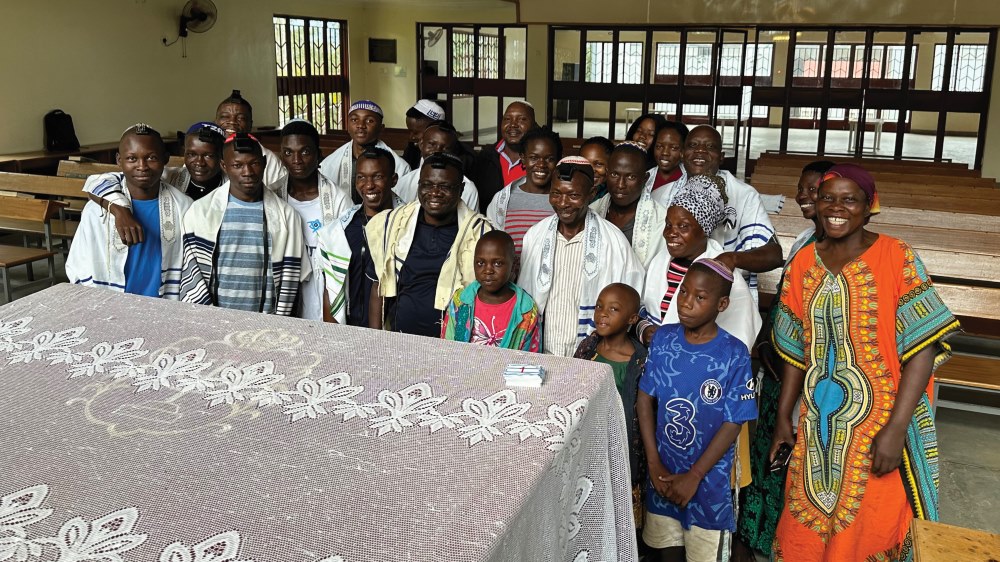
As visiting rabbis, my wife Miriam and I were asked to teach Torah whenever the opportunity presented itself, Kabbalat Shabbat being the first of numerous times we did so. After services, we made our way down the hill to the rabbi’s home where we dined with the community on rice, beans, savory plantains, periwinkle g-nuts sauce and small pieces of gamey chicken that had been ritually slaughtered earlier that day. After dinner, we thanked God for the bounty of our Shabbat meal.
Shabbat morning brought more music, prayers, learning and food. After services during which girls and boys, women and men, read Torah, we adjourned to the generous shade of two enormous mango trees. The Abayudaya peppered us with questions, about our sermons, about the Torah portion of the week, and with any Jewish query that was gnawing at them. We found their inquiries to be incisive and delightfully provocative — never shying away from life’s big challenges. Lunch was served (every meal was delicious and more or less the same). Children lined up for treats backward, so they were unable to game the system by running to the end of the line for seconds.
After a Shabbat nap, a smaller group reconvened for Talmud study. We passed around three tattered copies of the Vilna Shas, reading in the original Aramaic with Rabbi Gershom helping his flock to decode the language. Readers took turns by age, from eldest to youngest. The back and forth of ancient rabbinic debate stimulated further debate, until a treat of roasted g-nuts (a small version of peanuts, but more flavorful) was distributed along with refreshing watermelon juice. As the sun set and darkness descended, the assembled made their way to the rabbi’s house once more for Havdalah (Debbie Friedman’s melody!), followed by hours of waiting while a group of women lit the charcoal stoves at the outdoor kitchen and began to prepare our late supper.
Shabbat in Uganda was like nothing I’ve experienced. The davening and learning were rich and elevated by the palpable sense of gratitude felt by all for having enough nourishment to learn and learning that accentuated the sanctity of each meal. Baltimore has its share of poverty and real food insecurity — including in my own Reservoir Hill neighborhood. But it was watching my daughter prepare food with the women in a smoky mud-brick kitchen after Shabbat, my son (a vegetarian) observe with fascination the process of ritual kosher slaughter, that helped me appreciate how much I take for granted.
In Mbale, the Torah we learned was richer, sweeter, and more satisfying because we took none of it for granted. And the food we ate was made tastier and more fulfilling because the Torah we learned fed our minds, hearts, and spirit.
Gazing out at the Ugandan hills, I thought of how humanity began right there in East Africa hundreds of thousands of years ago. At some point, humans learned to harvest wheat and bake bread. Learning and flour are both elemental; they are the raw materials that make for human thriving. In Eastern Uganda my family discovered the best of that thriving among Jewish people!

Rabbi Daniel Cotzin Burg is spiritual leader of Beth Am Synagogue in Reservoir Hill. This column and others also can be found on his blog, The Urban Rabbi.

As he gets ready to leave for California, Rabbi Daniel Cotzin Burg looks back on his time in Baltimore and his 10 years writing for Jmore.


Michael Olesker pays tribute to WJZ’s retiring Marty Bass, a longtime fixture on local TV screens.

The Orioles' weak defense plays a major role in the nightly carnage, writes Michael Olesker.