

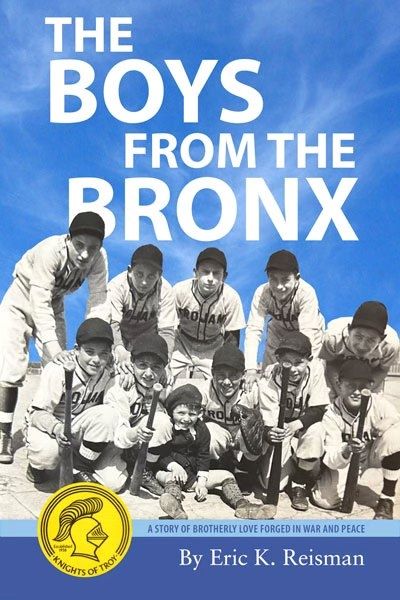
Pikesville resident Eric K. Reisman recently published “The Boys from the Bronx: A Story of Brotherly Love Forged in War and Peace.” The book is about his late father, author and educator Bernard Reisman, and several of his friends who started a sports club as 11-year-olds in the East Bronx in 1938. The boys cemented friendships that endured throughout their lives and, according to Reisman, shaped them as adults.
Jmore recently spoke with Reisman, a retired special educator who grew up in Newton, Massachusetts, about the book.
What compelled you to write this book?
I’d been thinking about my father. He had a Ph.D. from Brandeis and was founder of two major programs there: the Hornstein Jewish Professional Leadership Program and the Osher Lifelong Learning Institute at Brandeis.
He came from a huge family. His mother was one of 11, and his dad was one of eight. So he couldn’t walk out the door without bumping into and interacting with relatives and — without even realizing it, probably — negotiating all those family dynamics.
I’d heard all my life about this group of childhood friends [that] called themselves the Trojans. I realized those two groups — family and Trojans — were the basis of everything he would accomplish subsequently. That’s where he learned about groups and leadership and about loyalty.
Why’d you concentrate on the Trojans?
It seemed like the Trojans were unique, so that’s what I wanted to build the book around. About four years ago, my mom gave me a notebook full of letters from the ‘30s, ‘40s, ‘50s and beyond that my dad had kept — over 100 letters. And those letters illustrate the love these guys had for each other. They couldn’t say certain things, but they could write about them. One letter from the war said, ‘So much has happened. Maybe when we get back, we’ll talk about it over a keg of beer. Or maybe not.’ In fact, they never talked about it.
After the war, they split up and went their own ways, but the core group stayed friends throughout their lives. They had many reunions over the years. I interviewed several of them in 2004, and every man said how important the group was, that these guys were each other’s brothers.
How did you research the book?
I did some research about World War II, and a little booklet the group put out in 1987 for their 50th anniversary became a really important source for me. Mostly, it was from stories my dad told me, from the letters and those interviews I did in 2004. Two of the guys are still alive, both 96, and one of them still has an unbelievable memory and told me the addresses and even described the houses in the Bronx where several of them had lived.
What was process of writing the book?
A couple years after my dad died [in 2011], I blurted out at a yahrzeit gathering, ‘I’m going to write a book about my dad and how he built community.’ Then I thought to myself, ‘I must be crazy. I’m not a writer!’ I taught high school special education for 34 years and have had several other jobs around the edges, but until this book I’d never thought of myself as a writer.
But then in the summer of 2015, I tried to start writing things down. Writing it really was a labor of love, although the last six months the editing process was pretty painful. But I got a lot of positive feedback along the way from people who read parts of it. And I was so eager to get the book out. It was like waiting for a baby to be born.
Three people helped me edit it, including my wife who was born with a red pen in her hand. I knew she had to be the last person to look at it because she wouldn’t have been able to get through the first sentence without marking it all up.
Any frustrations along the way?
Only one of the Trojans, Howie Greenberg, died during the war, and my greatest frustration has been no matter how hard I’ve tried — do you have any idea how many Greenbergs are out there?! — I haven’t been able to track down any of Howie’s relatives. I would like so much to be able to share this story with them, one they probably know nothing about.
What did you learn from working on ‘Boys from the Bronx’?
As a result of thinking so much about my dad and the Trojans and their values, I started a program called ‘The Gentle Man’ to see how we can make it more attractive for guys to show their more compassionate side. Back when I was teaching, I had a group of students and we’d talk about what it was like to be a man — for example, how do you tell someone you love them without it being sexual? I’ve done some workshops around the subject, and we’ll just have to see where it goes.
Second, if you really want to write, you’ve got to be really passionate about it. It’s a lot of work, and you’d better really love it.
“The Boys from the Bronx” is available through Amazon and also at the Jewish Library of Baltimore, 5708 Park Heights Avenue, on the second floor of the Park Heights Jewish Community Center.
Jonathan Shorr is a local freelance writer.

One of the most competitive local races for public office this political season is for Baltimore County Executive. Jmore recently spoke with four of the candidates about their views on how they hope to enhance life in the county.
The Pikesville resident's latest offering "There's a Dragon in the Tree House and He Won't Come out!" was co-written with her grandsons.
A new biography captures the intensity and magic of the musical theater giant, writes Michael Olesker.
A native of Poland who lived in Baltimore since 2010, Pancerman passed away a day after her birthday.