

Right in time for the Chanukah season comes a new book by veteran journalist and author Peter Lovenheim addressing the issue of gratefulness in a unique way.
“Gift Shop of Gratitude: A Journal to Explore the Journey of Your Life” (G&D Media) suggests using such souvenirs and common items as key chains, T-shirts, stuffed animals, bobbleheads and refrigerator magnets to encourage readers to relive cherished memories and appreciate the gifts of life and love.
Lovenheim, who splits his time between Washington D.C., and Rochester, New York, recently spoke with Jmore about the book.
What inspired you to write this book?
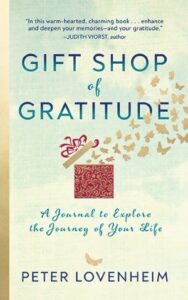
My wife recently retired. We started traveling more and I quickly found that pretty much wherever we went, whether we visited a museum or national park or a local zoo, we were required to exit through the gift shop.
At first this put me off, but then I started thinking about it. I turned to my wife and said, ‘You know, a gift shop could be a metaphor for all the good things, all the blessings we receive in life.’ You could see the individual items sold in gift shops — and they’re the same all over the world — symbolizing different specific things that we’re grateful for.
I wrote an article about it [in The Rochester Beacon] and had a very good response. Many readers said they would like to create their own gift shop of gratitude.
How does the book work?
The book is a journal filled with stories that prompt you to remember and write down the things in life you’re most grateful for. The prompts are stories about 20 specific items found in every gift shop in the world — from snow globes to T-shirts and tote bags — that help us remember the people, places and experiences that we most value.
I hope when people fill out the journal part of the book with their own specific expressions of gratitude, they will create a family keepsake, an heirloom for their children and grandchildren that says, ‘This is who I am. This is what I cherish.’
What did writing this book teach you about gratitude?
I don’t think gratitude comes naturally to human beings. It has to be learned and reinforced often.
A good example is in the Bible, in the story of Exodus. The Israelites are freed after 400 years of bondage in Egypt. What do they do? After just a couple of weeks in the desert, they’re complaining about the food and saying they want to go back. I think that’s why in Jewish liturgy, we say three times a day in the Modim prayer part of the Amidah, a prayer for thanksgiving, a prayer recounting our blessings. It’s probably why we have a whole national holiday just about thanksgiving. We need that reminder.
What else did you learn?
That it’s relatively easy to speak about gratitude broadly, but much more challenging to be specific about what we’re grateful for. At Thanksgiving, we typically invite guests to say what they’re thankful for. People speak in general terms — ‘I’m grateful for my health, I’m grateful for my family.’ But it’s much more difficult to remember and put into words specific things we’re grateful for.
There are a lot of studies showing that while cultivating a sense of gratitude is important as a countermeasure for stress and anxiety, the benefits are greater if we’re able to be more specific about what we’re grateful for. My book attempts to give people a way of remembering and writing down very specific things keyed to 20 gift shop items we’re grateful for.
Examples from your own life?
I just picked up this Abraham Lincoln bobblehead in Washington. I have a chapter on bobbleheads because every gift shop in the world seems to have them. We think of them typically as a cartoonish. But if you look at the history, they were developed over a thousand years ago in China and India, where they were called shaking head dolls and made to honor revered members of a community.
So in my chapter on bobbleheads, I suggest them as prompts to think about people who really helped us in life — for example, teachers and mentors. I mentioned my sixth grade teacher and an editor who really helped me get started as a writer.
I invite the reader to write down teachers and mentors they would like to honor with a bobblehead in their gift shop of gratitude.
I also have this spoon my wife picked up in Iceland. I have a chapter on souvenir spoons because every gift shop has them. And in my book, the spoons are used as prompts to remember memorable meals we’ve had and the people we shared them with. I have a chapter on t-shirts.
I use T-shirts as prompts to think about special experiences. I learned that according to a national survey, nine out of 10 Americans have a T-shirt that they cannot give away for sentimental reasons.
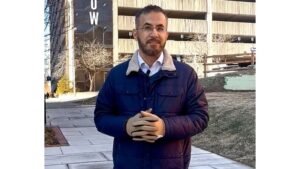
Mansoor Shams is known for carrying around a sign proclaiming, “I’m a Muslim and a U.S. Marine. Ask anything.” Now the Baltimore County Department of Recreation and Parks community engagement and outreach officer is running for Baltimore County Executive.
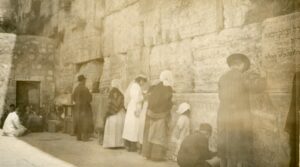
The Tower of David Jerusalem Museum is collecting photographs of the Western Wall ahead of an exhibition next year marking the 60th anniversary of the Six Day War.
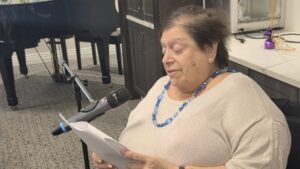
Baltimore native Susan Landsman recently celebrated her rite of passage surrounded by family, friends, fellow residents and staff.
Founded by Marci Yankelov, Julie Kichline, Elizabeth Miller and Lila Perilloux, the Bmore Community Fridge Network serves a crucial role in feeding the hungry.