
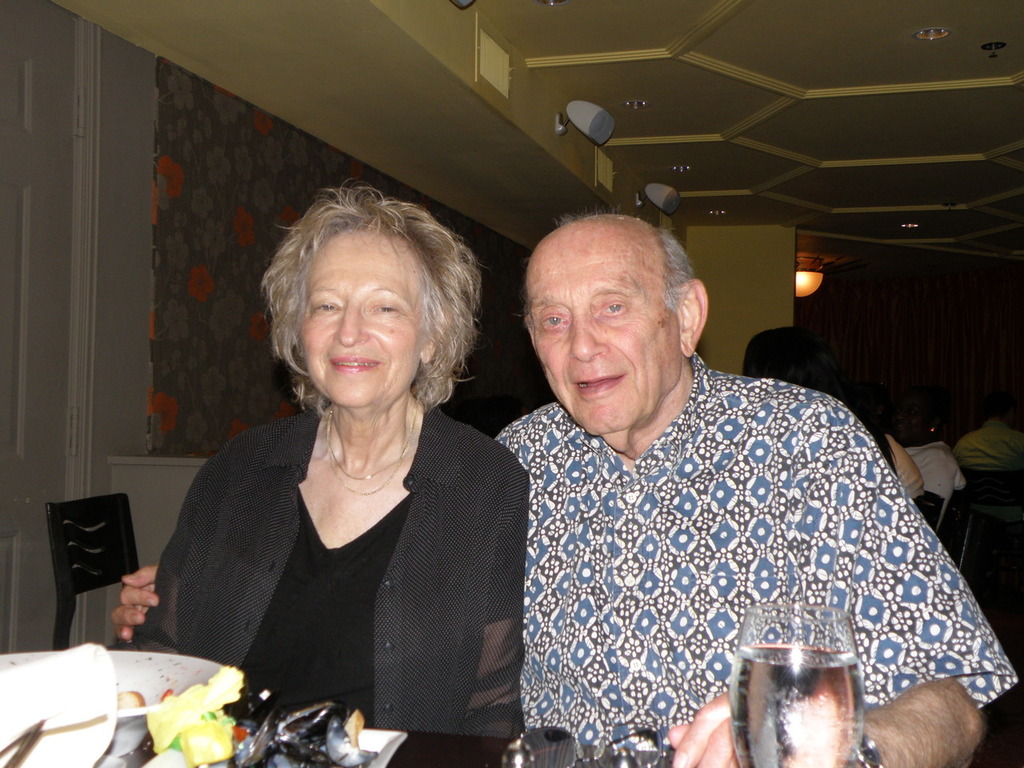
Helene Ageloff, a civil rights activist, social worker and longtime Baltimore area resident, passed away on Tuesday, Dec. 31. She was 89.
A native of Buffalo, New York, Ageloff was the daughter of Bernard and Elizabeth Berleant, and lived in that city for the first two decades of her life.
She attended the University of Buffalo, where she earned a bachelor of arts degree. She later earned a master’s degree in social work at the University of Maryland.
She and her first husband, Dick Wilson, divorced while she was in graduate school. In 1980, she married Lawrence J. Ageloff, a local civil rights activist who worked for the Social Security Administration. The Ageloffs lived in Towson. Larry Ageloff died in September of 2017.
Helene Ageloff worked as a psychiatric social worker specializing in geriatrics for the Baltimore County Department of Health.
She first became involved in social justice issues as an undergraduate student. In 1961, she traveled to Mississippi as a “Freedom Rider,” a civil rights activist who rode interstate buses into the American South to challenge racial segregation and Jim Crow laws.
She was arrested and imprisoned for six weeks at the notorious Parchman Farm, also known as the Mississippi State Penitentiary.
Ageloff was later part of the successful efforts to integrate Glen Echo Amusement Park in Montgomery County. Her efforts there were documented in Emmy Award-winning filmmaker Ilana Trachtman’s “Ain’t No Back to a Merry-Go-Round,” which made its world premiere in Baltimore last May at the 25th annual Maryland Film Festival.
The documentary chronicles the Glen Echo Amusement Park protests. In 1960, five Black students from Howard University sat on a carousel at Glen Echo, which was a whites-only recreation spot. The subsequent protests to desegregate Glen Echo largely consisted of Jewish activists, including Ageloff.
In her eulogy for Ageloff, Trachtman characterized her as “self-effacing, high-minded, appreciative, humble, sweet. … Helene was a reliable narrator, and a great storyteller — because not only did she remember what happened, but she also remembered how it felt.”
Trachtman called Ageloff “a heroic participant in the Civil Rights Movement, starting with early pickets in the late 1950s and through the Freedom Rides. Yet in the Freedom Rider halls of fame and reunions and interviews, she is obscure. People don’t know what she did, and she didn’t think she did much. I chose Helene as one of the key storytellers in the film for many reasons. But most of all, I wanted to hold up her example. When we learn about the Civil Rights Movement, or any movement in fact, we tend to only hear about the giants — the MLK and John Lewises, and if we’re Jewish we also learn about Rabbi Abraham Joshua Heshel’s involvement.
“But learning that the [movement] was fueled by a small army of Helenes — people who simply could not turn a blind eye while others suffered — that is inspiring. She is a wakeup call. I want her story to be a shofar for us — ringing out and saying, ‘If this lady who reminds you of your grandmother could stand up, what are you doing?'”
Throughout the years, Ageloff and her husband continued to be involved in civil rights and social justice issues.
In an interview featured in the Jewish Museum of Maryland’s Generations 2009-2010: 50th Anniversary Double Issue: The Search for Social Justice, Ageloff, the granddaughter of Jewish immigrants from Eastern Europe, said learning about the Holocaust was the catalyst for her interest in social justice causes.
“I grew up with those images [of the Holocaust] in my mind,” she said. “And when I was [at Parchman Farm], in my mind I related it to that. It was the same thing. There was the watchtower outside, you could see it through the high window in the cell, with guards and guns. I thought of people who had seen that same view in concentration camps. And people were being, for no reason at all, treated so badly.”
Ageloff said she was “traumatized for so many years” by her experiences as a civil rights activist. “But I feel blessed to have been in the period when something could be done,” she said. “You could do something that really helped the situation. … You can see that the children and grandchildren of the people who helped move this country forward have benefited.”
In their spare time, the Ageloffs enjoyed traveling and spending time with family. She also enjoyed painting figurative and floral subjects, and often exhibited locally.
Helene Ageloff is survived by her brother Arnold; her college friend and later sister-in-law Riva Schiller Berleant; her stepson Steve Ageloff, his wife Karen and their children Jacob, Roland, Joshua, and Alexandra; her close friend of many years Susan London Russell, her friends Marilyn Marcus and Ilana Trachtman; her nieces Anne Berleant and Chana Milman; her nephew Daniel Berleant and his wife, Chiou-Guey Liaw; many loving grandnieces and nephews, and by the staff at Cardinal Cove in Oakcrest Retirement Community.
Services were held Jan. 6 at Sol Levinson’s Chapel in Pikesville. Interment was at Beth El Memorial Park in Randallstown.
Contributions in her memory may be sent to Civil Rights Memorial Center, 400 Washington Avenue, Montgomery, Alabama 36104, or Hadassah, 40 Wall Street, New York, New York 10005, or to the charity of your choice.
“Ain’t No Back to a Merry-Go-Round” will be screened on Thursday, Jan. 16, at 7 p.m. at Third Space at Shaarei Tfiloh, 2001 Liberty Heights Avenue in Baltimore. Among the panelists after the screening will be Ilana Trachtman and Baltimore civil rights activist Rev. Al Hathaway. For information, visit thirdspacest.org/event/aint-no-back-to-the-merry-go-round/.

A former college campus activist, Veksler will speak at Chizuk Amuno on June 8 at the Ruth and Jay Lenrow Visiting Scholar-in-Residence for Combating Antisemitism.
A lifelong Baltimorean, Judge Rosenberg served as a U.S. magistrate judge from 1973 to 1998.
A former resident of Baltimore and central Florida, Ritt was active in the Soviet Jewry movement of the 1970s and 1980s.
For more than four decades, Goldman played a vital role in the supervision of elections in the city.