
By Rabbi Micah Streiffer
A religious leader rises before a head of state. Calmly, deliberately, they teach from their tradition, quote words of scripture, plead with the powerful man to govern with mercy. In so doing they implicitly call the powerful to task, criticizing them for past actions and current policies and challenging them to change.
They are rewarded with anger and a demand for apology.
This is a familiar scene. Such moments of priest-against-power dot the history of our society: Martin Luther King, Jr.; Abraham Joshua Heschel; Dietrich Bonhoeffer; even the biblical Moses — all stood before political leaders to demand justice and compassion.
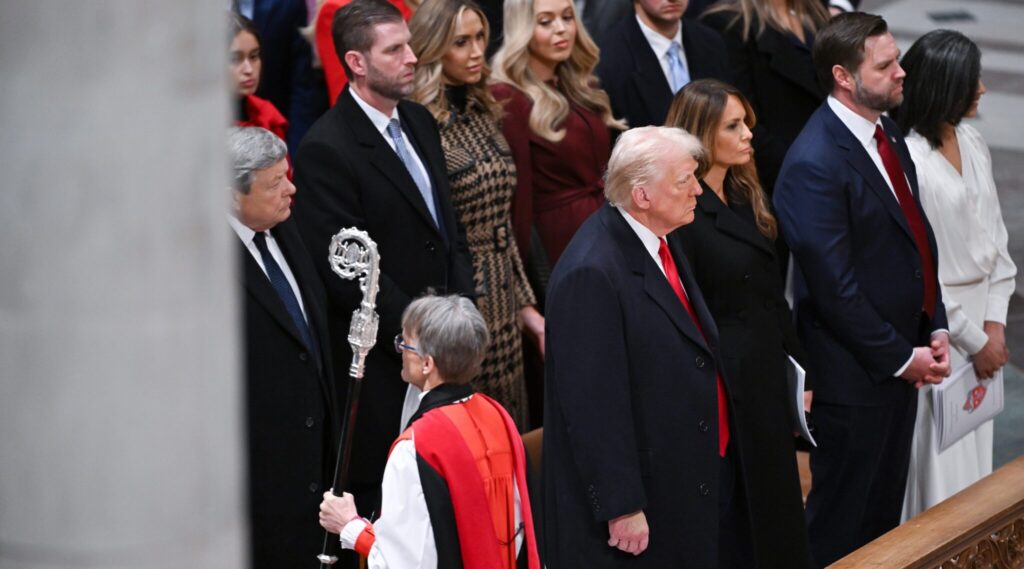
The scene played out again this week in the Inauguration Day sermon by Episcopal Bishop Mariann Edgar Budde and the angry response by President Trump. Speaking in the National Cathedral on Monday, Budde delivered a message in which she called for unity and warned the president against sowing seeds of division and fear. “Honoring the inherent dignity of every human being,” she said, “means refusing to mock, discount, or demonise those with whom we differ.”
Budde’s sermon ended with an explicit plea to the president to “have mercy on the people in our country who are scared,” members of the LGBTQ+ and immigrant communities who “fear for their lives” or “whose children fear their parents will be taken away.”
It seems to have been this last bit that raised the president’s ire. His response was to condemn and insult, taking to Truth Social to call Budde a “so-called Bishop” and a “Radical Left hard line Trump hater” who “brought her church into the World of politics in a very ungracious way” and demanding an apology.
Trumpian bluster aside, the kerfuffle raises anew an old question about what part religious leaders ought to play in the public sphere. Should priests and rabbis have something to say about policy? Is it the role of ministers and imams to speak on matters of politics and partisanship? Did Budde overstep her bounds, and does she owe an apology?
This is a question that has come up from time to time in my own rabbinate, and one that most of the clergy I know have had to contend with in one way or another. After all, our society is (at least theoretically) founded on a separation of religion and state, so shouldn’t religion stay out of state matters? Shouldn’t ministers and rabbis keep their mouths shut when it comes to social policy?
Here’s the thing: As a rabbi, I can tell you that speaking from a pulpit is an inherently political act, because it deals with social ethics. Unless you’re talking strictly about private ritual matters, giving a sermon necessarily involves encouraging people to confront their own behaviours and choices: how we treat others, how we use resources, how we care for our planet, the people on it, and the vulnerable in society. When people say their pastors and rabbis are getting “too political” it’s usually because they don’t like or agree with the message. That seems to be Trump’s problem with Bishop Budde’s remarks: She called him out on his behavior, and he doesn’t want to hear it.
Judaism has no expectation that religious leaders will stay away from talking about what is good for society. To the contrary, the Hebrew Bible institutionalizes this responsibility in the form of the prophet, who is a kind of social critic who reminds people of the gap between moral expectations and actual behaviors. Although we colloquially use the word prophet to refer to someone who can predict the future, the biblical prophet doesn’t predict anything.
Rather, he or she (they were mostly he in the Bible) presents a vision of a better society by commenting on the present state of society:
By speaking truth to power: “Hear me, you who devour the needy and annihilate the poor of the land!” (Amos 8:4).
By calling out rulers: “You have been haughty and said, ‘I am a god.’ But you are not a god; merely a human” (Ezekiel 28:2).
By demanding social justice: “Unlock fetters of wickedness; let the oppressed go free; share your bread with the hungry, and to take the poor refugee into your home” (Isaiah 58:6-7).
By teaching humility: “Do justice, love mercy, and walk humbly with your God” (Micah 6:8).
Most of all, the biblical prophet calls upon leaders and citizens alike to do exactly what Bishop Budde pleaded: to have mercy and compassion on the vulnerable.
I’m not suggesting here that Bishop Budde is actually a prophet. Nor am I suggesting that this is simple or that there are no lines to be crossed. Clergy ought not endorse specific candidates or tell people how to vote, and they need to be mindful of their power and use it wisely — to challenge and to ruffle, to support the vulnerable and advocate for basic humanity, not to coerce or control or to foment hatred and division.
In the end, religion is at its best when it serves to “comfort the afflicted and afflict the comfortable.” When it offers us a thoughtful, truthful critique of our actions, while reminding us that we still have both the ability and the responsibility to make the world a better place.
Rabbi Micah Streiffer s the founder and director of LAASOK, a center for progressive Jewish text study. He hosts the Seven Minute Torah podcast and speaks at synagogues across North America.

Jmore Publisher Scott Rifkin, M.D., reacts to President Donald Trump's latest poll numbers and the real force behind the growing decline of the Trump movement.

Last weekend's Flower Mart once again demonstrated that there's nothing to fear about downtown Baltimore, writes Michael Olesker.

A junior at Roland Park Country School, Katie Grossman writes about a recent experience that spurred her to take action to fight antisemitism.

At a time when many Jews fear appearing Jewish in public, seeing Judaism depicted correctly onscreen is reassuring, writes Jewish content creator Rabbi Yael Buechler.