
By Robyn Stevens Brody
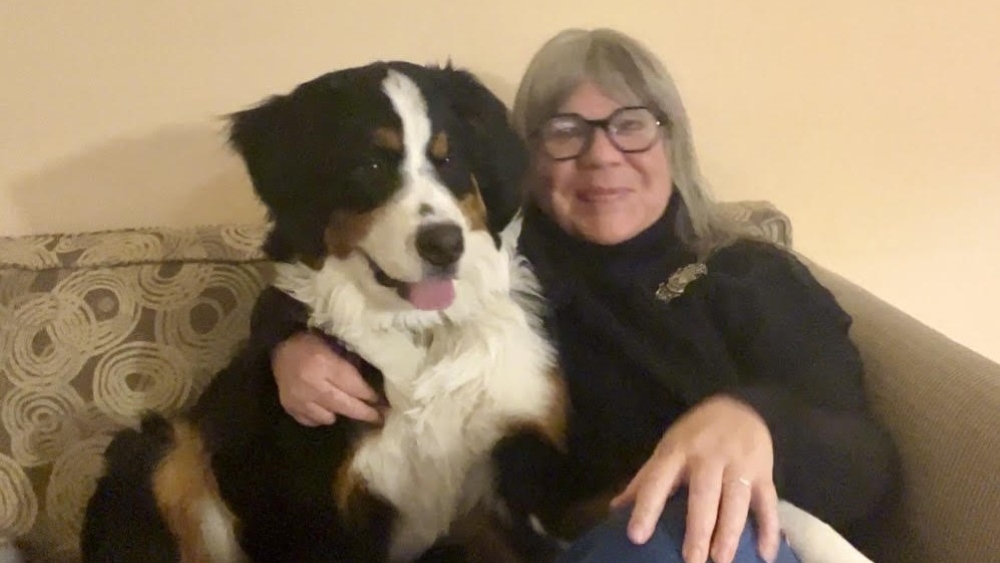
My dog Willow and I were recently hiking along a trail in the woods near our home when we noticed four young guys walking in our direction. I wasn’t too concerned about our safety since Willow is big.
These guys wore kippot (skullcaps), tzitzit (ritual fringes) and payes (sidelocks). One was twirling around a Seven Mile Market grocery bag.
“Where is a beautiful place with grass around here?” one of the men inquired. I responded, “Not here. It’s winter. Everything will look like what you see. It’s beautiful to some.”
At that point I thought we were all going in our separate ways, but one suddenly yelled, “We are from Brooklyn. We want to see beautiful flowers!”
Willow and I turned around on the path, and they did as well. Willow was a bit jumpy, and the boys seemed rather scared by my dog. I held her close.
I don’t recall why we all stopped, but I told them that Willow is a very friendly puppy. One young man asked if she wanted their food. “Probably,” I said, but I knew what she really wanted was their tzitzit. It could’ve been a disaster.
They told me they were just coming from Washington. They’d stopped by Seven Mile Market, our local kosher supermarket and the largest of its kind in the nation. Now, they said they just wanted to enjoy a little nature, and Google had sent them to Lake Roland.
They shared with me that they’d snuck out of their yeshiva because they wanted to experience some excitement in D.C. I inquired about the level of news that they generally hear at the yeshiva. They said they get all their news from “Yiddish radio.”
Two took calls on their flip phones. One held a coveted iPad. They rented it from a friend to “make pictures” and get Google. I mentioned that I am a photographer.
One apologized for his English. I asked where he was from. It turned out he was born in Brooklyn and they only speak Yiddish at school and home, with one hour of English lessons (if there’s time) each week.
I asked him, “So if you need to communicate in the larger world, outside of religious people, how does that work?” He told me that he manages to get by, but he can read English better than he speaks it.
I learned that these young men had never before spoken to a woman who was not a relative. And to boot, a Jewish woman who didn’t look much like the women they know.
“Go ahead,” I offered, “ask me anything. I doubt you will have an opportunity like this again when you sneak back into the yeshiva.”
One of them told me he is the grandson of Holocaust survivors. While in D.C., he and his friends went to the U.S. Holocaust Memorial Museum, and he discovered that his family is not represented in the archives. I told him that someone in his community can help them make a connection, that it’s important to register his family so their stories will live on.
Then, we got down to the nitty-gritty. Their questions included “Are you a real Jew?” “Do you know about Yom Kippur?” “What do you do for Passover?” “Have you ever really been to a seder?” “Do you know know what a siddur is?” “A Haggadah?” “How will your children know they are Jewish?” “Do they know what a mezuzah is?” “Is that your real hair?
To the last question, I responded, “Messy, but all mine.”
But I gently scolded them for asking if I was a ‘real’ Jew. “That is impolite,” I said. “Anyone who says they are Jewish is Jewish. It is not for you to decide if they are, as you say, ‘real.’ All Jews should support one another, especially with the rise of antisemitism.”
I brought up Columbia University. They were unfamiliar with this New York institution where antisemitism has been a serious problem on campus since the Oct. 7th Hamas attacks.
“We are ‘real’ enough for people in your community to take our money,” I said to them.
They wanted to know why so many people in the non-Orthodox Jewish community don’t like President Trump. I asked them why they do like him?
One of the young men said, “I heard he pardoned a Jewish person 20 years ago.” I asked how that would’ve even been possible since he wasn’t the president at that time.
After we all parted company, I wondered why these yeshiva boys happened upon Willow and myself on this trail on this particular March day, since I truly believe there are no accidents in life. Here I was with my “scary” dog and four boys who’d escaped their yeshiva with a rented iPad, and they found me for a Q&A session.
Chalk it up to bashert.
Robyn Stevens Brody is a native of Baltimore. She is a freelance photographer with a passion for documentary photography.

Jmore Publisher Scott Rifkin, M.D., reacts to President Donald Trump's latest poll numbers and the real force behind the growing decline of the Trump movement.
Last weekend's Flower Mart once again demonstrated that there's nothing to fear about downtown Baltimore, writes Michael Olesker.
A junior at Roland Park Country School, Katie Grossman writes about a recent experience that spurred her to take action to fight antisemitism.
At a time when many Jews fear appearing Jewish in public, seeing Judaism depicted correctly onscreen is reassuring, writes Jewish content creator Rabbi Yael Buechler.