
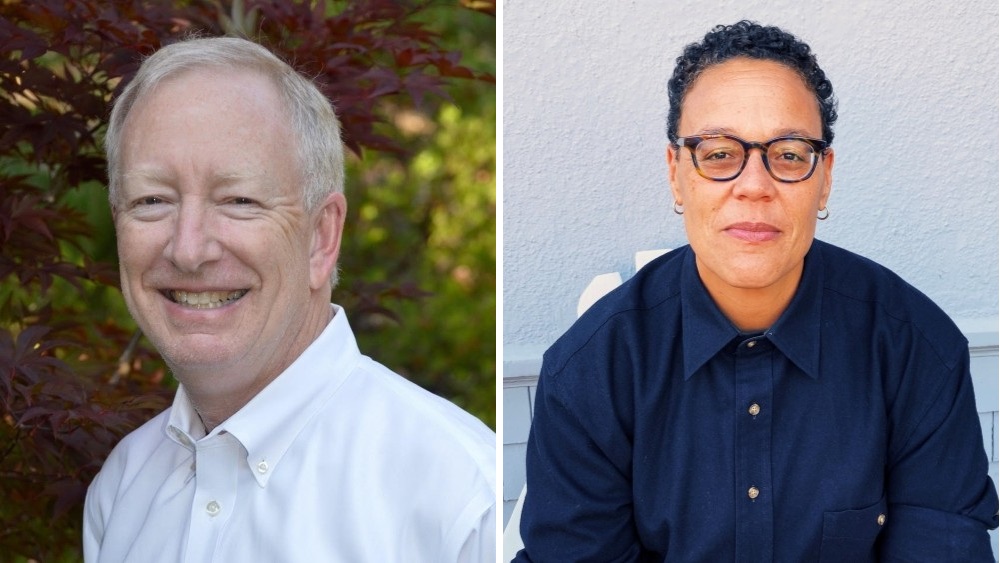
After being published in 2018, Marc Dollinger’s “Black Power, Jewish Politics: Reinventing the Alliance in the 1960s” (Brandeis University Press) sold out of four print runs — a rarity in the academic literary world.
The book — challenging long-held assumptions about the Black-Jewish alliance in the aftermath of World War II — was especially timely following the 2020 murder of George Floyd.
“A lot of white liberal Jews found [the book] and wanted to learn,” said Dollinger. “I did 130 Zoom classes on Jews and race and four lectures in 15 weeks.”
But then Dollinger shared his book with Ilana Kaufman, founder and CEO of the Jews of Color Initiative, and everything changed.
In honor of the 10th anniversary of Freddie Gray’s death while in Baltimore Police custody, Dollinger and Kaufman spoke Wednesday night, Apr. 9, at a discussion about Black-Jewish relations and civil rights. The gathering took place at Third Space at Shaarei Tfiloh, at 2001 Liberty Heights Avenue.
“I met Ilana for lunch,” recalled Dollinger, chair for Jewish Studies and Social Responsibility at San Francisco State University. “I’d given her the manuscript ahead of its publication, and I was fully expecting she would have loved it.”
Instead, Kaufman was deeply critical of the book.
“Marc was telling this story from the book about a group of white rabbis who are recreating the civil rights march [of 1965], carrying Torahs through the South,” Kaufman said. “And he’s talking about how wonderful this is. And I’m looking at him and asked, ‘Did you have any Black Jewish people on this march?’ And he looked at me like, ‘What are you talking about?’ I said, ‘Marc, how can you write a whole book about Black-Jewish politics but not have any Black Jewish people in the book?’”
Kaufman went on to suggest that Dollinger’s sense of white privilege precluded him from understanding the existence of Jews of color. She recommended that he revisit each chapter with an eye toward white privilege.
Dollinger was initially resistant, but he eventually admitted that Kaufman’s criticisms were well-grounded.
In preparation for the book’s fourth printing, he added a chapter titled “After Black Power” which defines and explores such topics as cultural appropriation, intersectionality and the Black Lives Matter movement.
In addition, he wrote a new preface about growing up white and Jewish in a liberal household in a San Francisco suburb. He also penned an epilogue alluding to his lunch with Kaufman and the revelations that came from the meeting.
The new preface acknowledged Jews of color and apologized for the text’s omission.
At first, the publisher’s feedback to the second edition was positive, Dollinger said. There was even talk about co-publishing part of it in the Los Angeles Review of Books.
“I was so excited,” Dollinger said. “But the next day, I got an email saying that an anonymous peer reviewer is so upset about two things in the new preface that they have already sent the book for its fourth printing without the new preface included.”
Dollinger said he learned that the publisher objected to his use of the phrase “white supremacy.”
“They didn’t like the fact that I was talking about Jews in the 1950s who moved into white suburbs because the antisemitic restrictions were removed,” he said. “But the anti-Black restrictions remained, which meant Jews were reinforcing the system of white supremacy in their lived experience.”
Dollinger said Brandeis University Press was also uncomfortable with his apology for “erasing Black Jews” from the book’s first edition.
Determined to get out his new preface to readers, Dollinger said he asked for permission to run the preface by five prominent Jewish academics, who all agreed with its content and contended he was being unfairly censored.
In response, Brandeis University Press wrote to state they were giving back the rights to his book, Dollinger said. After shopping the book around, Dollinger gave the rights to New York University Press. After consulting with his editor, he asked Kaufman to write the book’s afterward.
Kaufman’s afterward talked about growing up Black and Jewish in a Black urban neighborhood of San Francisco. Her family was active in a Reform synagogue, even though she was one of the only Black Jews in attendance and sometimes referred to by a Yiddish slur for Black people.
While rereading Dollinger’s book in preparation to write its afterward, Kaufman said she experienced a multitude of feelings, including “betrayal.”
“There’s this chapter in the first edition about the Soviet Jewry movement, and Marc is talking about how the Jewish movement to free Soviet Jews, the pedagogy of it, was designed or informed by the Black Power movement — all the strategies of ‘Let my People Go’ and Black Power protest,” Kaufman said.
“I remember marching from my synagogue through my Black neighborhood to the Soviet consulate with my ‘Let my People Go’ signs without me understanding that we were using the tools and the technology of my Black freedom movement,” she said. “What would it have done for me to know that that was actually all my story?”
For information, visit thirdspacest.org.

Stewart, a business attorney, believes trust and affordability are the county's biggest obstacles.

The County Councilman from the 2nd District feels that transit-oriented developments can help meet pressing priorities.
The gathering on June 4 will be part of activities and programming around the world marking "Holocaust Survivor Day."

'It's Classic!" featured rock climbing, food, live entertainment and more.