

By Gabe Friedman
“I’m preparing a tea so we can talk with leisure,” Sasson Gabay says over the phone from Israel.
The Israeli film and TV star wants to get comfortable so he can talk about one of his favorite characters from his 50-year career, Nuchem Shtisel.
If that surname sounds familiar, yes, it’s a character from the popular and internationally acclaimed series “Shtisel,” about an Israeli haredi Orthodox family.
Now, Gabay has reprised Nuchem for a prequel series titled “Kugel,” streaming in the United States exclusively on Izzy, a streaming platform for Israeli and Jewish content.
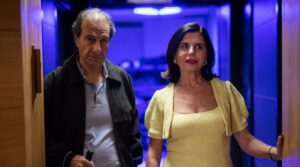
Yes, the new show’s title refers to the popular Ashkenazi noodle dish. The series follows Nuchem, who frequents a kugel shop in his native Antwerp years before the plot of “Shtisel,” as he and his daughter Libbi (Hadas Yaron) navigate familial and romantic struggles.
Nuchem’s heart is generally in the right place, but the curmudgeonly diamond dealer often finds himself at the center of financial shenanigans that threaten his place in his family and his community.
As complex as that character sounds, it didn’t take much convincing to get Gabay — who is also well known for starring in the Israeli film “The Band’s Visit” and the Tony-winning Broadway musical based on it — on board for the poignant and wryly humorous series.
Like “Shtisel,” “Kugel” was created by Israeli filmmaker Yehonatan Indursky.
“I loved [Indursky’s] writing. I loved his plot. I loved this poetic element in all his writing — wise, human and brilliant, in my opinion,” Gabay said.
Gabay, 77, recently spoke with the New York Jewish Week about “Kugel,” filming in the Belgian city of Antwerp, playing a religious Jew, and the state of the Israeli film and TV industry since the Hamas attacks of Oct. 7, 2023.
How did you react first approached about ‘Kugel’?
The love that we got [for ‘Shtisel’] from the audience in Israel and abroad was such a warm response so we just waited for it to continue, but Yehonatan Indursky didn’t write another season for us. In the back of my mind, I was sure that it was not a farewell to my character. And Dov Glickman, who plays [Nuchem’s older brother] Shulem, and myself were fantasizing of doing something together about it, but it didn’t happen.
Then after a while, Dikla [Barkai, producer of ‘Kugel’] came up with the idea. They discussed it with Indursky, the scriptwriter, and they came with the idea to me. And before I knew anything, I said immediately yes, because it’s going back to material that you trust and that you know.
How would you compare ‘Kugel” to ‘Shtisel’?
‘Shtisel’ is more … broad, with many layers, many characters, and each one has his own story. ‘Kugel’ is more concentrated, more limited to a few characters. So it’s more intimate, and maybe even more poetic, in my opinion.
What is it like to be a secular actor portraying a haredi character?
Not only am I not Orthodox, I’m not from this community. I’m from the Iraqi Jewish community, which has nothing to do with Yiddish.
I was born in Baghdad, came to Israel at three years old. I don’t remember anything, but Yiddish is really far away from the culture that I came from. But nevertheless, when you live in Israel, you are exposed to many cultures, many communities, many Jewish people who came from many countries.
My dad had a grocery in Haifa, and as kids we came to help him. And I remember over there … a lot of people who immigrated from many countries, from many backgrounds, from America, North Africa, Iraq, Poland. And among them were also ultra-religious Orthodox Jews. So I knew this kind of people. I knew how they behave, and I watched them. To sum it up, it wasn’t strange to me.
What was it like filming in Belgium as opposed to Israel?
When I was dressed as an Orthodox Jew, I was recognized by many people, many kids in the street, as my character from ‘Shtisel.’ In Antwerp, [haredi Jews] admit that they see TV. In Jerusalem, they don’t admit it.

In Antwerp, I felt at home, in the Jewish restaurant, in the main streets of the Jewish community in the city. We were accepted as something natural. For example, we shot in the rabbinical court, in the actual place.
The ultra-Orthodox Jews there are more relaxed, more open, more accepted. In Israel, we have a problem that the Orthodox, many of them, at least the people who go to yeshiva, don’t go to the army and many times they’re not working, just getting support from the government. So this is a political issue. But in Antwerp, the ultra-Orthodox are supporting themselves. They travel around the world more. They are more open, up to date, a part of modern society.
What is your hair and makeup process for your character?
I didn’t use a wig! But the [faux] beard and the payos, it’s a lot of work. The mustache was mine and we mingled it in. At the beginning it was a process of two hours every morning. And then you and the makeup artist get used to it, and we managed to do it in one hour, and later on less than that.
How has the post-Oct. 7th era affected the Israeli film and TV industry?
The industry is very prolific, and there’s a lot of productions. We have a problem with films becoming very hard to make because the subsidies are often declined and getting smaller.
We’ve experienced some less demand and interest from festivals abroad. Usually we had more interest in our materials, even though almost a year ago I was [at the Toronto International Film Festival] for the film “Bliss.” There’s a lot of Jewish festivals, Israeli festivals. Often when we are going to festivals, we experience demonstrations, and sometimes people try to shout during events, but we are used to it.
We’re living normally but at the same time living in an impossible situation, in war. So it’s kind of a paradox, a human laboratory that produces many stories, many visions. And I’m really, really glad to see a lot of artists, a lot of script writers and directors … who are doing things with TV [that are] really amazing compared to the financial possibilities.
This article was provided by the JTA global Jewish news source.
The BCO, founded in 1984, will perform the works of Frank Zappa, Beethoven, Mason Bates and Karena Ingram.
Led by local Israel-American cellist Amit Peled, the Mount Vernon Virtuosi aims to inspire people beyond musical enjoyment.

A former college campus activist, Veksler will speak at Chizuk Amuno on June 8 at the Ruth and Jay Lenrow Visiting Scholar-in-Residence for Combating Antisemitism.

Container vegetable gardening is a terrific option for people with limited space and/or time. Rebecca Brown and Norman Cohen share some tips.