

Baltimore has a reputation for being a quirky town, and there may be no better example of this than the annual Kinetic Sculpture Race, a program of the equally quirky and totally fabulous American Visionary Art Museum.
This year’s eight hour-long, 15-mile race will be held on Saturday, May 3, rain or shine.
For the uninitiated, a kinetic sculpture is an amphibious, human-powered artwork capable of maneuvering on pavement, mud and water. Sculptures are created by teams that work for months to develop vehicles both mobile and artistic.
Teams compete for wacky prizes such as the “Golden Dinosaur” (the first vehicle to break down or experience the most memorable malfunction); the “Golden Flipper” (the competitor with the most interesting water entry); the “Worst Honorable Mention” (the lowest award known to humanity); and the “Grand Mediocre Champion” (the sculpture that finishes right in the middle of the pack).
Rebecca Alban Hoffberger, the AVAM’s founder and artistic director, launched the race after meeting Hobart Brown, an artist who in 1969 started the first kinetic sculpture race in California.
This year, Baltimore’s race celebrates its 25th anniversary. Baltimore-born sculptor David Hess has participated in the annual event since the beginning.
In fact, before the museum’s opening in 1995, Hoffberger commissioned Hess to build the central staircase in the main building as well as the museum’s gates, railings and benches.
When the museum’s Jim Rouse Visionary Center opened in 2004, Hess built the bird’s nest balcony attached to the building. His sculpture, public art, architecture and furniture can be seen all over Maryland, including at Reservoir Hill’s Beth Am Synagogue where he built the balustrade in the congregation’s newest building.
Jmore recently spoke with Hess, who lives in the Baltimore County community of Phoenix, about the race.
How did you originally get involved with the race?
Rebecca Hoffberger reached out to some local people, including me, to help build a vehicle for the museum. At that time, I had a studio assistant named Colin Germain, and he was from Michigan and kind of a mechanical guy. A guy named Mark Ward, who was then the head of exhibits at AVAM, was also involved. We did a little bit of research about what had to be done to build a vehicle that was human-powered and could go in water and mud and maybe have a mechanical component, but more importantly an artistic sensibility.
What did you come up with?
The first year, an artist named Al Zaruba gave us a life-size dragon he had built out of plastic with some red fabric, and we used that as the art part [of the vehicle]. We made this vehicle that floated on some big pontoons, and we got a bunch of bicycles and welded them together. It was a four-person kinetic sculpture. As soon as it caught some wind, it took off down the harbor.
What were some of the other vehicles you’ve created?
The next year, I took my son, who was turning 5, to the event. He had just learned how to ride a two-wheeler, His training wheels were off and we did the kinetic sculpture race together as father and son but without a vehicle, just on bicycles with costumes.
We took it more seriously when he was 6, and we built a rocket that went in the water. The following year, we built this huge, labrador retriever named after our black lab Louie. We did that with a friend of mine who’s a sculptor named Karl Saar, who’s in Baltimore.
The year Eli turned 8, we had a little mishap in the water and the vehicle almost capsized. My wife kind of snatched Eli off the dock before he fell into the water. She was pretty mad at me because she was thinking he might get hurt.
The following year we built what we have now, which is called the Platypus.
What is the Platypus?
The Platypus is built using parts from a Suzuki Samurai truck. We took off the axles and the transmission and one seat out of it, and then we got eight bicycles and geared them all together.
A guy I worked with who was one of my studio assistants that year — Jason Bennett — did a ton of work on the mechanical side of this. For the subsequent 20 years, we’ve always called it the Platypus and frequently we have an actual platypus on the top of the vehicle or inside it.
But it’s also taken on other entities. One year, it was a giant shark. Each year there’s a theme to the race, so each year our vehicle sort of changes its costume. One year, the creature was dismantled because it was really in bad shape from hitting trees and dry-rotted. So for about five years, we lost the Platypus and were a submarine sandwich.
The Platypus name is an acronym and stands for the ‘Personal Long Range All Terrain Yacht Proven Unsafe.’ Now it’s made out of brown fur, which gets wet when it rains because it usually does rain on the event. This new Platypus has arms that move mechanically so we can pose them in different positions like an action figure, a G.I. Joe or a Barbie.
How do you feel about the race turning 25?
It’s kind of a strange realization how long I’ve been doing it, and how my family has gotten involved and stayed involved. Twenty-five years is such a long time, but it’s gone by so quickly. It’s such a huge part of so many people’s lives. We jokingly say it’s the best day of the year.
There are 25 people on our team. There are only nine people on the vehicle — one driver and eight pedaling. Then, there are all these other folks riding along in the pit crew, helping make costumes and getting the vehicle ready. There are a couple of other metal workers in our crew. And then, it’s kind of a random assortment of people. We’ve got a psychiatrist, two architects, a photographer, an exhibit designer, a graphic designer, an engineer, a nurse and a painter.
This race is a gift. Rebecca’s a gift. I’m inspired by the museum. They’re working hard to do a capital campaign. It would be really nice to see more support from the community. The museum’s not political or religious. This is a time when we just need to put our differences aside and just celebrate what people can do.
For information about the race, visit kineticbaltimore.com. For information about David Hess, visit davidhess.net.
The BCO, founded in 1984, will perform the works of Frank Zappa, Beethoven, Mason Bates and Karena Ingram.

For more than 130 years, Sol Levinson & Bros. has been woven into the fabric of Baltimore’s Jewish community.
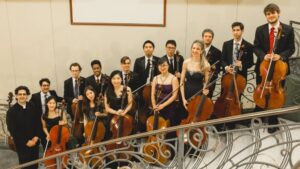
Led by local Israel-American cellist Amit Peled, the Mount Vernon Virtuosi aims to inspire people beyond musical enjoyment.
A former college campus activist, Veksler will speak at Chizuk Amuno on June 8 at the Ruth and Jay Lenrow Visiting Scholar-in-Residence for Combating Antisemitism.