
By Dr. Jay Himmelstein
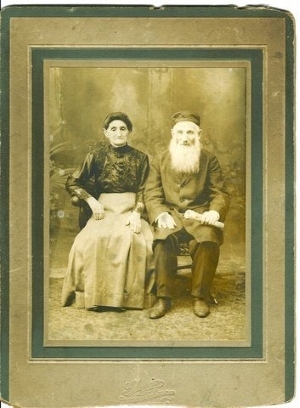
1905, Kyiv, Ukraine: My grandmother, Reba, crouches beneath the kitchen floorboards, pressed against her mother and infant brother as footsteps echo above.
A pogrom is sweeping through Kyiv. Just two years earlier, at five years old, Reba had watched Tsar Nicholas II parade through the streets on his magnificent white horse.
But now, her innocence has given way to terror. She and her family know what is at stake after hearing of six murdered cousins in the Kishinev pogroms.
For generations, my Jewish Ukrainian family has endured cycles of persecution and upheaval—pogroms under the Tsars, two world wars, the Holocaust, and forced emigration. The terror that forced my grandmother into hiding in 1905 is just one chapter in a long, painful story of fight, flight, and survival. And now, as Russia’s invasion of Ukraine rekindles old wounds, my family’s story feels more relevant than ever.

My grandmother had little formal education but was sharp, curious, and blessed with an incredible memory, and a gift for storytelling.
Her parents, Paul Fader (Federofsky) and Risza (Rose) Distoyator arrived in 1905 and settled in Baltimore. Reba married Jacob Cooper (Kupsov), also born in Ukraine, and together they ran Cooper’s Restaurant on Pimlico Avenue in Baltimore, which opened as a neighborhood confectionery-grocery store in 1932.
In the 1980s, as my interest in genealogy grew, I recorded Reba’s recollections. During one session in 1988, on her 90th birthday, she recounted the thrill of seeing the Tsar, the terror of hiding during the pogroms, and stories of relatives—some who escaped to the U.S., while others remained in the old country.
She also mentioned her first cousin, Sarah Distoyator. Reba had recently learned that Cousin Sarah had survived both world wars and the Holocaust and lived in Moscow.
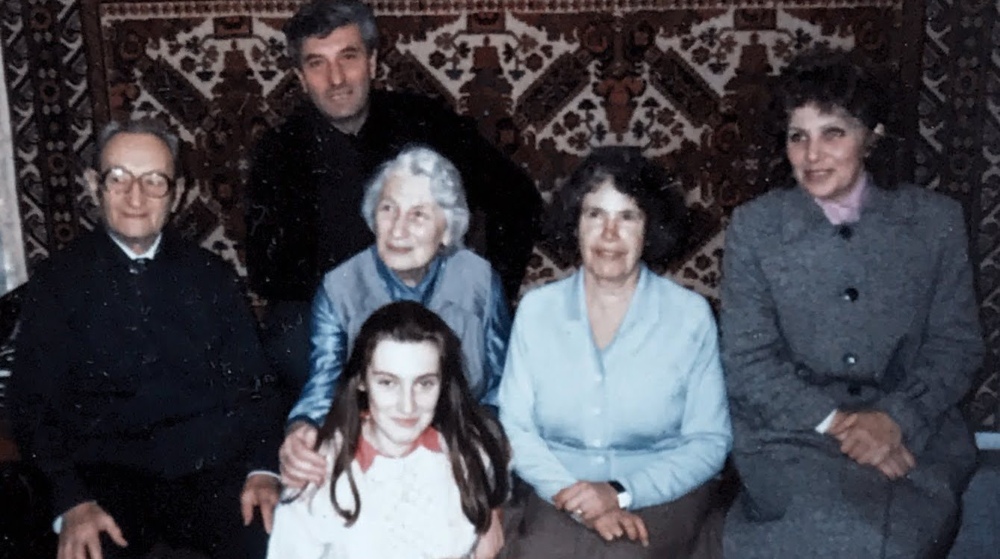
1990, Moscow: A conference in Finland allowed me to visit the USSR as it teetered on the edge of collapse. A Russian-speaking colleague called Sarah Distoyator’s Moscow apartment, and they told me I could visit the following Sunday.
Not knowing what to expect, I arrived to find Sarah’s son, Ura and her 16-year-old granddaughter, Anna, waiting for me at the airport.
Sitting in Sarah’s small apartment, sharing a Sunday meal with her and Anna’s family, I felt like I had stepped into another world. Sarah spoke no English, so we relied on Anna’s high school English, my broken German, and Sarah’s Yiddish. I learned that Sarah’s family had remained in Ukraine but had lost touch with their American cousins before World War I…until now.
The meal—borscht, smoked fish, and sour cream—felt familiar, reminiscent of my grandmother’s cooking. At one point, Sarah began to cry, overcome with emotion as she recalled her childhood relationship with my grandmother.
I suggested we call Reba, but my cousins looked at me as if I was insane. In the waning days of the Soviet empire, making an international call required days of planning.
2022, Ukraine: When Russia invaded Ukraine, I thought about Kyiv and the war-torn regions tied to my family’s history. Around this time, distant relatives contacted me through Ancestry.com. Five of us—genetic cousins and descendants of Moshe Distoyator (1788-1855)—gathered virtually to piece together our shared history.
One cousin, David Goldman, emigrated from Ukraine to the U.S. in 1988. His family had survived WWII and the Ukrainian holocaust by escaping to Kazakhstan. Fluent in Russian and Ukrainian, he accessed 19th-century Ukrainian census records to verify our family tree and ancestral towns.
Ukrainian Jews in western regions suffered fates similar to Polish Jews, perishing in the Holocaust. Those in central and eastern Ukraine had a narrow window to flee.
Like many Soviet Jews, David’s family was able to emigrate to the US in the late 1980’s following trade agreements between President Reagan and Mikhail Gorbachev. In the U.S., he was surprised to discover surviving Distoyator relatives.
His experience mirrored my own — most American relatives assumed their Ukrainian family had perished.
2025, Worcester, Massachusetts: My Distoyator family’s journey seems to mirror cycles of history — falling empires, persecution, survival. Under czarist rule, Jewish communities faced pogroms, like the ones my grandmother endured. Those who remained in Ukraine survived Stalin’s Great Purge, the Nazi invasion, and post-WWII Soviet oppression.
Our family history is a microcosm of Jewish resilience, a testament to the ways history has scattered, tested and, in some cases, reunited us.
My grandmother’s family successfully escaped the pogroms of the Russian empire. Cousin Sarah’s family dodged WWI by relocating to Moscow; the surviving cousins I met there emigrated to Israel in the 1990s. Cousin David’s family, who survived WWII and the mass shootings of Jews in Ukraine, came to the U.S. in the late 1980s.
Russia’s invasion of Ukraine in 2022 brought destruction to places tied to my family’s past. Kyiv and the surrounding villages became battle zones. The invasion echoed past aggressions forcing another generation of Ukrainians, including Jews, to flee.
Ukraine’s resistance—led by a democratically elected president of Jewish ancestry, Volodymyr Zelenskyy—has defied what many believed was possible. Ukrainians have shown incredible courage and have rallied much of the world to their cause of freedom, self-determination, and resistance to tyranny.
But now, at a critical moment, the United States risks abandoning Ukraine. Aligning with Putin—the architect of repression and war—Donald Trump has turned his back on Zelenskyy, the Ukrainian people, and the cause of democracy.
I think of my grandmother—seven years old, trembling beneath the floorboards, her mother’s hand gripping hers. The terror she felt then mirrors what countless Ukrainian families endure today, as missiles fall and history repeats itself with brutal clarity.
I am sickened by what this abandonment means for those fighting to survive. But we are not powerless.
We can bear witness. We can raise our voices. We can donate. We can stand with Ukraine.
The world has seen this pattern before. We know where silence leads.
This time, let’s choose to act.
A Baltimore native, Dr. Jay Himmelstein lives in Worcester, Massachusetts. He is a professor emeritus in the Department of Population and Quantitative Health Sciences at the University of Massachusetts Chan Medical School. He can be reached at jay.himmelstein@gmail.com.
As he gets ready to leave for California, Rabbi Daniel Cotzin Burg looks back on his time in Baltimore and his 10 years writing for Jmore.

Michael Olesker pays tribute to WJZ’s retiring Marty Bass, a longtime fixture on local TV screens.
The Orioles' weak defense plays a major role in the nightly carnage, writes Michael Olesker.