
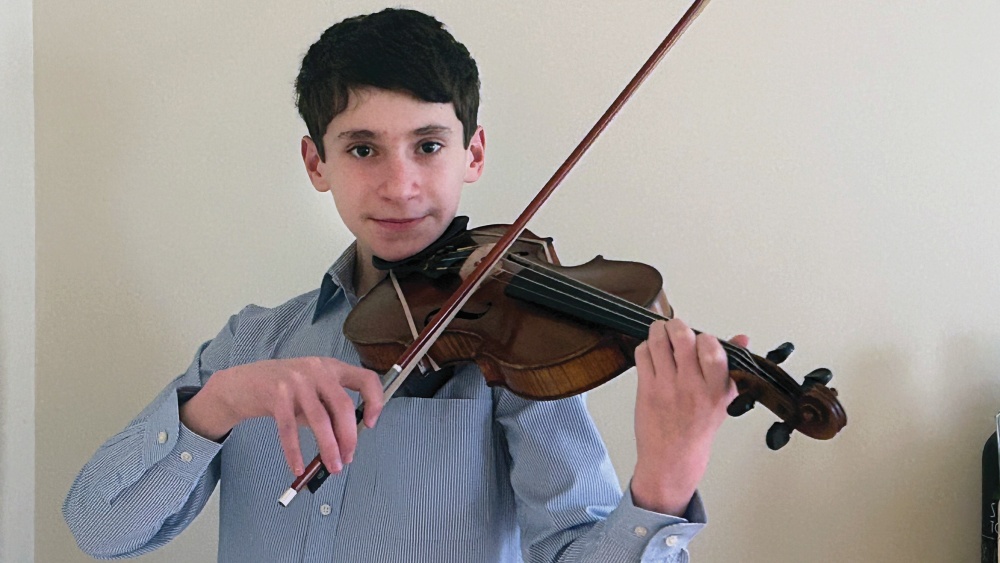
You might say bar mitzvah-to-be Micah Seliger is a triple threat.
His mitzvah project, a requirement for his rite of passage at Columbia’s Beth Shalom Congregation this summer, has three different components — each substantial in their own right.
The idea for his project came to Micah, a violinist, while attending one of the Baltimore Symphony Orchestra’s “Recovered Voices” concerts. The concerts were part of a series orchestrated by conductor James Conlon, who sought to amplify “suppressed music” by Jewish composers silenced during the Holocaust.
“I really liked the piece he conducted with the BSO, and I wanted to know more about suppressed music,” says Micah, a seventh grade student.
While visiting his grandparents in Vermont, Micah met a Julliard School graduate student writing his thesis on suppressed music.
“He told me a little bit about his thesis, and it kind of clicked that I’d like to do this for my bar mitzvah project,” Micah said. “It would be a great way to bring attention to the music and really explore my passion of classical music in an interesting way.”
Once the decision was reached, Micah — whose late paternal grandfather was a Holocaust survivor — brought his idea to his school orchestra conductor at Columbia’s Bonnie Branch Middle School and to Dr. Daniel Levitov, conductor of the Peabody Young Artists Orchestra. (Micah is a member of YAO.)
Both conductors agreed to include suppressed music in their spring concerts.
The Bonnie Branch Middle School Chamber Orchestra performed “Despair,” a piece of vocal music sung in the Warsaw Ghetto and arranged by Micah, on May 22. The YAO performed “Wiegala” by Ilse Weber and “Praeludium” by Viktor Kohn, both suppressed composers, at the Johns Hopkins Peabody Institute on May 4.
Last Saturday, May 31, the YAO performed works by Arnold Schoenberg, whose career was also impacted by the Holocaust, at Shriver Hall on the Johns Hopkins University Homewood campus. The concert was free and open to the public.
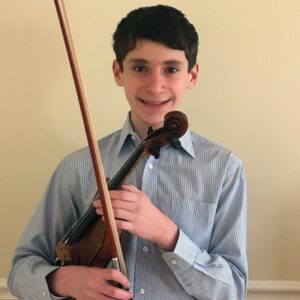
“Micah is both a dedicated musician and thoughtful individual,” says Dr. Levitov. “Both the subject matter of this project and Micah’s approach to it show his maturity and attention to precise detail. Micah came to me with this proposal a year ago, and that kind of advance planning allowed us the time to collaborate, and for me to build a complete concert program that supports Micah’s vision.”
Dr. Levitov says that Micah is an unusual student.
“As an orchestra director, I occasionally have students come to me with suggestions for music they would like to perform,” he says. “Never have I had a student to come to me with such a meaningful project as this one. It is a great pleasure to work with Micah to present this important music.”
In addition to initiating concerts of suppressed music, Micah has learned a violin sonata by suppressed composer Bob Hanf.
“Hanf was an up-and-coming Dutch Jewish composer at the time of the Holocaust,” says Micah, who performed the sonata at a school concert in January. “He really wasn’t able to become famous because he was killed during the Holocaust and then silenced by the Nazis.”
Micah will present three encores of the sonata piece at his synagogue’s talent show this Sunday, June 8, and then at his congregation’s Shabbat services on Friday, June 13, the night before his bar mitzvah.
But that’s not all. Micah is raising money to purchase volumes of scores published by Forbidden Music Regained, a Dutch organization devoted to reclaiming suppressed music. Once obtained, he plans to donate these volumes to the Peabody’s Arthur Friedheim Library.
Each volume costs about $750 and Micah is hoping to purchase at least two of them. So far, he has raised enough money to purchase one by encouraging his bar mitzvah guests to donate to a GoFundMe page.
Micah’s research revealed that locating scores and ensemble parts of suppressed music is extremely difficult. Donating the scores to Peabody will make them available not only to music students and faculty but through inter-library loan throughout the United States.
Despite his enthusiasm for music, Micah says he has his sights set on becoming a baseball analyst. He’s also a big football fan.
“Sports and music are my passions,” he says.
Leslie Simmons, executive vice president and chief operating officer of LifeBridge Health, will serve as interim president of Sinai and Grace Medical while a national search is conducted for Shlossman’s successor.
Schwab currently serves as president of Cumberland's historic B'er Chayim Congregation.
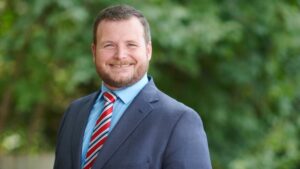
A former U. S. Marine, Pat Young has served as a Baltimore County Council member representing District 1 since 2022.
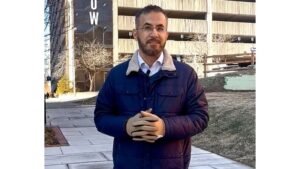
Mansoor Shams is known for carrying around a sign proclaiming, “I’m a Muslim and a U.S. Marine. Ask anything.” Now the Baltimore County Department of Recreation and Parks community engagement and outreach officer is running for Baltimore County Executive.