

Grammy Award-nominee Jerry Portnoy credits a rabbi for uncovering his talent for replicating the intricate riffs and solos of a revered blues harmonica virtuoso.
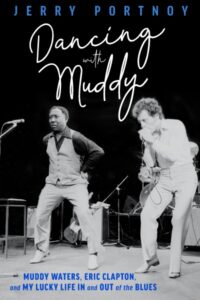
In his memoir “Dancing with Muddy: Muddy Waters, Eric Clapton, and My Lucky Life In and Out of the Blues” (Chicago Review Press), Portnoy describes “religiously” skipping Hebrew school amid parental concerns about his ability to chant the Haftarah at his bar mitzvah. A local rabbi was summoned who brought over an audio recording of the Torah portion.
“It was great ear training and would serve me well years later when I’d use the same methodology to decipher Little Walter records,” Portnoy writes. “The rabbi was surprised and my parents were delighted when I pulled it off without a hitch.”
Now 81 and a grandfather of five (with another grandchild on the way), Portnoy eventually took over Little Walter Jacobs’ coveted spot in Muddy Waters’ beloved Chicago blues band.
He also performed and recorded with Clapton, Lightnin’ Hopkins, Bo Diddley, Buddy Guy, Willie Dixon and the Rolling Stones over the course of his career. In addition, Portnoy has performed at the White House, Carnegie Hall, London’s Royal Albert Hall and Radio City Music Hall.
Jmore recently caught up with Portnoy, a Chicago area native who now lives in Dennis, Massachusetts, to talk about his new memoir and his life in and out of music.
Why did you decide to write this memoir now?
I wrote the early part of the book at first and then ran out of steam. I wanted to write about the area and time I grew up [in Chicago in the late 1940s and early ‘50s]. It was a magical scene for a kid, with my dad’s store [Max Portnoy & Son, King of Carpets] on Maxwell Street.
So in September of 2021, I showed what I had to my friend [bestselling author and journalist] Robert Sabbag and he said, ‘The writing is so great. You’ve got to get this published.’ That put the fire under me. So I went into the mancave of my house downstairs and wrote the rest of it.
Were you aware that you have a knack for writing?
They say to be a good writer, you have to be a good reader, and I’ve read a lot of great writers. Also, being a musician helps because you watch the flow of words and rhythms of language.
Obviously, you have a very good memory.
I didn’t really have any problems writing the book until I got to the era that I played with the Muddy Waters Band. For some reason, I struggled at that point. But the Rosetta Stone for me was finding online a [touring] itinerary of Muddy’s career and I scrolled to when I started with him in 1974, and I remembered where certain things happened. That really triggered things and unlocked the stories.
What kind of reaction are you getting to the book?
So far, I’ve been receiving a lot of good responses from readers. In many ways, the accolades [to the book] have been more meaningful to me than that to my music. I’m very proud of this book.
Who’s your target audience?
Thousands of books come out every week, and people today don’t read as much. We all do our reading these days on our iPhones. But I’m hoping to appeal to everyone, not just the blues reader but also the casual reader. That’s why I wrote about growing up in Chicago and my family, and being in San Francisco during the ‘Summer of Love’ and traveling through Europe. I would like to get a general readership.
In some ways, couldn’t you be viewed as the ‘Zelig of the blues’?
[Laughs] Timing is everything, man. Look, I had the chops and was ready for the gigs. But I was lucky to be in the right place at the right time, and you can’t beat lucky. I feel very blessed. I’ve had a very fortunate life. Everyone has a gift, but you have to be fortunate to discover it. In my case, it was all by accident.
In the book, you write about highly personal stuff, including about your father’s personal and professional trials and tribulations and your parents’ divorce. Was that painful to revisit?
It was sad to see what happened to my dad. He was an extraordinary guy with a heart of gold who helped a lot of people. Fate didn’t work out for him. But I had no trouble telling his story.
When you write the story of your life, it rekindles certain experiences. It was an emotional experience to write the book but when I read it later, that’s when I choked up.
You also wrote with a lot of candor about the dissolution of the Muddy Waters Band?
The breakup of that band was a topic of rumor and innuendo for 40 years. I was the only one who really knew the true story. It was quite a time. I stood up for the band, and in return they later stood up for me.

We all revered Muddy and ultimately it was a result that no one wanted, including Muddy. But at one point, there was no going back, so we went off on our own.
But playing with him was the pivotal moment of my life. Muddy gave me a life.
And Clapton?
I’m very grateful to Eric, too. He saved my life in many ways, and it was a great gig to play with him. I enjoyed it immensely.
But at the same time, it was more of a business kind of thing. Eric was a bit emotionally remote. It was a different kind of gang and gig. But it was a great time in my life, and I loved it.
Do you listen to a lot of the albums you’ve played on?
Not really. I’d rather have a cheese grater up and down my arm than listen to myself play. I’m a perfectionist, so when I listen to myself, I think, ‘Why didn’t you zig there instead of zag?’
I am quite proud of [Clapton’s 1994 blockbuster blues album] ‘From The Cradle.’ I’m all over that. I enjoyed [his own solo album] ‘Down in the Mood Room,’ which was more eclectic. Recording [the 1978 album] ‘I’m Ready’ with Muddy was a lot of fun. I played with [blues harp legend] Big Walter [Horton] on one of those sessions, and that was great.
Were you always a blues maven?
I always loved music, but I generally listened to what other people listened to at that time. I didn’t really know anything about the blues until I listened to [the landmark album] ‘The Blues of Sonny Boy Williamson.’ That hit me so hard. It changed everything for me.
Maybe it reawakened some childhood memories of hearing the blues played on Maxwell Street. It really turned my life around and was all I cared about going forward.
Did being Jewish inform your passion for the blues?
Ray Charles once said, ‘If a white man ever could ever really play the blues, it would be a Jew.’ There have been a lot of great Jewish blues musicians – Mike Bloomfield, Barry Goldberg, Harvey Mandel, Bob Margolin, Paul Oscher, Rick Estrin.
But I don’t think being Jewish ever played a part for me. Being white played a small part, though I never had any problems from my fellow musicians or at any of the Black clubs I played. I was completely accepted because I could play. The danger was on the streets outside those clubs, on the south and west sides of Chicago.
How do you view the state of the blues today?
The blues will never die. There is something about the music that when properly played is just so powerful. There are a lot of great young musicians coming up today – Mack McDonald, Jontavious Willis, blues harp player Andrew Alli. It’s become world music and is listened to in countries where there are no cultural relations to the blues.
I was very fortunate because I got to meet and play and party with some of the originators, the people who set the template. Today’s young players just didn’t have that opportunity. But the blues aren’t going away. It will always have a coterie of followers.

Your future plans?
In November, I’ll be playing at the Lucerne Blues Festival in Switzerland, and I have a killer band. But I don’t really play out much anymore – just the big gigs that I can’t refuse.
The harmonica is sometimes called “the Rodney Dangerfield of musical instruments.” What’s your take on its appeal among some people and disdain among others?
The harmonica has incredible tonal capabilities. That’s what makes it such an unusual instrument. It’s the only instrument that you breathe music into. You can make it sing or talk or bark. It’s got its quirks. The most important thing is to get a good sound coming out of your instrument.
Do you play or practice in your spare time?
I don’t really play the harp around the house. I’m really a band player. I like to have a bass line under me and a vocal. I like playing with real musicians.
I practice for a few minutes every day, just so the [throat] muscles don’t atrophy. But you can’t do at 80 what you did at 50. Still, I’ll be woodshedding before Lucerne so I’ll be in good shape.
What kind of music do you listen to in your private hours?
I don’t listen to that much music these days. When I do, I go back to the stuff I love – T-Bone Walker, Elmore James, Muddy, Howlin’ Wolf, Little Walter. They all set the template. Little Walter was the originator of the blues harp. It’s hard to beat him, although [blues singer and harmonica player] Kim Wilson comes pretty close.
Your “Blues Harmonica Masterclass” CD, which came out in the late ’90s, was popular among harp novices, students and enthusiasts. Is it still a big seller?
I lived on [the sales of] that for many years. It was the Rolls-Royce of harmonica instruction. But now with the internet, the resources today are so much more widespread and richer. There’s a lot out there. But people can always contact me if they want to buy a copy. I still have some around my house.
Did you write “Dancing With Muddy” as a legacy project for your family?
That wasn’t the motivating reason, but I’m glad I did it. It’s a great gift for them. Twenty years from now, this book will be there to tell them my story and about my family. I’m very glad I wrote it. It will be a valuable resource for them.
Do any of your grandchildren play the harmonica?
[Laughs] No, I wouldn’t wish that on them.
For information, visit jerryportnoy.com/dancing-with-muddy.

The Jerusalem Orchestra East & West, which arranged the program for young musicians, blends Western orchestral music with Middle Eastern traditions.

Pikesville resident and entrepreneur Luna Rosendorff discusses what she's seeing these days in the world of contemporary interior design.

Jewish Community Services' upcoming "Future-Ready Workplace" event will feature a keynote address from workplace expert and bestselling author Liz Fosslien.

The BCO, founded in 1984, will perform the works of Frank Zappa, Beethoven, Mason Bates and Karena Ingram.