
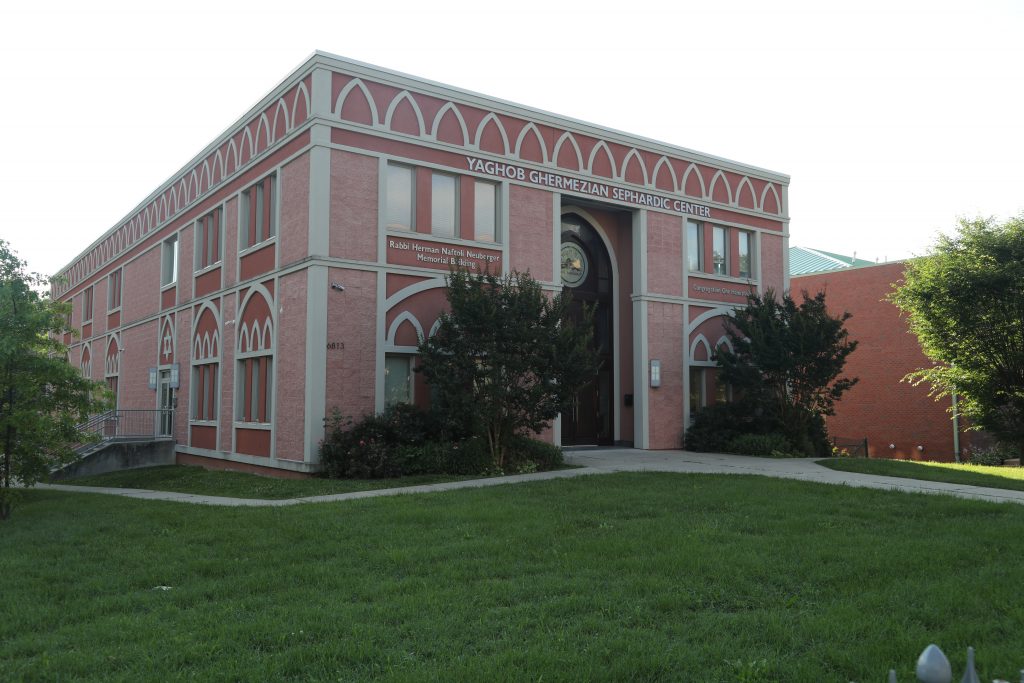
The other day, I was at a stoplight at the corner of Park Heights Avenue and Fallstaff Road, just lost in my thoughts, when I gazed over at the palatial façade of Ohr Hamizrach Congregation.
Ohr Hamizrach (Hebrew for “Light of the East”) is a Sephardic-style Orthodox shul consisting mainly of Jewish immigrant congregants from Iran who came here decades ago.
Engraved on the front of the ornate structure, under a trio of windows, are the words, “Rabbi Herman Naftoli Neuberger Memorial Building.” Seeing that inscription always makes me smile because I have many fond memories of Rabbi Neuberger.
Rabbi Neuberger, who passed away in October of 2005 at age 87, was indisputably the macher, the mover and shaker, of Baltimore’s Orthodox community for decades, long before the influx of observant families from New York, New Jersey and elsewhere.
He served as the president and executive director of Ner Israel Rabbinical College for more than a half-century, and was well-entrenched in local political circles, Jewish and otherwise. Among those who enjoyed a strong relationship with Rabbi Neuberger were former Maryland Sen. Barbara A. Mikulski and Cardinal William H. Keeler, the late archbishop of Baltimore.
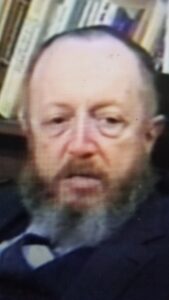
With his old-world charm, strong diplomatic skills and keen understanding of the human psyche, the Bavarian-born rabbi traveled well in all circles and could connect with virtually anyone. I spent many a morning at the yeshiva catching up with him and schmoozing over a bowl of gruel, and it was always an enlightening and enriching experience.
Rabbi Neuberger was a crucial and steadfast figure in Jewish Baltimore throughout the 20th century, impacting many lives here and around the world. He could be prickly at times if pushed – I recall one instance when he suddenly hung up the phone on me over what he considered intrusive questioning — but overall, he was a benevolent and beloved figure who always had the wellbeing of the Jewish community at the forefront of his mind.
Perhaps this was best demonstrated when Rabbi Neuberger, beginning in the mid-1970s, took it upon himself to help Iranian Jews come here to study Torah. The initial plan was to educate a new generation of scholars to return to their homeland and rebuild Jewish communities. But after the Islamic Revolution of 1979, the need to rescue Iranian Jewry became more critical than ever.
The stories of Rabbi Neuberger’s efforts to get Jews out of Iran are legion and legendary. Some of the anecdotes, if accurate, are amazing acts of courage and selflessness worthy of a film treatment.
With his political connections and powers of persuasion, Rabbi Neuberger, in one way or another, is credited with helping more than 60,000 Jews escape from Iran.
“Rabbi Neuberger considered us his children,” Ohr Hamizrach’s Rabbi Reuben Arieh told Jewish Action, the magazine of the Orthodox Union, in 2021. “He took our boys into the yeshivah without asking for payment, and helped us with food and immigration. In his zechut [reward], these Ner Yisroel alumni are teaching Torah in Atlanta, Los Angeles, and around the world.”
It’s quite a legacy, certainly one worthy of naming a building in someone’s memory and honor. But I can’t help but wonder what Rabbi Neuberger would think of what’s going on in the aftermath of the Israeli and U.S. strikes against Iran’s nuclear facilities.
Multiple reports filtering in claim that about 24 Iranian Jews – some of them rabbis and leading figures of the communities in Tehran, Isfahan and Shiraz – have been rounded up on suspicions of espionage. Reportedly, some of those charges are merely based on maintaining contact with family members in Israel, or allegedly “liking” anti-regime posts on social media platforms.
“Anyone can suddenly disappear from the street or workplace, just because of a surname or a previous visit abroad,” a source told the Israeli news source Ynet.
Said another individual close to the situation: “The detainees are being held under harsh conditions, isolated from their families and denied communication. We ask the people of Israel to pray, recite Psalms and include them in their prayers. Only divine mercy can bring them home.”
Last week, Iran announced it executed three members of its Kurdish population convicted of aiding the Mossad, Israel’s intelligence agency, in the 2020 assassination of of prominent nuclear scientist Mohsen Fakhrizadeh.
For more than four decades, Iran’s Jewish community has walked a fine line as a religious minority living in a fundamentalist Islamic environment. The leaders have always professed a strong allegiance to the regime (despite its oft-stated desire to wipe Israel off the face of the earth), but it must be an incredibly tense, precarious situation for this community now numbered at approximately 9,000. (The community was believed to be more than 80,000 before the fall of the shah.)
Still in recent memory are the arrests of 13 Iranian Jews who in 1999 were accused of being spies for the Mossad. After a trial, 10 were sentenced to incarceration. Through global pressure and secret negotiations, all of the accused were released by early 2003 and reportedly now live in Israel.
Rabbi Neuberger was a man of faith, but also a man of action. Following his example, we must pray for Iran’s Jewish community and those who have been accused of committing treason against their country. But we must also do everything in our power – politically and otherwise – to help this community, one of the oldest in the Jewish diaspora, without endangering their delicate, complex situation.
Rabbi Neuberger, always the committed, tireless diplomat and activist, would never expect anything less.

In Italy, the Jewish Brigade's flag has unfairly become a flashpoint in today’s battles over Zionism and anti-fascism, writes Dr. Ginaluca Fantoni.
At its annual meeting this year, the Baltimore Jewish Council will honor the late Harford County educator and longtime Holocaust education champion.
The former Colt, who passed away on May 25 at age 93, achieved immortality during a cold December day in 1958, writes Michael Olesker.

A new biography on the creator of "Doonesbury" misses the mark, writes Michael Olesker.