
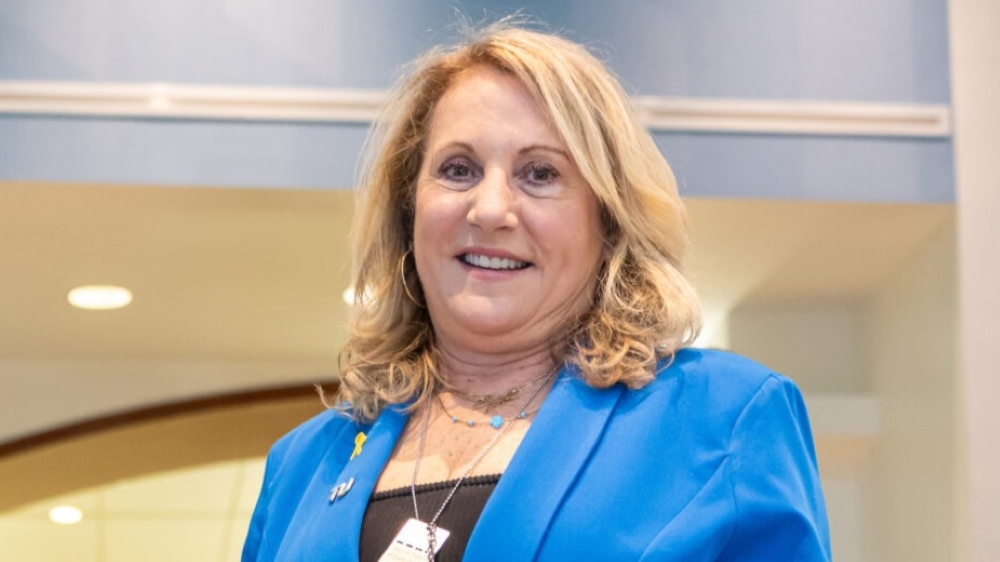
Dr. Hana Bor, a longtime local Jewish educator, talks about why she joined Jmore’s mission.
Dr. Hana Bor is a member of Jmore’s inaugural nonprofit board.
A professor at Towson University’s College of Liberal Arts, Dr. Bor is founding director of the Sandra R. Berman Center for Humanity, Tolerance & Holocaust Education, and director of the university’s graduate certificate program in Holocaust education.
Throughout her career, Dr. Bor has presented at numerous national and international conferences and led study abroad programs in Israel, Poland and Germany. Her research focuses on leadership, nonprofits, diversity, culture and Holocaust education. Her book “Enhancing Values of Dignity, Democracy, and Diversity in Higher Education” ( Routledge), was published in 2022.
She is a member of Pikesville’s Beth El congregation and active in the Jewish community of Howard County.
Jmore recently spoke with Dr. Bor about her role as a board member and her hopes for the media platform’s future.
How did you come to be part of the board?
[Former Associated President and CEO] Marc [Terrill] called me and told me the exciting news that Jmore was becoming a nonprofit organization, and he asked me if I was interested in getting involved. We talked for a while, and I thought, ‘That’s really a great initiative,’ and I decided to join the board.
Why do you think this initiative is an important mission?
As a professor, I work with students and see the need to train Jewish professionals, to get young people curious about working in the Jewish community as a Jewish professional. There are a lot of misperceptions, and there is growing antisemitism and Jew-hatred.
I think young people don’t know what to say, how to handle it. They know it’s wrong, but sometimes they don’t have the tools to deal with this. I think it’s important to have another venue to train young people to be literate, to be able to talk about what’s happening in the world, to know how to write, to speak, to be creative and to network with others.
What do you see as the Jewish community’s primary challenges today?
We’re a small community, and we’re surrounded by people that don’t remember the past, don’t know the past. We need to be out there to explain and educate and network and communicate with others if we want to be part of society.
Now is the time to collaborate with others. We can’t tackle the challenges of antisemitism, hatred, misconceptions and conspiracies alone. We need partners and we need to respect and appreciate each other.
How do you think Jmore can do that?
I think Jmore is positioned to talk to young adults and adults through programming, education, exposure, advertising. It’s a really good venue to educate the public, both Jews and non-Jews, about some of the challenges in the greater Baltimore Jewish community, and beyond.
I think there’s going to be a great future. They have the right stuff and the right leaders who are willing to do the work and excited and enthusiastic about the work and the mission. I’m happy to be to take a small part of it.
What skills do you bring to the table to help with this initiative?
I’ve been a a Jewish professional for many, many years. I served as a director of religious school and was a day school and religious school teacher. I was a professor at Baltimore Hebrew University, and I trained teachers, leaders principals in Jewish education and Jewish communal service.
In 2009, I made a shift to Towson University, and I grew within Towson to become a full professor and tenured. I worked in academia, but I still ran a program for Jewish communal service and Jewish education. I ran a graduate degree that focused on leadership in which I prepared educators and others to be leaders in the Jewish community.
I teach about nonprofits and Holocaust education. I think I can bring from my experience and creativity and ability to create large programs.
Where do you envision Jmore in a decade?
I think Jmore will be a publication and nonprofit that is known not just in Maryland but around the country, and maybe in Israel and among Jewish diaspora as well. I think it will be bigger and stronger, and it will have a legacy of training young people to be proud Jewish professionals and proud Jewish members of the community and be able to represent the community in many different endeavors.
They have a vision and a mission, and they now have the people to start carrying this vision. Ten years from now, I believe the board will grow from five people to 18 and there will be enough work for everybody.
I commend the leaders of Jmore and their vision and creativity and willingness to do the hard work to create something new and successful.
Donate to Jmore and help support local Jewish journalism and strengthen community programming for the next generation.
A junior at Roland Park Country School, Katie Grossman writes about a recent experience that spurred her to take action to fight antisemitism.
Presented by Jews United for Justice and a consortium of local synagogues, "Beyond Welcoming the Stranger" offered a Jewish approach to helping immigrants.
John Singer wants to help Marylanders of all economic backgrounds to afford ankle foot orthoses.
At Krieger Schechter Day School, joining in the later elementary or middle school isn’t a setback -- it’s a launch pad.