

By Skye Estroff
This story originally appeared on The Nosher.
Our family’s approach to the Yom Kippur break-fast is a decidedly Southern one.
Many North Americans associate this feast with an array of sweet kugels, bagels with all of the accoutrements, rugelach in every flavor, blintzes and maybe a special cake or two.
Chances are you have never seen a spread filled with egg casserole, cream cheese grits and homemade biscuits.
Before the early 1900s, my family had not either. How did this menu come to be for a half-Sephardic, half-Ashkenazic Jewish family?
It’s a funny story.
I recently recovered my great-grandpa’s autobiography that was stowed away in storage. He detailed the lengths that it would take to acquire kosher food in Georgia in the early 20th century.
Quick synopsis: It required special connections and efforts to secure the holiday food necessities from the certified grocer. The “good stuff” was reserved for the residents of Atlanta, Augusta and Savannah, while little was set aside for small-town Jewish families.
My family was one of the latter so we had no choice but to incorporate ingredients that were more accessible into our meal planning. Eggs, grits and flour were much easier to secure than specialty meats. Thus, Southern-style cuisine became intertwined with our family meals and traditions.
All of this to say that I’ve grown accustomed to this style of break-fast. I prefer it to the regretful annual reminder that my stomach is not meant to digest mounds of mayonnaise-laden proteins or seconds of sugar immediately after 24 hours without.
Simple, flavorful and easily digestible foods are the strength and strategy in our Southern-inspired menu.
The hearty pièce de résistance of our table is my mom’s egg casserole. It’s silky, cheesy and smells amazing coming out of the oven. Egg casserole can be made in advance; refrigerate overnight and forget it until an hour before sunset.
When going in for the bake, know that the egg mixture will be settled so the ratio of bread to egg mixture will look skewed. It’s not. The “casserole” bakes like a souffle, so the egg mixture will rise and create a pillowy texture to complement the crusty bits of challah that are exposed at the top.
Feel free to modify this recipe to use any kind of bread (i.e. wholewheat, gluten-free, sourdough, etc.), milk instead of half-and-half or a different sharp cheese (Gruyere or Manchego would be nice). That’s the essence of my mom’s style of Southern Jewish cooking — make it tasty, but creatively configure the ingredients to work for the specific group you’re hosting.
Serve her egg casserole alongside cream cheese grits, thick-cut biscuits plus a little bit of fruit and not only will you be covered for the holiday, you’ll get a taste of the lesser known tradition that we hold so dear.
Notes:
- The casserole needs to chill in the fridge for a couple of hours, or overnight, before baking.
- Egg casserole can be made in advance; refrigerate overnight and forget it until an hour before sunset (start from Step 7).
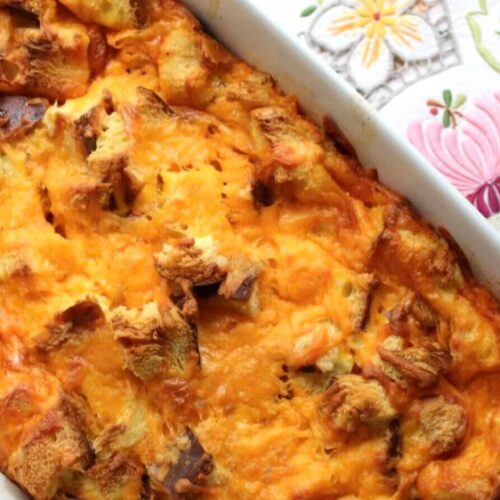
Challah Egg Casserole
Ingredients
- 8 oz. challah, cubed (half a challah)
- 1 1/2 cups shredded yellow cheddar cheese
- 6 large eggs
- 2 cups half-and-half
- 1 teaspoon mustard powder
- 1/2 teaspoon salt
- 1/4 teaspoon black pepper
- 1/2 teaspoon garlic powder
- 1/2 teaspoon onion powder
Instructions
- Spread the cubed challah across the bottom of a 9×13 baking dish.
- Sprinkle the shredded cheese evenly over the bread cubes.
- In a large bowl, whisk together eggs, half-and-half, mustard powder, salt, pepper, garlic powder and onion powder until well combined.
- Pour the egg mixture evenly over the bread and cheese in the baking dish.
- Cover the dish with plastic wrap or foil and refrigerate it overnight (or at least a couple of hours) to allow the bread to absorb the egg mixture.
- Preheat the oven to 350°F.
- Remove the casserole from the refrigerator and let it sit at room temperature for about 15 minutes while the oven preheats.
- Bake, uncovered, for 45-50 minutes or until the top is golden brown and the casserole is set in the middle. You can insert a knife in the center to check if it’s fully cooked (it should come out clean).
- Let the casserole cool for a few minutes before cutting and serving.
Notes
- The casserole needs to chill in the fridge for a couple of hours, or overnight, before baking.
- Egg casserole can be made in advance; refrigerate overnight and forget it until an hour before sunset.

Skye Estroff is known as “Atlanta’s Food Expert” on TV, radio, and podcasting. She has a degree in dietetics from the University of Georgia and is a regular food judge of culinary competitions and a contributor to local, regional, and national media.

Dara Bunjon talks with legendary chef Jimmy Schmidt, a three-time James Beard Award recipient, restaurateur, author, food scientist and innovator about his journey from the Rattlesnake Club restaurants to Chefs Collaborative and JR Ranch Foods.

Inspired by his Israeli grandmother’s cooking, Chef Raz Shabtai of Miami's Mutra restaurant says the award was for “the entire Jewish community.”
These snowy almond cookies from Elite Jakob are gluten free, easy to make, and most importantly -- delicious.

Dara Bunjon talks with award-winning author Monica Saigal (Bhide) about her "Modern Spice" cookbook, "Papa's Butter Chicken" children's book, and more.