
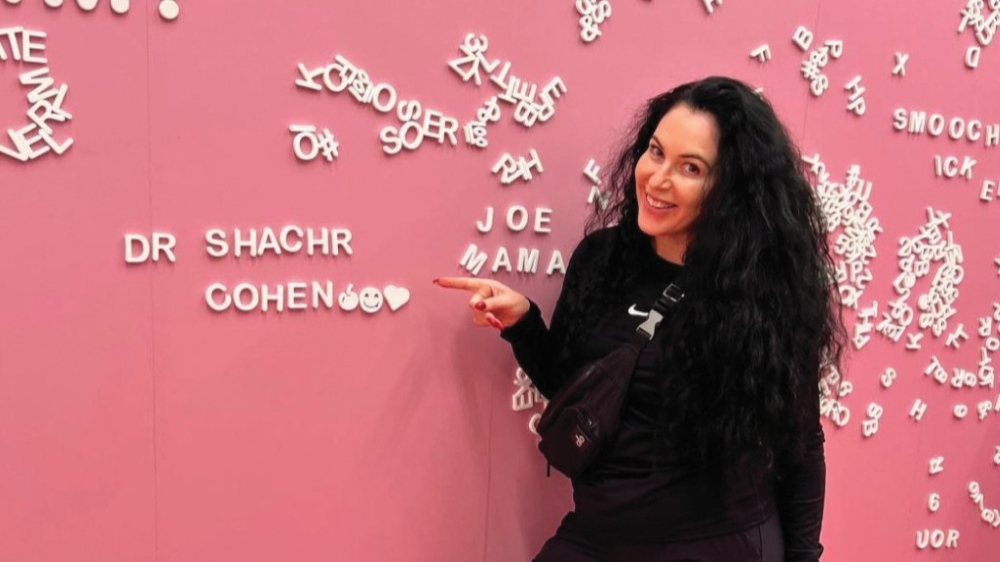
Born in the southern Israeli town of Eilat, Dr. Shachar Cohen, Beth Tfiloh Dahan Community School’s high school director of Hebrew language, brings a fun and authentic approach to teaching the subject.
Jmore recently spoke with Dr. Cohen, who last year earned her doctorate in educational leadership from Gratz University, about her approach and philosophy of teaching contemporary Hebrew to American Jewish students.
What’s it like teaching at a Jewish day school here as compared to a school in Israel?
[American] kids are very different. They say thank you at the end of each class! What I feel here is that kids have a thirst for learning, something I did not really see in Israel.
In Israel, I had classes of 40 kids — three different levels in the same classroom. Israeli kids are more balagan [crazy] and the ‘distance’ is less. Sometimes, there is a little bit of chutzpah. If an Israeli [student] wants to go to the bathroom, they won’t ask — they just go. If there is a fire drill, everybody [in an American class] will go quietly but in Israel everybody will go out screaming. That’s something that’s very Israeli to me.
What are your plans for the Hebrew program at BT high school?
I want my Hebrew department to be the best in all of Maryland. Our high school is the only one in Maryland that has an ‘advanced placement’ Bar-Ilan [University] Hebrew course.
I know in the past, our school was not as strong in this department as we are now. We are going in a very positive direction, changing the curriculum for the lower and middle schools as well, [and] printing new books for the classes and writing new lessons. It’s going in a different direction.
Why is it important to teach Hebrew to Jews living outside of Israel?
You cannot study a culture without studying the language. It’s not just about the benefits of studying a second language. It’s our language. [Hebrew] connects us with our identity, who we are, our ancestors, it’s something you cannot ignore.
If you want to learn about who you are as a Jew, you need to know the language. What is so beautiful about our language is that it started from the Tanakh and is always growing. We now have the Ivrit HaChadasha [the new Hebrew], which is still changing and building.
How did you first hear about Beth Tfiloh?
It was at a party for Israelis where I learned about the Jewish schools in Baltimore. In the beginning, I thought Beth Tfiloh was a very religious school because of the name, and I thought about teaching at [Krieger Schechter Day School] instead.
A shaliach [Israeli community emissary], Dani Steiner, who is a close friend of my sister’s husband, did his shlichut [emissary service] at Beth Tfiloh and I asked him to send my resume to Dr. [Zipora] Schorr [Beth Tfiloh’s director of education]. Three weeks later, I got the job. It was meant to be!
What are some of the challenges of being a department chair?
Sometimes, when you bring in a new curriculum, it is hard for some teachers to adapt. When you’ve been doing your method a certain way for years, it’s very hard to adapt to a new one, especially for teachers.
It’s also challenging to bring AI into the Hebrew department, [more] than it would for math or science. I still need to figure out how to use AI without having [students] simply using it to translate. We’re still building, but all the teachers at Beth Tfiloh understand that we can use AI to the best we can.
How did you feel about winning the school’s “Teacher of the Year” award last year?
I was very excited. Hebrew is only three hours a week [at Beth Tfiloh], and it’s not [what students] consider the most important subject when it comes to college. English is six hours a week, science is seven, and math is eight. I was very surprised and so happy.
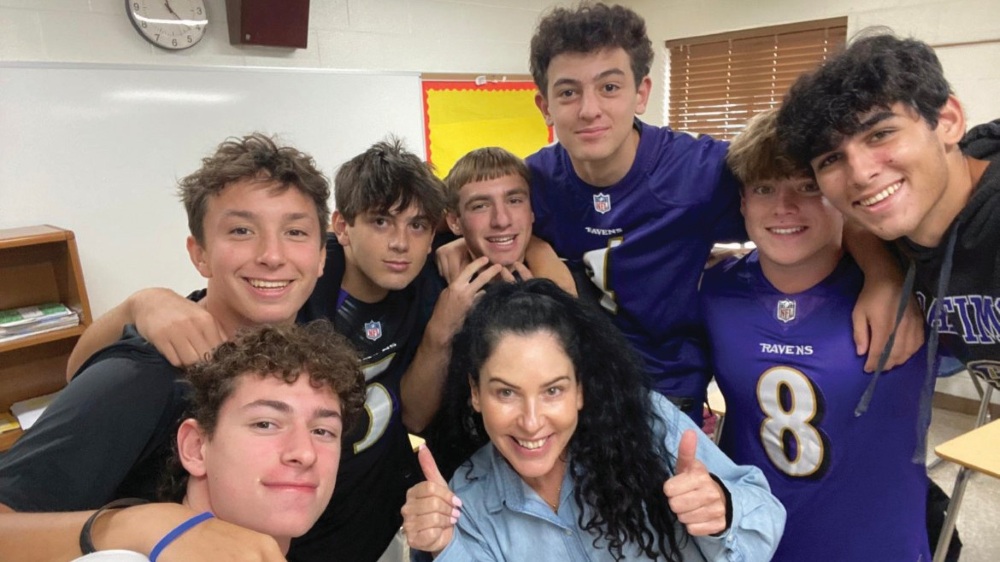
I feel a certain kirva [closeness] to my students. The empathy I feel for them, love for who they are not just as Jewish kids but as people, I think that’s what got me ‘Teacher of The Year.’ I come in to teach a class, I have an agenda, but I also look at my students as human beings.
Your plans for the upcoming school year?
We have an all new tzevet [team] of Hebrew teachers. We have many more students, and I expect that more classes will open up because of that.
We have a new head of school [Bracha Rutner] and a new high school principal [Rabbi Mordechai Soskil]. We are going in a great kivun [direction] and there are a lot of great people who have my back. There will be many changes, but they will be good ones.
Gefen Miller is a Jmore editorial staff intern.

A former college campus activist, Veksler will speak at Chizuk Amuno on June 8 at the Ruth and Jay Lenrow Visiting Scholar-in-Residence for Combating Antisemitism.

A lifelong Baltimorean, Judge Rosenberg served as a U.S. magistrate judge from 1973 to 1998.
A former resident of Baltimore and central Florida, Ritt was active in the Soviet Jewry movement of the 1970s and 1980s.
For more than four decades, Goldman played a vital role in the supervision of elections in the city.