

For three decades, Susan R. Levy worked in advertising sales, and then became a health and life insurance agent. But after two-and-a-half years in that role, something happened to Levy — a novel, unplanned but extremely gratifying.
It evolved from a short message written to herself years earlier to a full-time project consuming most of her spare time for nearly three years.
Her book, “Galleon Investments: Investments and Murder,” was recently published by Archway Publishing.
A Baltimore native, Levy and her husband, Alan, live in Owings Mills and have a daughter, Dr. Saryn Levy. Jmore recently caught up with Susan Levy to talk about “Galleon Investments.”
How did this book come about?
I was cleaning out a file cabinet about three years ago and came across the first paragraphs of a book about a dysfunctional person. I had written that years before, and I thought, ‘She’s an attention-getter.’ I wondered where things would go, so I sat down and wrote a page and a half.
I sent that to my sister, Bonnie, who said she thought it was good. So I wrote a chapter, and I thought, ‘This deserves to be a book.’ I’d never written a book and didn’t know where it would go. But I decided I was up for the challenge. I didn’t use an outline. The story evolved.
Where did the story come from?
The characters are variations of the people in my life; most are composites of different people. I didn’t have a list of characters. They came up as the story progressed.
I’ve always been creative, in raising our daughter, in cooking and in design, so I felt creative about developing characters. Here’s an example: Evan. He was fashioned after my husband, Alan, who is one of the most dedicated, honest employees I’ve encountered. Evan continued making strides for his clients through his conscientious research, his congenial disposition, and an astute instinct to position the right financial vehicle to launch and perpetuate his clients’ monetary growth.
The book took on characteristics of its own. But I could write only when I wasn’t working. It took me almost three years to complete, but nothing was going to stop me. I wanted good to prevail over bad. I wanted to keep it simple by telling the story in one person’s voice.
There are some allegorical comparisons and some political overtones and themes. But most of all, I wanted people to enjoy it.
What were some of the challenges of writing this book?
I’d wake up at night thinking about things, and I’d jot down notes. My husband was a trigger, telling me I needed more surprises from the characters, not just the plot, especially at the end.
I needed to let readers know why these people are the way they are. Some elements of the end were a surprise to me!
Making time to write while I was working was a major challenge. Of course, I also needed time to be with my husband and family.
In terms of the story, the courtroom scenes were a major challenge. I did research and tried to be realistic, but I figured some readers would accept my descriptions and some would simply have more knowledge of the courts and their systems than I do.
A different type of challenge was finding the right publisher. I tried several different publishers and ultimately chose Archway. They are a self-publishing service under Simon & Schuster. I liked their affiliation with a major publisher and their emphasis on what they call ‘supportive publishing.’
They are publishing a quality book, they also help in marketing the book and in fulfillment. I have paid $22,000 for their different services.
Don’t authors of self-published books usually do most of the marketing?
Yes, and certainly that’s true in my case. That’s how I spend all of my time now, I’m in it hook, line and sinker. I’m contacting radio talk shows, and I’m going to just about every television and radio station in Maryland and to a great many Maryland bookstores. I get them interested in the local flavor because the novel takes place in Dundalk and Rosedale. I offer to do book readings at their stores.
You want to do as much marketing as possible, so I’ve contacted literary magazines that publish new authors. I’ve even gone to major publications with little chance of gaining interest, but why not? So I’ve tried the New York Times.
I haven’t done social media so far, but I’m having a website developed and will reach out digitally from there.
Is it all worth it?
This is all very gratifying. I’ve got a book that took three years to write, and I enjoy meeting people to discuss it. What I hope people will say is, ‘This book was really interesting. I wonder what she’s going to do next.’
So what’s next?
I don’t know. Not yet.
Peter Arnold is a local freelance writer.

Schwab currently serves as president of Cumberland's historic B'er Chayim Congregation.

A former U. S. Marine, Pat Young has served as a Baltimore County Council member representing District 1 since 2022.

Mansoor Shams is known for carrying around a sign proclaiming, “I’m a Muslim and a U.S. Marine. Ask anything.” Now the Baltimore County Department of Recreation and Parks community engagement and outreach officer is running for Baltimore County Executive.
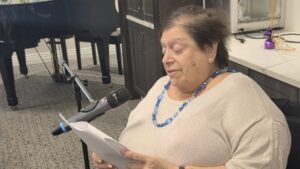
Baltimore native Susan Landsman recently celebrated her rite of passage surrounded by family, friends, fellow residents and staff.