
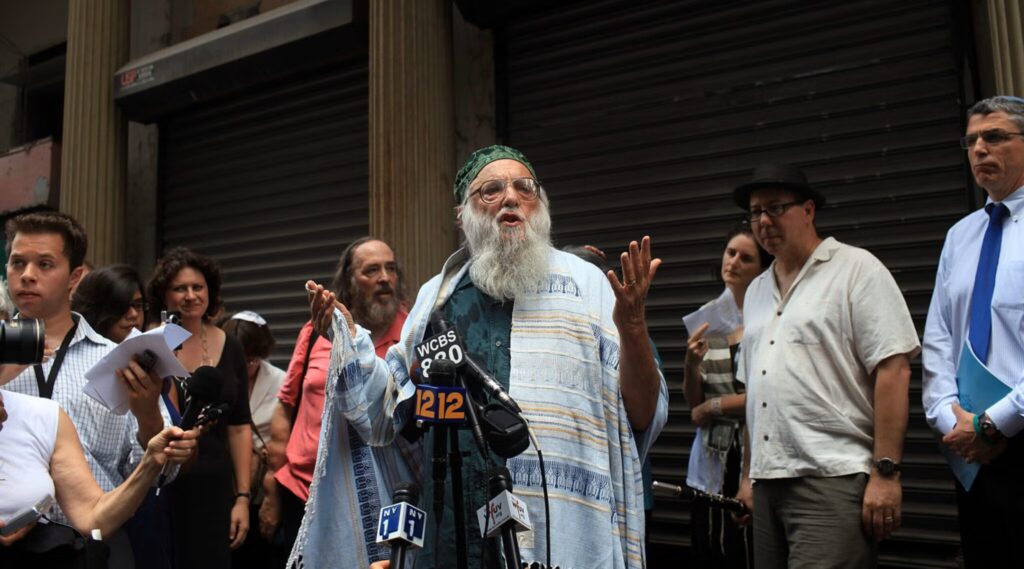
Rabbi Arthur Waskow, a Baltimore-born activist and author of more than two dozen books about civil rights, economic injustice and climate change, died Monday, Oct. 20, at his home in Philadelphia.
The 1950 Baltimore City College graduate, who grew up on Cottage Avenue in Northwest Baltimore, was 92.
“The Adamah family joins in mourning the death of Rabbi Arthur Waskow, one of the key founders and shapers of the Jewish environmental movement,” the Reisterstown-based national Jewish environmental organization Adamah posted on social media. “Every person and every program across Adamah bears his direct or indirect influence, and we are all now part of his enduring legacy. He will be greatly missed.”
Starting with his creation in 1969 of the “Freedom Seder,” a version of the Passover Haggadah that introduced contemporary liberation struggles into the ancient story of the Israelite escape from Egyptian bondage, Rabbi Waskow became one of the leading voices bringing Jewish spiritual wisdom to bear on the progressive political agenda.
Rabbi Waskow disseminated these ideas as the founder of the Shalom Center in Philadelphia, initially to address the threat of nuclear weapons through a Jewish lens. Over time, the organization came to focus on other concerns, including Middle East peace, interfaith relations and climate change.
In 1993, Rabbi Waskow co-founded, with Rabbi Zalman Schachter-Shalomi and others, ALEPH: Alliance for Jewish Renewal, a flagship for the Jewish Renewal movement. Rabbi Waskow was said to have coined the term “Jewish Renewal” — a movement grounded in “Judaism’s prophetic and mystical traditions” — in an issue of Menorah, a magazine for social justice and ritual issues he launched in 1979.
The author of more than two dozen books, several of which have become Jewish classics, Rabbi Waskow celebrated his 92nd birthday this month while in hospice care at a Zoom launch of two books that he’d written since turning 90. “Tales of Spirit Rising and Sometimes Falling” is an activist’s memoir; “Handbook for Heretics and Prophets: A New Torah for a New World” is a collection of essays by Rabbi Waskow and fellow Jewish activists.
His reach was so extensive that, in 2012, the Jewish feminist icon Gloria Steinem told Oprah Winfrey that it had been Rabbi Waskow’s urging that kept her going as an activist at a pivotal moment of disillusionment back in 1968. The pair reconnected for the first time since then in a public conversation about their eight decades of activism.
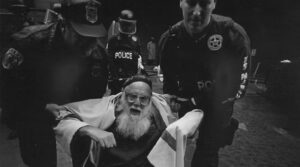
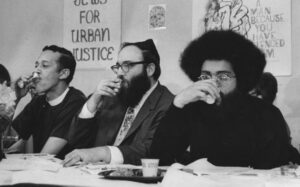
More than an armchair theologian, Rabbi Waskow was arrested more than two dozen times, first while protesting at the then-segregated Gwynn Oak Amusement Park in Northwest Baltimore in the 1960s and continuing throughout his life. In 2019, Rabbi Waskow was arrested outside an Immigration and Customs Enforcement office in Philadelphia while protesting the Trump administration’s treatment of migrant women.
Rabbi Waskow was destined for activism from an early age. Both his parents were politically engaged — his father was a labor organizer who had headed the Baltimore teachers union and his mother registered Black voters. Both were active with Americans for Democratic Action. His grandfather was a precinct organizer for Eugene Debs, the union organizer who ran for president five times as a socialist between 1900 and 1920.
“That was in my bloodstream,” Rabbi Waskow told the Jewish Telegraphic Agency in 2021.
Rabbi Waskow received a bachelor’s degree from Johns Hopkins University in 1954 and a Ph.D. in American history from the University of Wisconsin in 1963. He went to work on disarmament and civil rights for Robert Kastenmeier, an influential longtime member of the U.S. House of Representatives. Later, he became a fellow at the progressive Institute for Policy Studies.
In 1970, he testified for the defense at the trial of the Chicago 7, Vietnam war protesters who had been arrested for incitement at the 1968 Democratic convention in Chicago. The defendants included the Jewish radicals Abbie Hoffman and Jerry Rubin.
The trial was the first time that Rabbi Waskow had worn a kippah in a nonreligious setting — the judge tried to have him remove it, but relented at the prosecutor’s urging. At the time, Rabbi Waskow “was still wrestling with what this weird and powerful ‘Jewish thing’ meant in my life,” as he would write later. Though he had always observed Passover, Judaism had failed to seriously capture his attention until well into adulthood.
That changed on an April evening in 1968 as Rabbi Waskow headed home to prepare for the Passover Seder. Federal troops were out in force to quell riots sparked by the assassination of Dr. Martin Luther King Jr. just days before. Seeing a machine gun pointed at his block in the Adams Morgan section of Washington, D.C., Rabbi Waskow likened the show of force to Pharaoh’s army.
That insight inspired Rabbi Waskow to write the “Freedom Seder,” which referred to King and Mahatma Gandhi as “prophets” and introduced quotes from a range of modern thinkers alongside the traditional text, including Thomas Jefferson, the enslaved abolitionist Nat Turner and the Black Power leader Eldridge Cleaver.
In 1969, a group of young Jewish activists led by Rabbi Waskow organized the original Freedom Seder, which was held in the basement of a church in Washington.
Although it was written in a long tradition of adapting the Passover seder script for contemporary issues, the Orthodox Rabbinical Alliance of America denounced the work as “most offensive” for making radical changes to the Haggadah without rabbinic authority and quoting alleged anti-Semites.
“There’s no question, it was chutzpadik,” Rabbi Waskow said of the book, using a Yiddish expression that roughly means audacious. “I think it turned out to be holy chutzpah.”
The “Freedom Seder” would be the first of many works Rabbi Waskow would pen that reimagined Jewish tradition to speak more directly to contemporary concerns, initiating a movement that many Jews now take for granted.
Rabbi Waskow continued in this vein with his 1982 work “Seasons of Our Joy,” a New Age guide to the Jewish holidays (New Age became “modern” in subsequent editions). Written in the DIY spirit of “The Jewish Catalog,” the book reintroduced the earth-based, agricultural roots of the Jewish holidays decades before Jewish farmers and environmental activists would make such linkages seem obvious.
In 1982, when hundreds of Palestinians were massacred by Israel-aligned Christian Phalangists at Sabra and Shatila, Rabbi Waskow was at a retreat center near Baltimore for Rosh Hashanah. He took the front-page article on the killings from the Philadelphia Inquirer and chanted it as the haftarah at the morning service.
“He was almost a lone voice for a long time, really trying to bring Jewish values to the political situation,” said Rabbi Mordechai Liebling, a fellow Philadelphia activist rabbi and the founder of the social justice training program at the Reconstructionist Rabbinical College, in 2021. “[Abraham Joshua] Heschel certainly had done this, and there were two or three other rabbis who did that well — Everett Gendler, some more. But they weren’t as radical as Arthur.”
Rabbi Waskow decided to seek rabbinic ordination in 1995, when he was 62 and already teaching at the Reconstructionist seminary. He also taught at Swarthmore College, Temple University, Drew University, Vassar College and the Hebrew Union College-Jewish Institute for Religion (where he taught the first course on eco-Judaism in any rabbinical seminary).
In 2007, Newsweek named him one of the 50 most influential American rabbis.
Rabbi Waskow met Rabbi Phyllis Berman at a conference in 1982, some months after she read “Seasons of Our Joy” and sent Rabbi Waskow a love letter, which he never answered. (It had been lost in the mail.) Rabbi Berman confronted Rabbi Waskow over the lapse and the two struck up a friendship. Four years later, they were married and each took on a new middle name — Ocean — inspired by their shared love of the sea.
“People have said that I have softened him,” Rabbi Berman told JTA in 2021. “And I think that I have. And he has also toughened me. So both things are true. He said to me very recently, in a very precious exchange, that I don’t take any shit from him anymore. And I think I probably did for a long time. He is a frightening man when he’s angry. But I’ve learned to stand in the face of it in a much, much more profound way.”
Rabbi Waskow told JTA that he hoped his legacy would be a deeper shift in Jewish theology — and by extension in the Jewish psyche. He believed that modernity presented Judaism with a challenge on par with the one faced by the ancient rabbis following the destruction of the Temple.
That challenge, reflected in the cascading crises now facing humanity, will require a profound transformation in religious thought — from one centered on serving God as a ruler or king to a more ecological worldview that sees all of creation as part of an organic whole.
“Modernity did to us what Rome, and before Rome Egypt and Babylon, did,” Rabbi Waskow said. “And the question is now, has modernity gotten so powerful, and so uncaring, and so uncontrollable, it’s going to wreck the whole joint before we can create an effective response. Or can we create an effective response? And that’s what I’ve been trying to do.”
Rabbi Waskow’s successor at the Shalom Center, Rabbi Nate DeGroot, announced earlier this month, ahead of Rabbi Waskow’s Oct. 12 birthday, that he had entered hospice care.
Rabbi Berman survives him, as does a son, David Waskow; a daughter, Shoshana Elkin Waskow; stepchildren Josh Sher and Morissa Wiser, their spouses and five grandchildren.
Rabbi Waskow’s other books included “Torah of the Earth: Exploring 4,000 Years of Ecology in Jewish Thought,” “Down-to-Earth Judaism: Food, Money, Sex, and the Rest of Life” and “Godwrestling,” a collection of Torah commentaries.
Ben Harris wrote this article for the JTA global Jewish news source. Jmore staff contributed to this report.

For more than 130 years, Sol Levinson & Bros. has been woven into the fabric of Baltimore’s Jewish community.
Led by local Israel-American cellist Amit Peled, the Mount Vernon Virtuosi aims to inspire people beyond musical enjoyment.
A former college campus activist, Veksler will speak at Chizuk Amuno on June 8 at the Ruth and Jay Lenrow Visiting Scholar-in-Residence for Combating Antisemitism.
A lifelong Baltimorean, Judge Rosenberg served as a U.S. magistrate judge from 1973 to 1998.