
The award-winning author and activist Rabbi David Jaffe mused, “Rabbi Chaim Tchernowitz (d. 1949) relates in his autobiography how the synagogues of his youth in Russia were divided by profession. There was the shoemakers’ shul, the hatmakers’ shul, the carpenters’ shul, and the horse thieves’ shul.”
Jaffe declares this is clear “evidence of a breakdown in Jewish moral behavior.” The same people who presumably stood reverently in synagogue three times a year for the recitation of the Ten Commandments (including the Eighth one, “Do not steal”) had organized their institutional prayer around their common identification as thieves!
I have no justification for this behavior. I’m sure there are circumstances in which it might be morally defensible to steal a horse (To escape a forest fire? To rush a sick child to the hospital?). But horse thievery clearly ought not be a point of pride for observant (or non-observant) Jews.
The ancient Rabbis explore this concern about alignment of values and practice with regard to the major festival we celebrate this month of October. In Mishnah (Sukkah 3:1, 5), the great 2nd-Century compilation of Jewish law and legend, they proclaim that a stolen lulav and etrog is unfit for use. The reason is stated in the Babylonian Talmud (Sukkah 30a): “It is … a commandment that is fulfilled through a transgression (mitzvah haba’ah b’aveirah). As it says, ‘And you have brought the stolen [animal], the lame [animal], and the ill [animal as offerings] (Malachi 1:13).’ [Meaning] a stolen offering is similar to a lame one; Just as a lame animal is not permissible for sacrifice, the same is true for a stolen animal.”
Our rituals are not meant to be hollow expressions of faith. If we are to serve God “with all our heart … soul … and might” (Deut. 6:5), we must strive to be fully integrated as Jews and as human beings.
Stolen animals, even without blemish, may not be offered as atonement for sins, just as stolen ritual objects may not be used to express our devotion. The objects themselves are neutral. We make them holy when we infuse them holy intention — so long as we have not misused or received them through ill-gotten gain.
But we could ask, what about objects that have nothing explicitly to do with Judaism? Can these be tools of holiness and of justice?
There’s a tendency these days to ascribe moral weight to technology, the internet, AI, etc. This has certainly been true around conversations about security and especially surveillance which some would say are immoral, not amoral. There is a long and troubling history of surveillance in communities of color, which is one reason I signed an amicus brief to the ACLU’s challenge to the Baltimore spy plane a few years back.
We’ve also been deliberative and clear about expectations of our security guards at Beth Am Synagogue. They are certainly not there to racially profile in our majority Black neighborhood. Their charge is to keep everyone safe within our campus — equally true for Jews who come to pray with us on Shabbat, neighbors who gather for a concert or ice cream social, and Queer young dance enthusiasts voguing Ballroom in our social hall weekday evenings.
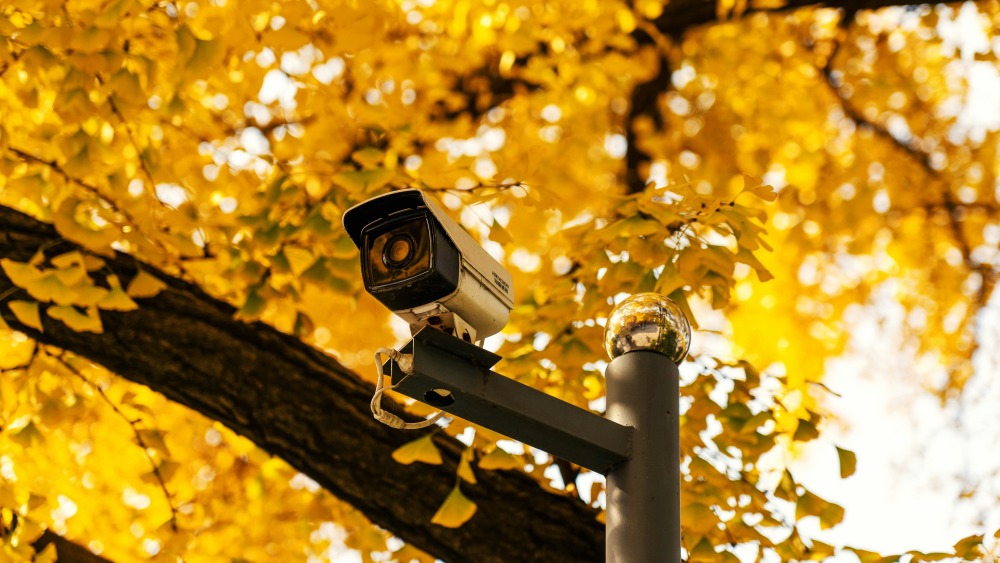
Cameras installed through previous years’ security grants have been helpful as well. Mostly, they are there to monitor for potential vandalism and (God forbid) those who would seek to do harm as well as serve as a deterrent against such things.
But occasionally, our footage has been directly helpful for our neighbors. For example, earlier this summer, a neighbor was picked up in East Baltimore for dealing drugs. His mother came by my home, frantically worried. She was convinced he was no drug dealer and wondered if our video footage could help exonerate her son.
In fact, it did. At precisely the time he was accused of committing a crime in East Baltimore, the time-signature showed him unceremoniously walking his dog in front of Beth Am.
There are objects in this world that are fundamentally dangerous, designed for creating maximal harm, like high-capacity magazines for assault rifles. But most of our material world is relatively neutral. There are reasons to question certain technologies; I do wonder whether the benefits of social media outweigh the harm. But we can also learn from what Jewish tradition has to say about stolen animals, lulavim and etrogim.
Justice demands we pay attention to how we make use of our possessions. The difference between a tool and a weapon can sometimes come down to two simple questions: Who is using it and how?

Rabbi Daniel Cotzin Burg is spiritual leader of Beth Am Synagogue in Reservoir Hill. This column and others also can be found on his blog, The Urban Rabbi.

Cruel, inappropriate, egomanical, outrageous and bullying are all attributes that pass for presidential these days, writes Michael Olesker.


Commemorations of the Holocaust must transcend the past to include concerns about the present and future, writes Menachem Z. Rosensaft.

Someone needed to tell Donald Trump that his appearance at a UFC fight over the weekend was not a good look, writes Michael Olesker.