
By Ruth Messinger
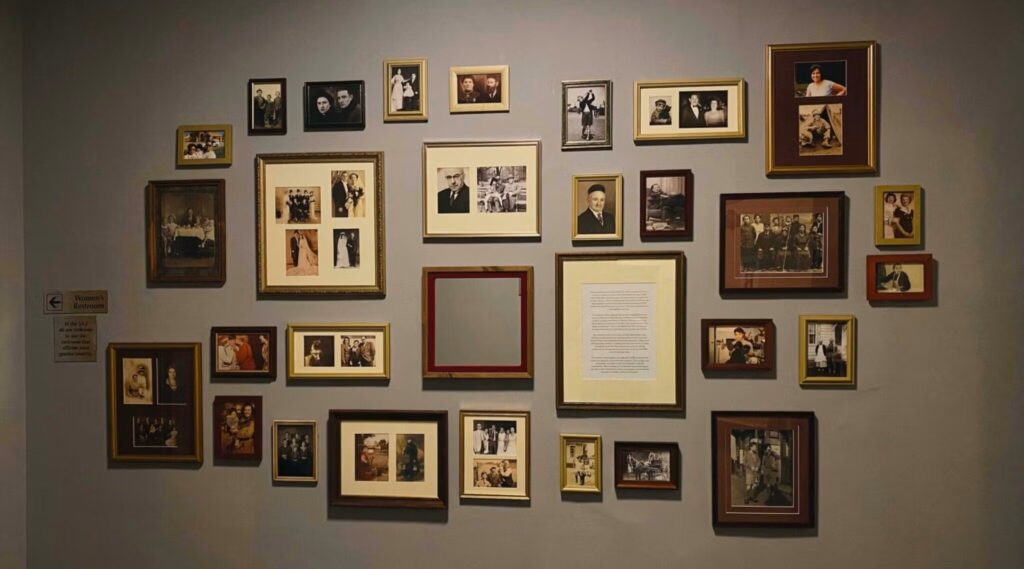
Outside the social hall of my synagogue, the historic Society for the Advancement of Judaism on Manhattan’s Upper West Side, a new modest-yet-elegant exhibition adorns the wall.
Fitted within vintage frames are the faces and figures of individuals from long-ago and far-away places. Each portrait is a story, brimming with unique details.
But these are no generic photos in the public domain. This is no faux vintage display. Instead, the photos are family portraits belonging to members of the congregation, the results of our year-long project, “How We Got Here: Honoring Our Immigrant Forebears.”
The gathering of these photos — which will be published in a beautiful limited-edition volume — was an ambitious undertaking that took over a year and required the involvement of a professional staff and curator.
While preparing for the grand opening of this exhibition on the fourth night of Chanukah, I have a message for clergy and houses of worship: If you want to truly illuminate your sanctuaries, making them vibrant, alive and meaningful, begin by honoring your congregation’s immigrant past with a tangible photo and story project.
What better way is there to remind our congregations to be there for today’s next generation of immigrants?
St. Patrick’s Cathedral in midtown Manhattan did just this in a colorful and glorious manner, commissioning its largest-ever artwork paying homage to New York City’s immigrant past. The vivid panels of the work by New York-based painter Adam Cvijanovic focus on the arrival of Irish immigrants in the 19th century and the contributions they made to this city, juxtaposing their stories with those of more contemporary and diverse immigrant groups.
Every day of the week, visitors to the cathedral come face to face with this very human aspect of its history, previously uncelebrated. Cvijanovic’s murals enhance the meaning and essence of a house of worship.
For our synagogue’s project, we hired Rachael Cerrotti, an award-winning author, podcaster, educator and curator who works with familial history, inherited memory and personal archives. She was able to guide us in our quest for material objects and stories.
She and her husband, documentary photographer and storyteller T.J. Kirkpatrick, designed our exhibition and commemorative book. Rachael elevated our pursuit from the provincial to the global, inspiring us to see our best path forward begins by stepping into our recent past. As we remember and celebrate how we got here, we become more empathic to those making similar journeys today.
To celebrate, we will host a party with traditional Chanukah treats and live music, and invite guests to share their own family immigrant stories with us.
Why undertake such a project in a house of worship? Why not a school, community center or simply in the privacy of one’s own home?
Because houses of worship are places that have staff with community-building skills. It is in the DNA of churches, mosques, synagogues and temples to welcome worshippers, making them feel like they are part of a whole.
What better places to encourage people to learn and share their own immigrant history, digging out the details of who came when, from where and why?
While being “in the moment” is a value we cherish, it is also important to remember we all come from somewhere, that our ancestors are part of our story and inform who we are today.
We know the surest way to cultivate security in children is to ensure they have solid roots. So, too, with a house of worship. When everyone in a congregation undertakes their own “roots” research, then the community itself becomes firmly planted, with stories blossoming like ripe and delicious fruit.
Knowing our own stories and those of our worship community reminds us of the immigrant struggle and helps us understand that the people arriving on these shores today have similar stories and the same needs. Regardless of propaganda, they are not immigrants of lesser worthiness. Our ancestors likely faced similar prejudices, bias and suspicion.
Making the decision to help today’s immigrants is a blessing precisely because they are our grandmothers and grandfathers. They are our parents.
They are us.
In a political and social climate that is hostile to newly arrived Americans, it is critical for us to do this work publicly, to share it on our walls and tell our stories to the next generations.
Knowing where we came from — meeting our parents, grandparents and far-distant relatives who arrived on the shores of this country yearning to breathe free –infuses us with pride and true patriotism.
It restores us to the authentic meaning of what it means to love our country, a nation built on the promise of being a place of refuge for all peoples.

A lifelong New Yorker, Ruth Messinger is a former president of the American Jewish World Service and a former member of the New York City Council.
Shira Dicker contributed to this essay.

As he gets ready to leave for California, Rabbi Daniel Cotzin Burg looks back on his time in Baltimore and his 10 years writing for Jmore.

Michael Olesker pays tribute to WJZ’s retiring Marty Bass, a longtime fixture on local TV screens.
The Orioles' weak defense plays a major role in the nightly carnage, writes Michael Olesker.