

Thomas Kennedy reportedly never actually met a Jew during his lifetime. But that still didn’t prevent him from doing what he felt was right.
Kennedy – who was born in Paisley, Scotland, in 1776 and died in Hagerstown in 1832 — might be the most important non-Jew in the annals of Maryland Jewry and religious liberty in the Old Line State.
An accomplished poet and co-founder of the Hagerstown Mail newspaper, Kennedy lived most of his adult life in Washington County and represented Hagerstown in the Maryland House of Delegates (and later in the state Senate).
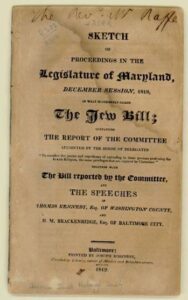
Most famously, he was the leading force behind the landmark “Jew Bill” of 1826, which allowed Jews to hold public office in Maryland.
This week marks the bicentennial of the passage of the “Jew Bill” by the Maryland legislature.
Only approximately 150 Jews lived in Maryland — mostly in Baltimore — during the eight-year period that Kennedy worked tirelessly on behalf of the bill.
When adopted in 1776, Maryland’s Constitution required public elected officials to declare their unwavering belief in the Christian faith. (Interestingly, this provision stood even though Lord Baltimore founded Maryland as a refuge for Catholics from England seeking religious freedom.)
“No other test or qualification ought to be required on admission to any office of trust or profit [other] than such oath of support and fidelity to the State … and a declaration of belief in Christian religion,” stated Article 35 of the Maryland Constitution.
Despite his own devout Presbyterian beliefs, Kennedy felt strongly that such a stipulation was discriminatory and myopic. He called on lawmakers “to consider the justice and expediency of placing the Jewish inhabitants on equal footing with the Christians.”
In Kennedy’s eyes, faith was a matter “which rests, or ought to rest, between man and his Creator alone.”
“There are few Jews in the United States. In Maryland, there are very few,” he said. “But if there was only one — to that one, we ought to do justice.”
Kennedy — who was first elected to the House of Delegates in 1817 — led the fight for years to rescind the requirement prohibiting non-Christian officeholders. An early version of the bill in 1818 was roundly rejected because some legislators feared it might provide rights to free Black men and other groups. (Kennedy was a staunch opponent of slavery in a state with an entrenched slave system, particularly in Southern Maryland and on the Eastern Shore.)
After being publicly berated as “an enemy of Christianity” and a “Judas Iscariot,” Kennedy lost his reelection bid in 1823 to Benjamin Galloway, an outspoken opponent of the “Jew Bill.”
Still, Kennedy pressed on for passage of the legislation even while out of office. “Although exiled at home, I shall continue to battle for the measure, aye, until my last drop of blood,” he said.
In 1825, Kennedy ran again for the House of Delegates and was elected. The Jew Bill was finally passed on Jan. 5, 1826, with Gov. Samuel Stevens Jr. of Talbot County signing it into law.
The final version stipulated that “every citizen of this state professing the Jewish Religion … appointed to any office or public trust … [shall] make and subscribe a declaration of his belief in a future state of rewards and punishments, in the stead of the declaration now required.”
The bill that Kennedy helped gain passage extended political rights to Jews but still required officeholders to profess a belief in a “future state of rewards and punishments.” That requirement was not removed until the adoption of the current Maryland Constitution in 1867.
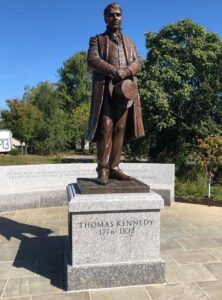
Kennedy eventually left political life and worked as a merchant, clerk, farmer and newspaper editor. He died in the Asiatic cholera pandemic of 1832, at the age of 55.
In 1918, the Independent Order of B’rith Sholom, a Jewish fraternal organization, erected a granite obelisk in honor of Kennedy at Hagerstown’s historic Rose Hill Cemetery, where he is buried. The monument bears the inscription, “One who loved his fellow man.”
In 1992, a plaque was installed at the Maryland State House in Annapolis honoring Kennedy and his crusade to secure religious liberties. Three years later, the House of Delegates created the annual Thomas Kennedy Award, honoring former members of the legislature who demonstrate a commitment to the pursuit of liberty and freedom. The first recipient was the late Comptroller Louis L. Goldstein.
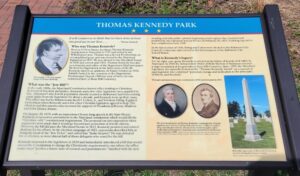
And in October of 2019, the state and the city of Hagerstown dedicated the Thomas Kennedy Park and the Thomas Kennedy Center, located across the street from the historic Congregation B’nai Abraham in downtown Hagerstown.
In his 2021 book “Thomas Kennedy: The Poet Who Loved Liberty and Led a Struggle for Religious Tolerance,” Dan Guzy wrote, “Thomas Kennedy is best remembered and honored today as the leader of the effort that gave political rights to Jews in Maryland. … Kennedy was a romantic who embraced the ideals of liberty and freedom that the United States promised but did not always deliver.”
In a message this week to constituents on the eve of the Maryland General Assembly’s 448th session, Sen. Shelly L. Hettleman (D-11th), co-chair of the Maryland Legislative Jewish Caucus, marked the bicentennial of the passage of the “Jew Bill” and the legacy of Thomas Kennedy.
“Delegate Kennedy believed deeply that Maryland could not claim to stand for justice, equality, and liberty while the rights of Jewish Marylanders (no matter how few there were at the time!) were denied,” she wrote. “This law paved the way for Jewish and other non-Christian Marylanders to participate fully in our State’s representative democracy. We look forward to more deeply recognizing this important milestone of our state’s history in the upcoming legislative session.”

The new plan helps sabbath-observant Jews seeking care in the Emergency Department.

A check presentation ceremony will take place on Tuesday, Aug. 25, at the Safeway location on Smith Avenue.
A Rockville resident, Feinberg was a familiar face in MoCo politics for several decades.
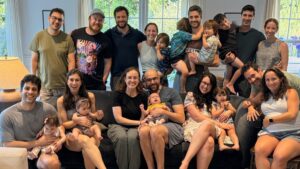
Known as "Unclecation," the yearly summer getaway offers an opportunity for a group of old friends (and their growing broods) to remain connected.