
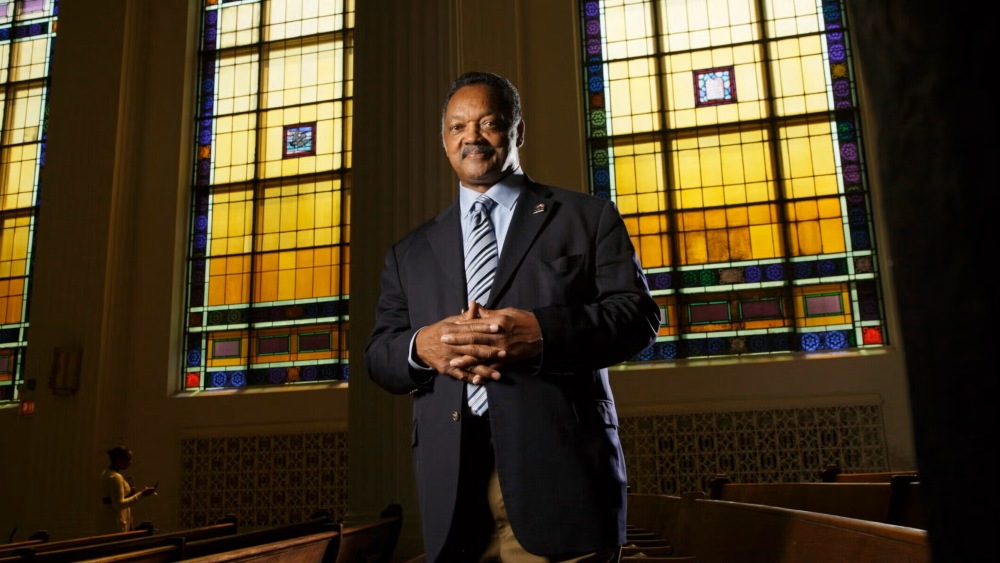
By Philissa Cramer
The Rev. Jesse Jackson — the Black leader who sought to build a “rainbow coalition” for America’s future but had a complex relationship with the Jewish community — has died at 84.
For American Jews, Jackson’s use of an antisemitic epithet, criticism of Israel and association with the Nation of Islam’s Louis Farrakhan during his first presidential run in 1984 proved hard to overcome, even as Jackson publicly apologized and preached reconciliation.
Born in the Jim Crow South and educated as a Baptist minister in Chicago, Jackson emerged as a purveyor of a hopeful vision of racial inclusion and economic uplift in the years after the assassination of Dr. Martin Luther King Jr., with whom he had worked.
After clashing with other King allies over the appropriate tenor of civil rights activism, Jackson formed his own group — ultimately called Operation PUSH — to advance his vision: uniting groups marginalized economically or politically into a governing majority to achieve economic and social justice.
Soon, his group’s economic boycotts were winning commitments to minority hiring and propelling him into the political mainstream. Jackson succeeded in negotiating the freedom of U.S. hostages abroad, including in Syria and Cuba in 1984.
Soon, he was mounting a historic campaign for president, becoming only the second Black national candidate since Reconstruction. In his second Democratic primary run in 1988, he won 11 primaries and caucuses, nabbing 7 million votes and driving a dramatic expansion in the number of Black registered voters.
But criticism dogged Jackson, even as he notched civil rights and national politics wins. Some in his own community accused him of caring more about the concerns of affluent African-Americans than about the poverty afflicting the majority of Black people in the United States; others charged him with profiting personally off of his advocacy.
Perhaps the most significant breaches came with American Jews, who played a prominent role in the civil rights movement of the 1960s.
In 1979, Jackson met in Lebanon with Palestinian Liberation Organization leader Yasser Arafat in an effort to broker ties between the group and the United States. At the time, the U.S. position was not to engage with the PLO or its leader until it acknowledged Israel’s right to exist.
In 1983, soon after announcing his first presidential campaign, the far-right Jewish Defense League announced a “Jews for Jackson” effort to thwart him. The announcement prompted Jackson’s first denial that he was antisemitic.
Tensions exploded early the next year when Jackson admitted he used the term “Hymietown” to describe New York City in what he believed had been a private conversation with a reporter.
The term, an offensive slur for Jews that riffs off the name Hyman, smarted for a community that had hoped antisemitism in the United States was a relic of the past.
Jackson first denied making the comments, including during a televised national debate, but then apologized in a speech at a synagogue in Manchester, New Hampshire, ahead of the first presidential primary.
“It’s human to err, divine to forgive,” he said, explaining that he had not wanted the comment to disrupt his campaign.
“I appeal to you tonight as a Jewish community to find yourself in the rainbow coalition,” Jackson said. “I categorically deny that I am either antisemitic or anti-Israel.”
At the same time, Jackson declined to distance himself from Farrakhan, a longtime associate who had introduced him at a Chicago rally. After Farrakhan made antisemitic comments, calling Judaism a “gutter religion,” Jackson’s campaign denounced the comments but not Farrakhan himself.
That summer, Jackson also made new comments about Israel that violated sacrosanct beliefs among American Jewish leaders. Jackson endorsed the idea of a Palestinian state alongside Israel at a time when the idea was far out of the mainstream of American and Israeli politics.
He also raised questions about U.S. military aid to Israel, saying that Israeli weapons were being used to maintain the apartheid system in South Africa.
Relations had soured so much that Jackson became a wedge issue during the 1988 election, when Republican strategists and figures such as Vice President George Bush suggested that Democrats were not forceful enough in condemning antisemitism.
But by the early 1990s, Jackson sought to rebuild trust with segments of the Jewish community, speaking at synagogues and Jewish community forums and participating in Holocaust remembrance events
In July 1992, Jackson made two headlining speeches condemning hatred of Jews, at the Democratic National Convention and to a World Jewish Congress meeting in Brussels.
In the WJC speech, he condemned antisemitism, praised Zionism as a “liberation movement” and called for Jews and Blacks to renew their joint fight against racism.
“Let us not turn closed scars into open wounds in the name of freedom and candor,” he said. “Let us be wise enough to act our way into a way of thinking, and not just think and talk ourselves into not acting.”
The speech won over some in attendance. “I was proved to be wrong,” said an Australian co-chair of the WJC’s board who opposed Jackson’s invitation. “I do see genuine opportunities now, if we move forward, to some sort of a rapprochement.”
But Abraham Foxman, national director of the ADL, said Jackson would have to do more to convince him.
“It is a record that has been marred by an insensitive view of Jewish history, the Holocaust, Zionism and the modern Jewish state, its government and their policies,” he said. “One speech to the Jewish community in the Palace of Congresses in Brussels will not repair it.”
But Foxman said he would work with Jackson if Jackson chose to deliver similar comments before Black audiences in the United States.
By the 1990s, a thaw appeared to have taken place. Park Avenue Synagogue and Yeshiva University invited Jackson to speak on the topic of Black-Jewish relations.
While Jackson faced some protests at Park Avenue, at Y.U., President Norman Lamm praised him as a “leading, vibrant” activist who has “performed miracles in fostering racial harmony.”
During that speech, Jackson denied that “Black antisemitism,” then a topic of growing concern among Jewish leaders, was a structural phenomenon, saying that any hatred that existed was confined to misguided individuals and not a product of the community as a whole.
He also argued that the far right posed a greater threat to Jews in the U.S.
Jackson also maintained personal relationships with Jewish figures.
Following the death in 2001 of Rabbi Robert Marx, a pioneering social justice advocate and leading Reform rabbi in Chicago who drew inspiration from his experiences marching with King, Jackson issued a bereft statement praising him as “the Jewish voice for justice” and saying, “We prayed together, sang together, and marched together. When Nazis marched in Skokie, we fought hate together. We have always been together. I love him so much. I miss him already.”
Jackson announced in 2017 that he had Parkinson’s disease and was largely out of the public eye for several years, making a final major appearance in a wheelchair at the 2024 Democratic National Convention in Chicago.
His organization announced in November that he had been hospitalized, and his family announced on Tuesday, Feb. 17, that he had “died peacefully.”
Jackson is survived by his wife Jacqueline; six children including his son Jesse Jackson, Jr., who was elected to Congress in Illinois; and several grandchildren.

One of the most competitive local races for public office this political season is for Baltimore County Executive. Jmore recently spoke with four of the candidates about their views on how they hope to enhance life in the county.
Leslie Simmons, executive vice president and chief operating officer of LifeBridge Health, will serve as interim president of Sinai and Grace Medical while a national search is conducted for Shlossman’s successor.

An ambitious new educational initiative seeks to emphasize personalized learning and strengthen Israeli society.
Schwab currently serves as president of Cumberland's historic B'er Chayim Congregation.