
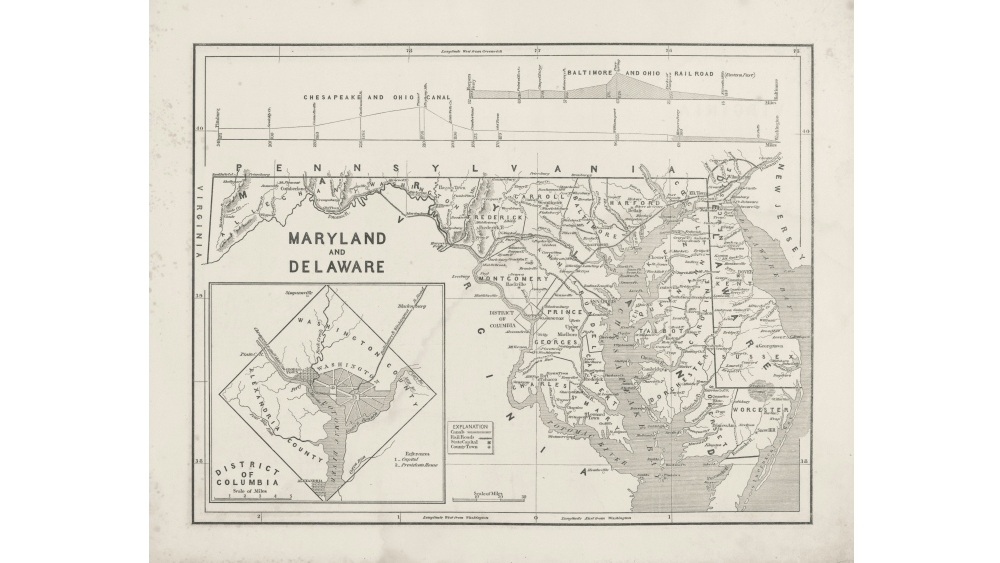
This year, Maryland is officially celebrating the 250th anniversary of American life in what we like to call “the Old Line State” or “the Free State,” take your pick.
Of course, any local schoolkid who manages to stay awake during history class will tell you the origins of Maryland actually predate the creation of the United States.
History Nerd Alert: The “province” of Maryland was founded in 1634 when colonists landed in St. Mary’s County to establish a haven for Catholics suffering persecution in England.
So, nu, where exactly do Yids fit into all of this?
Historians say there’s been a Jewish presence in Maryland since at least the middle of the 17th century, long before “Corned Beef Row,” the Jewish-owned department stores of Howard Street, and Park Heights Avenue’s “Shul Row.”
“Jewish individuals are known to have lived in the colony as early as 1656, only twenty-two years after its establishment by the first Lord Baltimore, George Calvert,” write Eric L. Goldstein and Deborah R. Weiner in their 2018 book “On Middle Ground: A History of the Jews of Baltimore.”
It seems the first Jewish denizen of “Merlin” was Jacob Lumbrozo. And with him comes a bumpy, awkward start to Maryland Jewish history.
Lumbrozo was a Lisbon-born physician, merchant and farmer. After leaving Portugal — presumably because of the Inquisition — he lived in Holland before relocating to Maryland, probably in the late 1650s.
Lumbrozo was reportedly one of the colony’s first medical practitioners, and historical records show he thrived as a businessman in southern Maryland for about a decade.
But Lumbrozo, it seems, had a knack for getting into tsuris. During a conversation about faith matters with townsfolk, Lumbrozo explained that Jews don’t believe Jesus was the messiah prophesied in the Torah.
For this offense, Lumbrozo was ordered to stand trial for blasphemy under the state’s so-called Toleration Act. Violation of the law was a loss of property and assets and could be punishable by death.
“[The Toleration Act] was adopted in 1649 to protect the rights of Catholic settlers, but it also outlawed blasphemy and the denial of Christianity, leading some historians to argue that Maryland was a hostile setting for Jews during its first century and a half,” write Goldstein and Weiner.
At his trial, Lumbrozo explained he was only expressing his perspective as a Jew and did not intend any offense. But he did himself no favors when questioned if he believed Jesus was a “necromancer,” a sorcerer capable of raising the dead. The court transcript reads, “To which said Lumbrozo answered nothing but laughed.” Apparently, no one else in the courtroom chuckled.
As fate would have it, Lumbrozo caught a break due to a sudden regime change in England, with Richard Cromwell ascending to head of state. As a celebratory gesture, Maryland’s governing body declared general amnesty toward those standing trial.
But not long after squeezing out of the blasphemy mess (and other legal scrapes), Lumbrozo was accused of sexually assaulting Elizabeth Wild, one of his servants, and giving her medication to induce an abortion. Before the case went to trial, Lumbrozo married Wild and all charges against him were dropped, since the law at that time stipulated a married woman couldn’t testify against her husband.
Lumbrozo is believed to have died in the fall of 1665 or winter of 1666. But his story is a curious chapter of Maryland Jewish history, which Jmore will explore in these pages and on our website throughout the year as part of the 250th anniversary of American life in Maryland.
Best,
Alan Feiler, Editor-in-Chief
This article is part of Jmore’s celebration of 250 years of Maryland Jewish history. For more, visit jmoreliving.com/history.


The Orioles this season have proven that money can't buy happiness, writes Michael Olesker.

A recent experience reminded Editor-in-chief Alan Feiler of why we cannot allow the antisemites to make us cower and hide.

A Maimonides statue in the Spanish city of Córdoba was defaced last weekend, but his teachings have an answer to hate, writes Rabbi Jeffrey K. Salkin.
The narrative against Israel's legitimacy took years to build, writes Baltimore-based branding expert Sharon Nevins.