
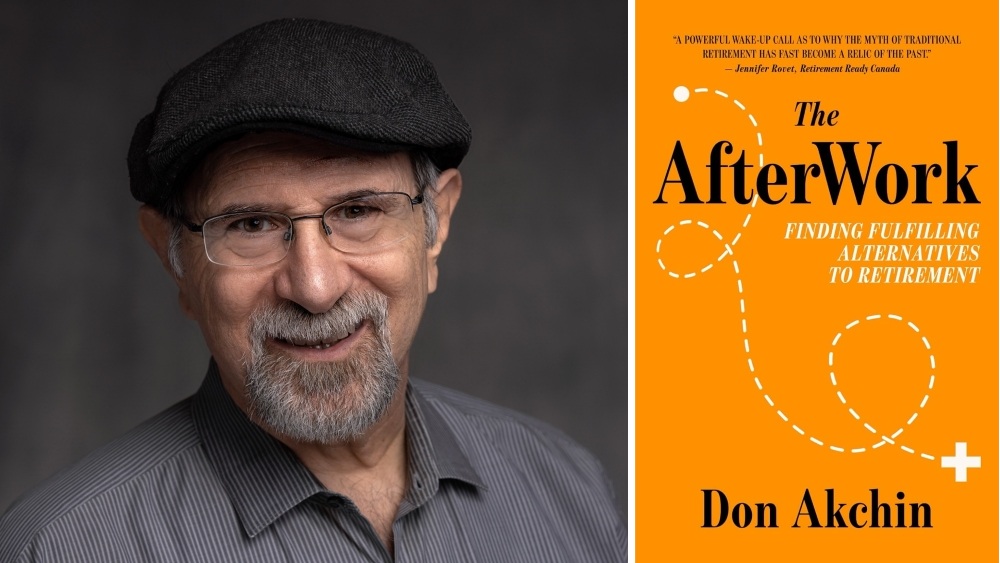
When retiring eight years ago at age 66, Baltimore resident Dan Akchin expected a “never-ending summer vacation.” Instead, retirement brought surprises — some uncomfortable, some eye-opening and some deeply rewarding.
After talking with dozens of other retirees and writing a weekly Substack column about aging with purpose, Akchin, a former journalist and marketing professional, realized the real story wasn’t just transitioning out of work but what comes afterward.
Jmore recently spoke with Akchin, a past president of Beth Am Synagogue, about his first book, “The AfterWork: Finding Fulfilling Alternatives to Retiring.” (Alte Kaker Books)
What was your expectation for retirement?
I couldn’t wait to retire. But the experience surprised me and when I started talking to other people, I realized I wasn’t alone. Once I interviewed 45 or 50 people, it became clear — for many, the bigger surprises weren’t the transition itself. The whole experience was broader, and the book ended up taking a different shape.
What were some of the things you discovered?
I assumed I’d spend retirement writing novels. But after working on a book for two years without feedback, it became lonely and anxiety-producing. I realized I wasn’t suited to that kind of isolation.
Eventually I found an online writers’ group and someone suggested, ‘Why don’t you write shorter pieces?’ Substack had just emerged and was perfect for a weekly newsletter. It took me four or five years to really find what worked for me, and many people I spoke with described that same scrambling process before landing somewhere that fit.
Why don’t you like the word ‘retirement’?
Retirement often connotes withdrawing from life, like it’s the beginning of the end. But for most people, it can be the beginning of something new and genuinely good. We’re living longer, often healthier lives. Many people may have 20 or 25 years after leaving a career. This is a time to try things you didn’t get to because you were busy being a responsible adult. You can experiment. That’s why I call it “the after work.”
What about ageism?
Ageism is very real. For people who were career-focused, the transition can be psychologically hard. Work disappears and leaves a big hole. But what can be even more shocking is realizing the world goes on without you.
I spoke with someone who’d been a department chair at a university. He said people used to defer to him, do small favors, bring him coffee. Then he retired and suddenly he was ‘a nobody.’ It can be a real jolt.
What else surprised you?
Relationships change. There’s even a term in Japan — “retired husband syndrome” — because many men there work constantly, so couples can be married for decades without spending much daily time together. Then suddenly the husband is home all day, with no structure and the household dynamics shift. You may find out whether you actually enjoy being around each other.
Do men complain about their wives retiring?
Not as much. But timing can create problems. One partner retires first and wants to travel, while the other still feels anchored to work or obligations and isn’t ready. And even when both are retired, simply having two people around the house all the time can be a strain.
What’s one of the biggest lessons you took away?
People become more different as they age, not more alike. So there isn’t one ‘retirement experience.’
A couple of people I spoke with sold their homes and moved across the country to be near their grandkids. Then, COVID hit. They were close [physically] but still couldn’t see them. It was a reminder that circumstances change fast.
That’s why resilience matters. You have to plan to roll with the punches.
It took me a few years to find my lane. Once I did, it got much better: a regular schedule, readers responding each week, a sense of community. And I published a book, which was a lifelong goal.
What are different approaches people can take in the ‘after work’ phase?
1) Keep working full-time if you love what you do; 2) Work part-time using your existing skills or trying something new; 3) Volunteering is a traditional path and a huge benefit to nonprofits; 4) Pursue a long-held interest either for fun, profit or even by starting a business.
Is it realistic for older adults to start new careers or businesses?
Statistically, older people who start businesses often do better because of experience and a clearer sense of reality. If entrepreneurship is your bent, it can actually be a great time.
What do you want people to understand most about this stage of life?
First, the transition can be psychologically difficult. There’s a lack of structure [and] purpose, guilt about not working. Second, longevity changes everything. Having an extra 20–30 years is a gift, but financing those years requires more savings than when retirement lasted 8-10 years.
We’re in a new era where so many people are living to advanced ages, and the world wasn’t built for that. In a way, we’re pioneers, figuring out how to live this time well.
For information, visit donakchin.com.
Duke Zimmerman and Lori Gale will talk at Towson University about their new book "People Get Ready" and the role played by Globe Posters in the civil rights movement.
The new exhibition revisits and updates a previous show about ritual hair covering in the observant community.

One of the most competitive local races for public office this political season is for Baltimore County Executive. Jmore recently spoke with four of the candidates about their views on how they hope to enhance life in the county.

The Pikesville resident's latest offering "There's a Dragon in the Tree House and He Won't Come out!" was co-written with her grandsons.