
Twenty years ago, when I was director of public programs at the Jewish Museum of Maryland, a young undergraduate from Goucher College became my intern.
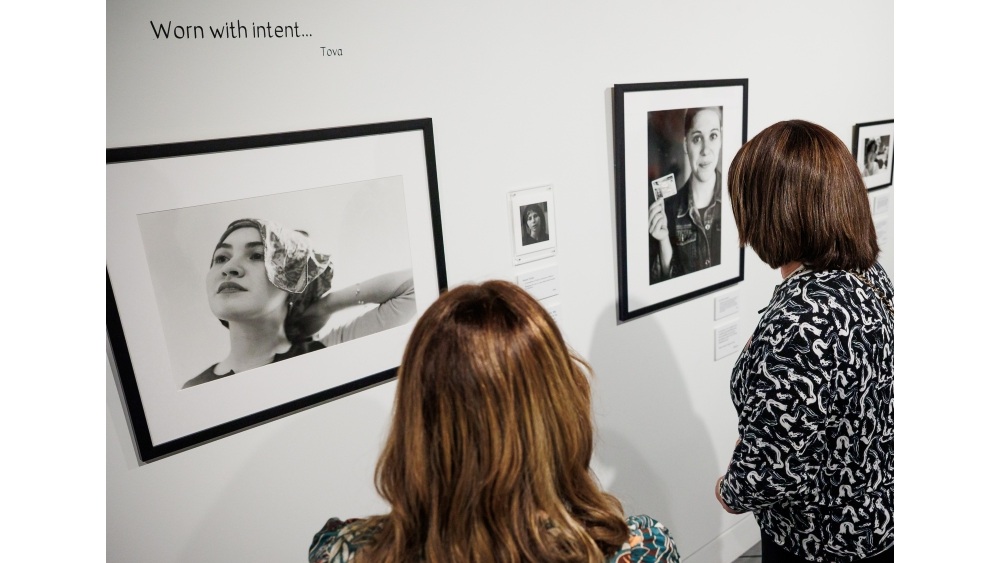
Zoe Reznick was sweet, smart and beautiful, with long brown locks cascading down her back. One day between teaching her how to write press releases and brainstorming about exhibition-related programming, Zoe shared with me her personal project — a series of black-and-white photos presenting perspectives on Orthodox women who cover their hair after marriage as a form of religious modesty.
When I saw the images, I was floored by their beauty and fascinated by their content. Immediately, I brought them to the attention of the museum’s then-curator, Melissa Martens, who agreed Zoe’s work should be exhibited.
The photos became the JMM’s 2005 exhibition, “Intimacy. Image. Identity. Perspectives on Orthodox Jewish Women’s Haircovering.”
After its run at the museum, the exhibition traveled to five other venues across the state before being stored in the JMM’s basement.
Two decades later, Reznick, who now serves as the JMM’s director of public programs, has revisited the project in a new exhibition, “RE: Intimacy. Image. Identity.”
The exhibition, which opened Sunday, May 31, and is on display through Sunday, Aug. 30, includes select framed prints from the original show, archival materials and photographs. It also features multi-media reflections shared by women who participated in the project that aims to enlighten viewers about the personal significance of the ritual hair-covering practice.

The decision to update the original exhibition was due to a confluence of events, Reznick said. One of these was a discussion she had with the museum’s executive director, Sol Davis.
“Before I was on the JMM staff, in 2022, Sol Davis introduced me to the museum practice of re-presenting existing content,” she said. “The practice is an invitation for people to think about something at a new point in time and in new ways.”
Two years later, after Reznick joined the JMM staff, an unexpected discovery reminded her about her conversation with Davis. While clearing out the museum’s basement, staff members came across prints and materials from the 2005 exhibition and alerted her.
Reznick brought them to her office and began sifting through them. It was the first time she’d seen the images in two decades, and was deeply moved.
She wondered how the photos might resonate with its subjects and potential audiences 20 years later.
Reznick pitched the idea to the JMM’s exhibition team, drawing on both the museum practice of re-presenting existing content and the filmmaking skills she developed while creating media with young people at New Lens, a local community arts organization.
The museum’s recent renovation — which included the addition of an audio-visual production studio — provided an ideal opportunity to showcase her work alongside reflections from the exhibition’s subjects.
“Now, there was an opportunity to not only hear what the women friends I had photographed thought and felt about these images, but there was a way for me to share their experiences through film and to braid those reflections together with archival contact prints on view for the first time,” said Reznick.
On Mar. 1, 2024, Reznick’s seven friends and subjects — some of whom were local, some far-flung – gathered at the museum. Not all of them had been included in the original show because it focused on women who were engaged or married.
Reznick’s original project included single women as well and the new exhibition is broader in scope, focusing not only on marriage but on friendship.
“While marriage is the more visible entry point into the subject of hair covering, friendship is the space where each of these images were made and these stories were shared,” said Reznick. “The encasing of these materials beside one another physically elevates friendship itself as sacred in Jewish life.”
Seeing her old friends together was “dream-like” for her, said Reznick.
“Each one is a friend made through various Jewish communities I was a part of — the East Bank Havurah, Congregation Tiferes Yisroel and Bais Yaakov School for Girls, which are all based in Baltimore — and at Darchei Binah, an Orthodox women’s seminary in Jerusalem. I had shared Shabbat afternoons to milestone occasions, art, music, drama, hijinks and more with each of them. Each friend and I have kept in touch in various ways over the past two decades, but we had never had the opportunity to gather at the same time, and many of them had never had an opportunity to meet one another before!”
But mixed in with the excitement, gratitude and joy about the reunion was some trepidation, said Reznick.
“Being filmed, photographed, recorded are often sensitive experiences,” she said. “I was inviting the group to talk about pretty personal topics, and I did not know how deeply people might be willing to share with one another.”

But Reznick said she shouldn’t have worried.
“It was incredible to see how people were able to share reflections with each other, coming from super-different perspectives within Orthodoxy and Jewish life,” she said. “Not everyone in that group has remained affiliated with the community, and people’s practices have changed over time.”
Reznick said she sees parallels between the exhibition and the way the JMM is anchored by two historic synagogues, the Lloyd Street Synagogue and B’nai Israel Congregation.
“One [congregation] split into two because of differences in how congregants wanted to practice — or no longer practice — Jewish traditions,” she said. “While this rift can be seen as manifestation of ruptures in community, another perspective is that what divides us is, in fact, an indication of deep commitment that looks different to different people and is generative in that it creates new forms of Jewish life.
“My hopes are that the exhibition and the museum more broadly can be a space where people can explore dynamic change, tensions and differences, but also find something new and shared within experiences that are not their own.”
The official opening celebration for “RE: Intimacy. Image. Identity,” will take place on Thursday, June 25, at 4 p.m. For information, visit jewishmuseummd.org.

One of the most competitive local races for public office this political season is for Baltimore County Executive. Jmore recently spoke with four of the candidates about their views on how they hope to enhance life in the county.
The Pikesville resident's latest offering "There's a Dragon in the Tree House and He Won't Come out!" was co-written with her grandsons.
A new biography captures the intensity and magic of the musical theater giant, writes Michael Olesker.
A native of Poland who lived in Baltimore since 2010, Pancerman passed away a day after her birthday.