

“Maybe I’m a little sentimental ‘ cause I know that things have to change
But I’d still like to go for a train ride ‘cause I’ve got a thing about trains”
—Johnny Cash, “I’ve Got a Thing about Trains”
For generations of Americans, trains have touched a nerve and sparked the collective imagination, whether it’s the haunting sound of a locomotive whistle in the distance or the image of a chugging fleet of rail cars and passenger coaches roaring around a bend.
Countless songs, books and films have celebrated the magic and spirit of the train, seemingly embodying the journey of life itself.
As the home of the B&O Railroad, Baltimore’s place in railroad history and lore is well known and documented. Besides having the nation’s first railway station and railroad manufacturing complex at the 40-acre Mount Clare site (formerly the B&O Railroad Museum, now known as the National Museum of Railroad History & Innovation), Charm City was the home of the first American-built steam locomotive, iron railroad bridge and the first electric-powered mainline track.
Next year, the American railroad will officially mark its bicentennial, with the first common-carrier railway line — then known as the Baltimore and Ohio Rail Road Co. — chartered on Feb. 28, 1827. The first section from Baltimore to Ellicott’s Mills (now known as Ellicott City) was completed three years later, and that 13-mile stretch was initially traversed by horse-drawn trains.
“The new railroad suddenly became the craze of the moment. Everybody wanted to enjoy the thrill of riding on it,” wrote Francis F. Beirne in his 1951 book, “The Amiable Baltimoreans” (Johns Hopkins University Press). “The next few years saw feverish activity as the line was pushed westward and constant experiment led to rapid involvement in locomotives, cars and other equipment.”
And it all started in Baltimore, which as a result became a 19th-century industrial powerhouse.
The railroad eventually transformed the physical and spiritual landscape of the United States, unifying the nation from coast to coast and informing the American identity and psyche with emerging ideas about technology, culture, commerce, transportation and history.
“When you’re walking or riding a horse, you experience the world one way, but when you’re sitting in a railroad car, you see it differently,” said American historian and author James P. Ronda. “In the West, where the distances are so great, the railroad brought near and far closer together.”
The so-called golden age of railroading might be in America’s rearview mirror, but with the rise of digital automation, AI and high-speed transit, the industry’s future appears bright and promising.
All aboard!
For information about events celebrating the 200th anniversary of American railroading, visit americanrail200.org or visitmaryland.org/200th-anniversary-railroading.
Significant Dates in American Railroading
1827 The nation’s first common-carrier railroad, the Baltimore and Ohio, is chartered by local merchants to carry goods from Baltimore’s harbor to the Ohio River.

1830 Pulled by horses, the Tom Thumb becomes the first American-built steam locomotive to operate on a common-carrier railroad, traveling from Baltimore to Ellicott’s Mills.
1833 Andrew Jackson becomes the first sitting American president to ride on a railroad car, traveling from Baltimore to Ellicott’s Mills.
1838 Disguised as a free Black sailor, future abolitionist, author and statesman Frederick Douglass boards a northbound train from Baltimore’s Canton train depot to escape a life of servitude. Other African Americans on the Underground Railroad also escape slavery by taking trains northward.

1838 By an Act of Congress, all railroads are designated postal routes. Railroad post offices carry mail across the United States.
1844 The world’s first telegram is sent by inventor Samuel Morse from the U.S. Capitol to B&O Railroad’s Mount Clare Station. Morse’s now-famous message was, “What hath God wrought?”

1850 Opening of Baltimore’s Calvert Street Station, the nation’s largest railroad terminal. It closes in 1948.
1851 Refrigerated rail cars begin carrying perishable produce over far distances.
1861 For the first time in global history, conflicting armies rely on the railroad to transport troops, equipment and supplies to the front lines during the American Civil War.
1865 The funeral train carrying the coffin of President Abraham Lincoln stops Apr. 21 at Baltimore’s Camden Station, the first stop on its three-week journey to Springfield, Illinois.
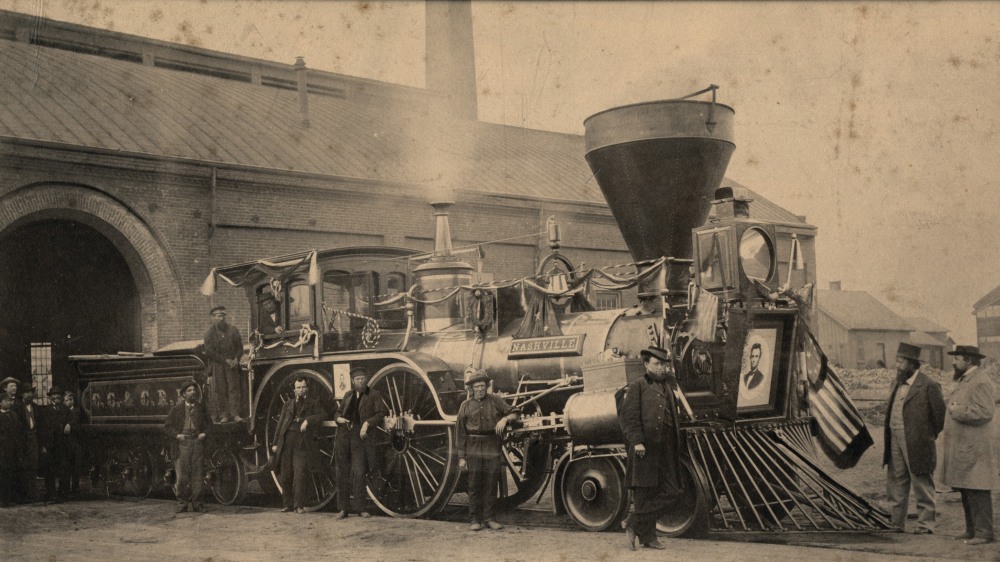
1866 In the wake of the Civil War, train hopping becomes an economic necessity for some Americans and “hobo culture” is born.
1869 With the completion of the first transcontinental railroad, the nation is united by 1,912 miles of continuous track, offering the first coast-to-coast service. The “last spike” of the railroad was ceremoniously hammered in Promontory Summit, Utah.
1918 Following an Act of Congress, Railroad Standard Time is adopted across the U.S. as the time zones used today.
1925 The Brotherhood of Sleeping Car Porters is founded, led for four decades by A. Philip Randolph. Pullman was the nation’s largest employer of African Americans.
1925 The CNJ No. 1000 is the world’s first commercially available diesel-electric locomotive. The shift away from steam engine trains begins.
1927 More than 1 million Americans converge on Baltimore County’s Halethorpe community for the “Fair of the Iron Horse” transportation exposition and pageant, celebrating the centennial of American railroading.
1929-1939 During the Great Depression, substantial segments of the rail industry are forced into bankruptcy as freight volumes decline and revenues fall sharply.
1941-1946 Railroads play a pivotal role in the American involvement in World War II, with trains transporting approximately 90 percent of military personnel and freight.
1953 The B&O Railroad Museum (now known as the National Museum of Railroad History & Innovation), opens at the site of Mount Clare Station and its adjacent 1884 Baldwin Roundhouse, at 901 W. Pratt Street. The Roundhouse is often called “the Cathedral of American Railroading.”
1955 Intermodal freight, the rail movement of containers and highway trailers, is reported as a separate category of freight for the first time.
1961 The Mount Clare Station is designated a national historic landmark.
1971 As other modes of transportation take business away from private railroads, the public Amtrak company assumes control of passenger services.
1980 Amtrak’s BWI Rail Station becomes the nation’s first intercity depot to service and connect trains, planes and buses.
1997 Baltimore’s former President Street Station — the site of the earliest bloodshed of the Civil War — reopens as the Baltimore Civil War Museum.
2000 Amtrak opens the Acela Express passenger train. Reaching top speeds of around 150 miles per hour, it is the first high-speed passenger service in the U.S.
2023 The Canadian Pacific Kansas City railway network spans the U.S., Canada and Mexico to improve trade and commerce between the three North American nations.
2025 A report published by the Association of American Railroad shows that in 2023, freight railroads contributed $233.4 billion in total economic output, supporting business activity and nearly 750,000 jobs across the economy.

The story is now coming out about three Jewish refugees from Nazi Germany who built Iceland’s classical music scene from scratch.

The history of Jewish Barcelona is fascinating and complex, and a tour of the Jewish Quarter offers a glimpse into the city’s tragic past.

With his chamber music organization, AmiciMusic, Daniel Weiser aims to break down barriers between audiences and performers.
Dr. Gerd W. Ehrlich's manuscript offers a unique look at life in Germany during World War II.