
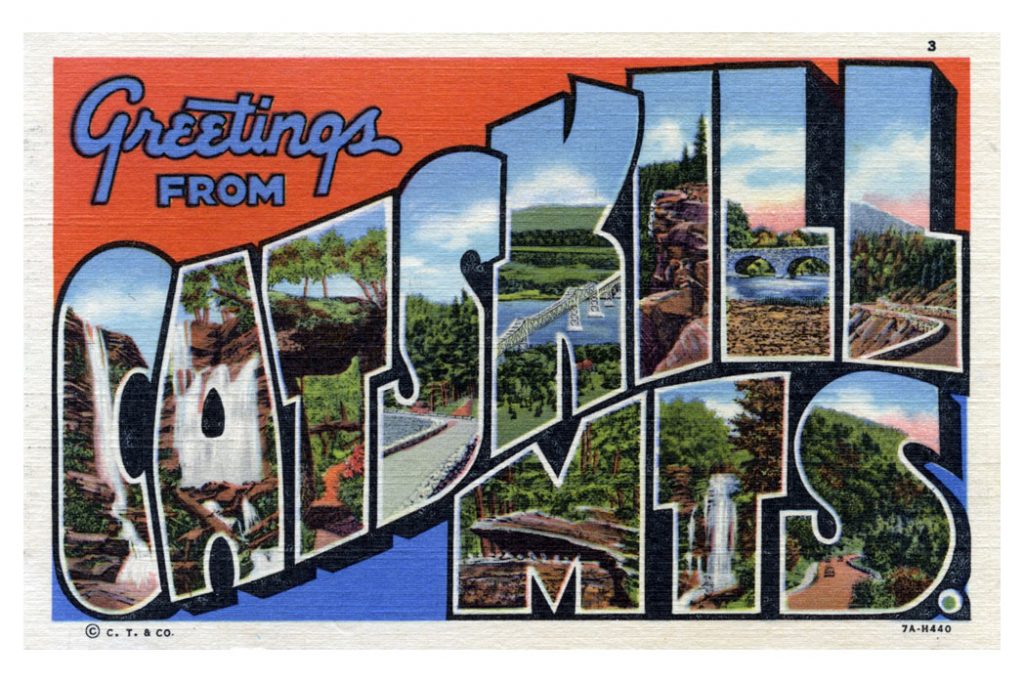
For generations of Baltimore Jewry, vacationing in the Catskills — also known colloquially as “the Borscht Belt,” “the Jewish Alps” and “Solomon County” — was a beloved annual summer tradition, a much-anticipated holiday and feast for the psyche and soul.
“Destinations such as Florida, the Catskills, Atlantic City, and sites of Jewish heritage became temporary communities of like-minded people and while some vacations were pursuits of abundance, others were havens from discrimination, and others emphasized Jewish ideologies and traditions,” observed “The Other Promised Land,” a 2006-2007 exhibit on Jewish vacationing curated by the Jewish Museum of Maryland. “All expressed the excitement and promise of America, and the changing Jewish-American dream.”

With Upstate New York’s Sullivan, Orange and Ulster counties only about five hours away, many local Jews, from the 1920s well into the 1960s, motored — like their co-religionists along the Eastern Seaboard — to Grossinger’s, the Concord, Kutsher’s, the Nevele, Brown’s, the Tamarack Lodge, the Hotel Brickman and others to enjoy all that those resorts had to offer.
As well-chronicled by such pop culture staples as “The Marvelous Mrs. Maisel” and “Dirty Dancing,” there were myriad opportunities for revelry and relaxation at “The Mountains” — seemingly limitless amounts of food and booze, upscale hotels and bungalow colonies, grand ballrooms, top-name entertainment, family-fun activities, swimming, sports, nearby small towns, nature-gazing and, on occasion, romance. (By the way, among those starring in 1987’s “Dirty Dancing” was the late actor Alvin Myerovich, a longtime Pikesville resident who also appeared in the Baltimore-themed film “Avalon.”)
By the 1970s and 1980s, the Borscht Belt was a dim shadow of its glorious past and most of the resorts dried up, victims of the changing tastes of the times. But the mystique of the Catskills lives on in the hearts of those who experienced that era (and even among some who didn’t).

Keeping that memory alive will be the Catskills Borsch Belt Museum, which is slated to open in the Ulster County hamlet of Ellenville, at the eastern base of the Catskills and about 90 miles northwest of New York City. Plans were recently announced for the museum to open in a historic bank building in 2025. (The former Home National Bank was one of the few lending institutions in the area to conduct business with early Jewish hotel and resort entrepreneurs.)
The museum will feature artifacts, educational materials, films and archival materials, as well as interactive exhibits. Its leadership is collaborating with the Catskills Institute at Northeastern University and the New York-based YIVO Institute for Jewish Research.
Among those on the museum’s artistic advisory board are singer Neil Sedaka, comedian Robert Klein, and actors Judd Hirsch, Mary-Louise Parker and Fran Drescher.
“The Borscht Belt Museum will not solely focus on entertainment, glamour and design,” reads the museum’s website. “Its curatorial mission will include weightier themes and narratives embodied by the era; the antisemitism that spurred the creation of a Jewish vacationland, the refuge it provided to African-Americans, Irish-Americans, L.G.B.T.Q. and other marginalized communities, and the forces of assimilation and tolerance that eventually helped fuel the grand resort era’s decline.
“In addition to its permanent core exhibition, the museum will have space for temporary and visiting shows, ensuring the institution delivers fresh interest to audiences and remains culturally relevant over time. The Catskills continues to serve as a refuge for all — an ethos that will find voice in the museum’s curatorial mission.”
On July 1, a pop-up museum will open in Ellenville for the remainder of the summer season.
For information, visit borschtbeltmuseum.org/.

The BCO, founded in 1984, will perform the works of Frank Zappa, Beethoven, Mason Bates and Karena Ingram.

Led by local Israel-American cellist Amit Peled, the Mount Vernon Virtuosi aims to inspire people beyond musical enjoyment.

Container vegetable gardening is a terrific option for people with limited space and/or time. Rebecca Brown and Norman Cohen share some tips.

Filmmaker Justin Schein looks at wealth and inequality through the very real story of his late father.