
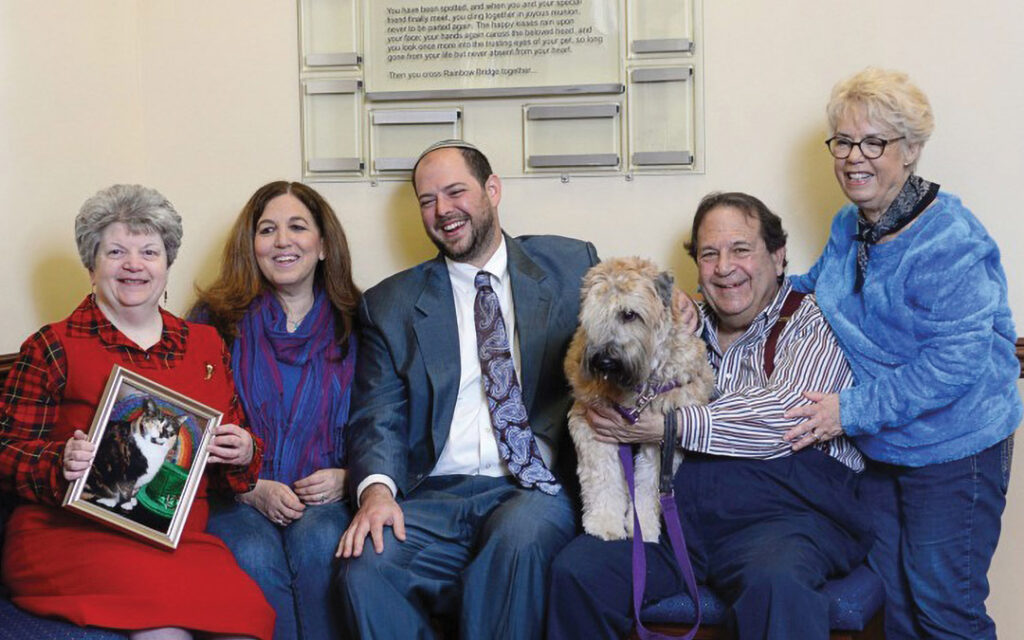
When something is designated ‘a day of rest,’ clergy are working that day. That’s when they earn their keep,” says Rabbi Jay R. Goldstein, Beth Israel’s rabbi emeritus. “To make something look easy takes a lot of hard work.”
That’s Rabbi Goldstein’s take on the paradox of Jewish clergy simultaneously observing and working on Shabbat and holidays.
Most people go into the clergy because of their own spiritual journeys. But for many, there are times during the year when they’re so busy working to create meaningful moments for congregants, they have to sacrifice some of their own spiritual experiences.
Where do rabbis and cantors go for their own spiritual nourishment and regeneration?
“What I’m hoping to get out of Shabbat is impacted by my concern to make sure it goes smoothly,” says Baltimore Hebrew Congregation’s Rabbi Andrew Busch. “The more complicated the reality of a worship experience — the energy that comes with Rosh Hashanah, guest speakers, Shavuot with the confirmation class — the more I’m thinking about service management and less about my own spiritual benefit.”
Rabbi Yerachmiel Shapiro of Pikesville’s Moses Montefiore Anshe Emunah Hebrew Congregation says spiritual passion cannot be faked.
“When I’m on the bimah, I’m in the zone,” he says. “I’m the person everyone’s looking toward to help them. If I’m not in a spiritual place, I can’t do that. I know that in that situation I’m a giver whereas when I’m sitting in shul as a congregant, I can listen and learn. In that situation, I’m a receiver.”
Kol HaLev’s Cantor George Henschel says he tries to avoid going on autopilot at services.
“Prayer and spirituality have to do with getting out of your head, into your heart,” he says. “If you have to spend more time making the trains run on time, it takes you out of your heart and back into your head.”
Some local clergy say they still manage to recharge their spiritual batteries during services.
“I find spirituality in the regular davening during services,” says Rabbi Goldstein.
Cantor Henschel agrees. “The chanting carries me into my own spirituality, whether it’s a song, Musaf, Torah trope, chanting through Shachrit [morning service] — I’m completely there. It’s those transitional times in and out of liturgy — thinking about what’s next, what page to call out, what reader to bring up — that’s more problematic.”
Beth El’s Rabbi Dana Saroken compares leading services to being a football quarterback. “At the same time, though, I like being in a relationship with and talking to God,” she says. “When you’re part of a caring community and the spirit is generous and kind and loving, whether I’m leading or following, that feeling makes for a nice experience.”
Some clergy say they find ways to modify the congregational worship experience to correspond with their own spirituality, such as adding more periods of singing or silent meditation.
Sometimes, a spiritual charges comes from outside the actual formal service, says Rabbi Busch. For instance, he says preparing the d’var Torah sermons he gives at Shabbat services helps him stay spiritually focused.
Because communal prayer is such an intimate experience, the recent COVID-19 pandemic proved to be a major challenge for many spiritual leaders. For some, the complexities and minutiae of virtual technology was an obstacle.
“After I learned to use the system, I was much more comfortable,” said Cantor Henschel. “But sometimes, it still seems like the mind of Zoom is as inscrutable as the mind of God.”
Other clergy say dealing with the sadder components of pastoral life can be overwhelming and tiring.
“No one in rabbinical school told me about all the pain and suffering I’d be exposed to,” Rabbi Shapiro said.
Says Rabbi Saroken: “Extending compassionate care and worry, the pieces that go along with loving, can be exhausting. But in those difficult moments, you see the most real, beautiful parts of people. That’s very spiritual. Regardless of the pain it causes us, making that journey with people is the privilege of being a rabbi.”
So how do rabbis and cantors find their own spiritual bliss? Rabbi Goldstein says he enjoys yoga and meditation. “That helps, as does davening and praying on my own, or occasionally visiting other synagogues,” he says.
Cantor Henschel says he and Kol HaLev’s former spiritual leader, Rabbi Geoff Basik, used to play golf every Monday. “We used to say that was our Shabbat,” he says.
Rabbi Shapiro says going on vacation helps him. “When I go on vacation with my family, there’s something about the newness of a different place that is itself renewing,” he says. “And once I’ve had that experience, I can come back to my shul and see it with new eyes.”
Rabbi Saroken says it’s always imperative for a clergy member to stay in touch with one’s own essence and mission.
“To make services meaningful, I try to offer people prompts, context and opportunities for reflection, and to help keep things real, I need to be in the experience,” she says. “To help people through their most difficult moments and bring meaning to their most joyful moments, I have to be in that moment with them. I have an opportunity to bring people closer to religion, to God, to themselves. And that provides me spiritual purpose.”
Jonathan Shorr is a local freelance writer.
Presented by Jews United for Justice and a consortium of local synagogues, "Beyond Welcoming the Stranger" offered a Jewish approach to helping immigrants.
John Singer wants to help Marylanders of all economic backgrounds to afford ankle foot orthoses.

At Krieger Schechter Day School, joining in the later elementary or middle school isn’t a setback -- it’s a launch pad.
Israeli-Americans Rachel Goldberg-Polin and Jon Polin talked about the pain of losing their 23-year-old son, who was kidnapped and later murdered in the Oct. 7th tragedy.