
By Jackie Hajdenberg
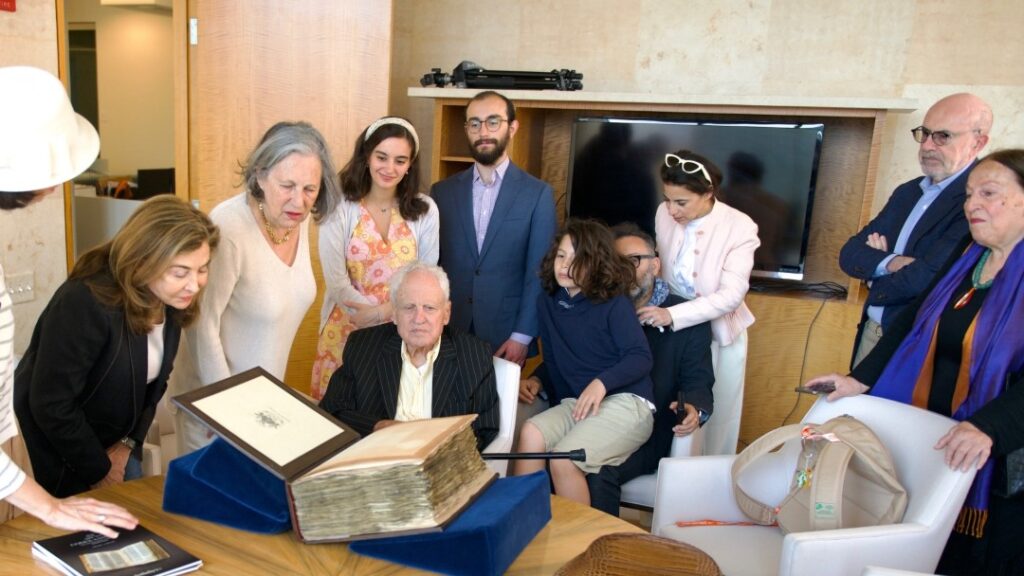
Yesterday morning, May 31, Northwest Baltimore native Alfred H. Moses sat in a small, white armchair at a round wooden table in a Manhattan office building as an historian gingerly turned the pages of a more than 1,000-year-old book in front of him.
Two weeks earlier, Moses, 94, paid a record-setting sum for the book — more than $38 million in total.
But this was the first time he actually laid eyes on it.
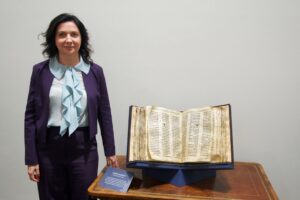
The book was the Codex Sassoon, the world’s oldest nearly complete copy of the Hebrew Bible. That morning, in Sotheby’s Upper East Side office, Sharon Mintz, the auction house’s senior Judaica specialist, gave Moses and some of his family members a history lesson on his new acquisition.
Mintz turned the pages with clean, bare hands, noting the scored ruling between the lines of text and the thickness of the parchment pages — made somewhat thinner in places where scribes scratched over each others’ notes.
Before Moses bought the book at a much-anticipated Sotheby’s auction on May 17, the Codex passed between multiple owners — most recently through the hands of Jacqui Safra, a member of a prominent Swiss banking family, and before him, in the 1920s, Iraqi Jewish book collector David Solomon Sassoon.
It will now be housed at the ANU Museum of the Jewish People (formerly known as the Museum of the Jewish Diaspora) in Tel Aviv, which exhibited the Codex earlier this year.
“It’s an inspiring book, to see a 1,200-year-old manuscript in perfect [condition] — even that we can read today — it’s quite amazing,” said Moses, who belongs to Reservoir Hill’s Beth Am Synagogue and Kesher Israel of Georgetown in Washington, D.C. “It has the vowels and the trope … it’s remarkable. It’s something that’s been preserved for 1,200 years. And we’re the beneficiaries of it.”
A 1947 graduate of Baltimore City College, Moses — who became a bar mitzvah at Chizuk Amuno Congregation at its former Eutaw Place location — is an attorney who served as U.S. ambassador to Romania during the Clinton administration and is a past president of the American Jewish Committee.
He had anxiously watched the auction online from his home in Washington, worried that another possible bidder, like the Museum of the Bible, also in D.C., might put in a competitive bid. Representatives from the American Friends of ANU, which supports the Tel Aviv museum, were concerned it might wind up in a private collection and lost to public view for another generation.
“I thought my chances were about 50/50,” said Moses. “But I was prepared to buy it if I could afford to.”
He expected to pay as much as $32.5 million, which he put in as an “irrevocable bid” with Sotheby’s ahead of the auction, according to Bloomberg. He ended up inching his bid up to $33.5 million after someone else bid $33 million. Fees brought Moses’ final tab to $38.1 million.
Part of the reason Moses decided to give the book to ANU — an institution he has supported for years, including as chair of its honorary board — is that he sees it as serving Jews worldwide. He feels other prestigious homes for historical artifacts in the country, such as The Israel Museum in Jerusalem, are meant to cater to Israelis specifically.
“It’s the museum of the Jewish people and I wanted the Codex to go to the Jewish people,” he said. “The Israel Museum is wonderful. But that’s the museum for Israel. I wanted the Codex to be for the Jewish people.”
Moses is making the hefty donation to Israel at a time when street protests across the country are raging at the government’s attempt to weaken the judiciary, and as friction persists between the Biden administration and Israel’s right-wing government.
But Moses sees the tension as a passing phase.
“I think there’s a bit of concern among American Jews as to what is happening politically in Israel, but that’s temporal. Twenty years from now, it’ll seem like history,” Moses said. “One has to have a sense of history in the longer viewpoint. Israel is the home of the Jewish people. Whom the Israelis elect to be their government and the prime minister is an Israeli decision.”
But Moses mused that the book could someday leave Israel after all. During the history lesson, Mintz explained that part of the mystery of the book’s provenance is its disappearance from the medieval town of Makisin — today the northeastern Syrian city of Markada — sometime around the year 1400. According to an inscription on the book’s last page, it was removed from the synagogue during an attack on the town and entrusted to the care of Salama ibn Abi al-Fakhr, who was instructed to return it as soon as Makisin was rebuilt.
It was during this part of the lesson that Moses cracked a joke: if the Jewish community returns to what is now Markada, would he have to return the book?
Given the conditions of Syria after more than a decade of bloody civil war, and the almost total loss of its once thriving Jewish community, that prospect seems remote. Mintz also noted that while the existence of the Codex in what is present-day Markada has been established, little else is known about the Jewish community that existed there.
For now, Moses hopes that the cultural treasure he bought will be seen as the property of Jews everywhere.
“I think the Sassoon Codex will give satisfaction, joy, and pride to tens of thousands, maybe hundreds of thousands, maybe millions of viewers,” he said. “I see benefit to the Jewish people.”
Jackie Hajdenberg wrote this article for the JTA global Jewish news source. Jmore staff contributed to the report.
The German-born rabbi, scholar and activist, who served Temple Emanuel from 1963 to 2000 , was a prominent figure in the local Jewish community for more than six decades.
A lifelong Baltimorean, Hirsh was the owner and CEO of Ottenheimer Publishers, a multi-generational family publishing business that operated for more than a century.

Opposition leader Yair Lapid spoke at Thursday's Jerusalem rally, which drew 10,000 participants and 2,000 police officers.
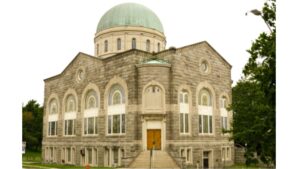
On its "Five Minute Histories" series, the preservation group recently looked at the historic "Shul in the Park," now and then.