
By Jackie Hajdenberg and Asaf Shalev
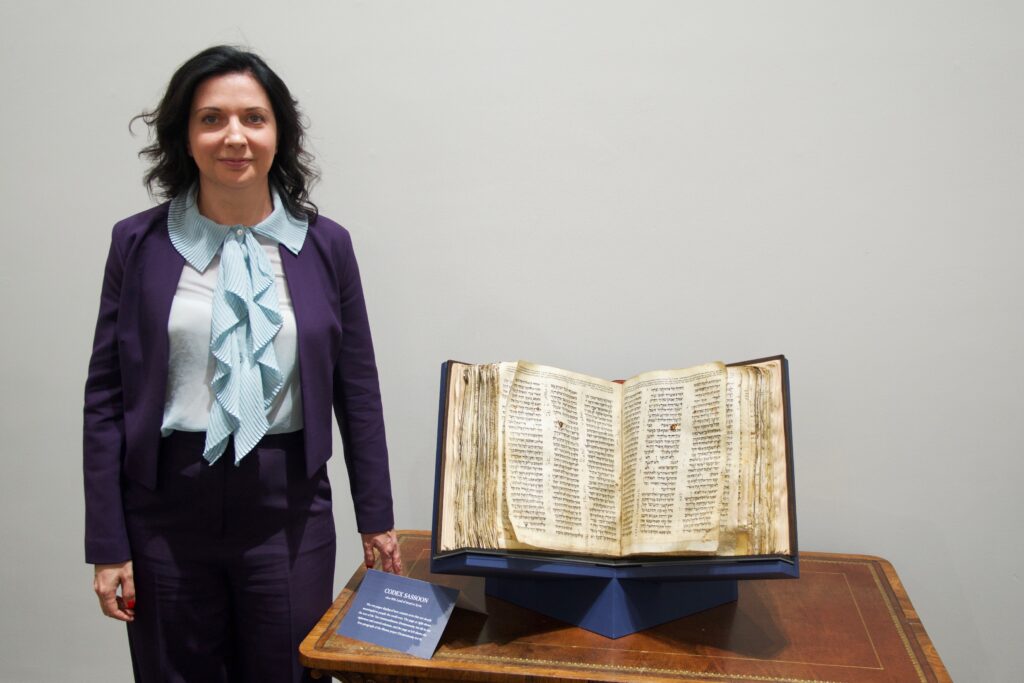
On Wednesday, May 17, Ambassador Alfred H. Moses, a Northwest Baltimore native and former resident with deep roots in the Jewish community here, and his family purchased an 1,100-year-old Hebrew Bible, which became the most expensive book ever sold when it drew a price of $38.1 million at auction at Sotheby’s in New York City.
The buyer of the item — known as the Codex Sassoon — was revealed to be the American fundraising group on behalf of Tel Aviv’s ANU-Museum of the Jewish People. The museum said that Moses, who served as U.S. ambassador to Romania for three years during the Clinton administration, and his family provided the funds for the acquisition and will gift the leather-bound, handwritten parchment volume item to American Friends of ANU.
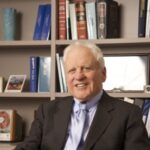
A 1947 graduate of Baltimore City College, Moses, 93, became a bar mitzvah at Chizuk Amuno Congregation at its former Eutaw Place location. He is a longtime partner at the Washington, D.C., law firm of Covington & Burling and author of “Bucharest Diary: Romania’s Journey from Darkness to Light: An American Ambassador’s Memoir” (Brookings Institution Press).
The manuscript is the world’s oldest nearly complete copy of the Hebrew Bible. It was handwritten in Syria or the Land of Israel roughly 1,100 years ago on 792 pages of sheepskin. It includes all 24 books of the Bible and is missing only about eight pages. Its writing and layout recall those of Torah scrolls read in synagogue.
The Codex Sassoon received its name in 1929 when purchased by David Solomon Sassoon, the son of an Iraqi Jewish business magnate who filled his London home with his collection of Jewish manuscripts.
The seller, Swiss financier and collector Jacqui Safra, had owned the volume since 1989. Speculation about where the book would wind up led to concern that it might be sold to a private collector rather than a public institution that could put it on display.
Those doubts were put to rest when the museum, formerly the Museum of the Jewish Diaspora, said the book would be part of its core exhibition.
“The Hebrew Bible is the most influential book in history and constitutes the bedrock of Western civilization,” said Moses, a member of Reservoir Hill’s Beth Am Synagogue and Kesher Israel Congregation in Georgetown, in a statement. “I rejoice in knowing that it belongs to the Jewish People. It was my mission, realizing the historic significance of Codex Sassoon, to see that it resides in a place with global access to all people. In my heart and mind that place was the land of Israel, the cradle of Judaism, where the Hebrew Bible was originated. In Israel at ANU, it will be preserved for generations to come as the centerpiece and gem of the entire and extensive display and presence of the Jewish story.”
Just a handful of buyers competed for the book — in person at Sotheby’s in New York and by phone — and the auction took less than six minutes. Ahead of the auction, Sotheby’s estimated that the item would sell for anywhere from $30 million to $50 million. The “gavel price” was $33.5 million, but with fees and premiums, the final price tag reached $38.1 million.
Since no book or historical document quite like it has been sold at auction for decades, the Codex Sassoon has earned comparisons to other foundational texts of civilization that have also commanded tens of millions of dollars. A copy of the first printing of the U.S. Constitution’s final text sold for $43.2 million in 2021. The Codex Leicester, a journal with writings by Leonardo Da Vinci, fetched $30.8 million in 1994. And a copy of the Magna Carta sold for $21.1 million in 2007.
“This is one of the rarest, unique, uniting documents that ever existed,” Irina Nevzlin, chair of ANU’s board of directors, told JTA. “For us to have it in the museum where it will be available for all those millions of people — this is something that can strengthen our roots and our identity, because it’s something eternal. …
“ANU embodies the Jewish narrative and safeguards the values, legacy, heritage and identity of the Jewish people,” she said. “We will be eternally grateful to Ambassador Moses and his family for ensuring that the most treasured, historic and complete Bible in existence will be permanently displayed at the world’s largest Jewish Museum.”
The in-person auction attracted a standing-room-only crowd of onlookers, many of whom said they felt compelled to witness a transaction of immense significance in Jewish tradition.
“This is a historic moment,” said Elinatan Kupferberg, a scholar and writer from Lakewood, New Jersey. “This is the oldest Torah in existence. Whoever is going to own it next is going to change history.”
Kupferberg, who said his most precious books were those containing the handwritten notes of great rabbis, said he sometimes regrets when Jewish texts are bought by collectors because they will not be used in everyday study.
Not so, he said, with this item. “It doesn’t make me feel sad to see it behind glass because it was meant to be a reference work,” he said.
Sandra Gogel, who was in New York from Paris, said she had hoped the Codex Sassoon would draw a higher price, and was surprised that bidding had closed so quickly. “Thirty-three point five is nothing to scoff at, but 50 would have been nice,” she said.
Gogel said she had traveled to London to see the Codex when it was on display there and was relieved that the book will end up on public display.
“I went to London to see it because I thought I might not see it again,” she said. “I’m happy it will be Israel where everyone can see it. … Everyone goes to Tel Aviv.”
Jackie Hajdenberg and Asaf Shalev write for the JTA global Jewish news source. JTA Editor-in-Chief Philissa Cramer and Jmore staff contributed to this report.
Leslie Simmons, executive vice president and chief operating officer of LifeBridge Health, will serve as interim president of Sinai and Grace Medical while a national search is conducted for Shlossman’s successor.

An ambitious new educational initiative seeks to emphasize personalized learning and strengthen Israeli society.
Schwab currently serves as president of Cumberland's historic B'er Chayim Congregation.
A former U. S. Marine, Pat Young has served as a Baltimore County Council member representing District 1 since 2022.